
在新加坡注册公司到底有多快?ACRA比客户的午餐还快(2026年真实案例)

Ray Tay
ACRA大多在付款后即批准注册(名称15新元+注册300新元,通常当天完成)。真正拖慢创始人的是未决定的事项:财年、股权、注册地址、银行KYC文件。
Published: 13 August 2026 · Last reviewed: 30 September 2026 · Reviewed by Ray Tay, Co-Founder & Managing Director, VIVOS PTE. LTD. (ACRA Filing Agent FA20240323 · MOM EA Licence 24S2425)
A convertible note is an interest-bearing loan that converts into equity at a future priced round, making it the preferred bridge instrument when Singapore startups need capital but cannot yet agree on a valuation.
Three immediate actions before you proceed:
Three regulators govern the lifecycle of a convertible note in Singapore: the Accounting and Corporate Regulatory Authority (ACRA) for corporate filings, the Monetary Authority of Singapore (MAS) for securities-law compliance, and the Inland Revenue Authority of Singapore (IRAS) for tax and stamp duty. Each touches a different stage of the transaction, and missing any one of them creates legal or financial exposure.
Convertible notes in Singapore are debt instruments that convert into equity at a priced round, and every stage from issuance to allotment requires specific corporate, regulatory, and tax steps to be executed correctly.
| Point | Details |
|---|---|
| Section 161 authority is mandatory | Shareholder authority to allot conversion shares must be current at the time of allotment, not just at signing. |
| ACRA filing deadline is 14 days | The Return of Allotment must be filed within 14 days of the allotment date; missing this is a statutory breach. |
| SFA exemption must be confirmed upfront | Accredited investor or private-placement exemption documentation must be obtained before the note is issued. |
| Cap is the dominant economic term | Model the cap against down-round, up-round, and acquisition scenarios before agreeing; it typically drives more dilution than the discount. |
| Vivos covers the full lifecycle | Vivos provides corporate secretarial, ACRA filings, cap-table updates, and tax coordination for convertible-note rounds in Singapore. |
A convertible note starts as debt. The company borrows a principal amount, accrues interest at an agreed rate, and the outstanding balance (principal plus accrued interest) converts into shares when a defined trigger occurs. The conversion price determines how many shares the noteholder receives.
Core formula:
Shares issued = (Principal + Accrued Interest) ÷ Conversion Price
The conversion price is typically the lower of two values: the capped price (pre-money valuation cap ÷ fully diluted shares) and the discounted price (price per share in the qualifying round × (1 minus discount rate)).
Conversion triggers include:
Worked example — S$500,000 note:
After 12 months, accrued interest totals S$40,000, bringing the outstanding balance to S$540,000.
At a qualifying round priced at a per-share price on a certain pre-money valuation with a specific number of fully diluted shares:
Without the cap, the investor would have received fewer shares at the discounted price. The cap increases shares issued, a notable effect often underestimated when modeling dilution.
Fractional shares are typically rounded down to the nearest whole share, with the residual amount paid in cash or carried forward. Conversion should occur within a contractually specified window — publicly filed agreements commonly set this at 15 business days from the conversion trigger date.
Pro Tip: *Always run the cap-table model with the cap binding and without it.
Every convertible loan agreement in Singapore contains a core set of negotiable terms. The ranges below are illustrative market references, not prescriptive standards.
Principal and subscription mechanics
Interest rate and accrual
Maturity date
Discount rate
Valuation cap
Most-favored-nation (MFN) clause
Conversion mechanics and qualified financing threshold
Change-of-control and liquidity event treatment
Repayment and redemption rights
Events of default
Information rights
Transfer and assignment
Pro Tip: Negotiate the conversion mechanics and qualified financing definition before agreeing on the cap. A high cap with a narrow qualified-financing definition can leave the note unconverted indefinitely.
A convertible note is a debt contract until conversion. At that point, it becomes a securities transaction subject to the Companies Act and, depending on the offer structure, the Securities and Futures Act (SFA).
Under section 161 of the Companies Act, directors need shareholder authority to allot new shares. This authority is typically granted by an ordinary resolution at the annual general meeting (AGM) or by a special resolution. The authority must be current at the time of allotment, not just at the time the note is signed. A common operational failure is executing a conversion after the section 161 authority has lapsed.
When conversion occurs, the company must file a Return of Allotment with ACRA within 14 days of the allotment date and update the register of members to reflect the new shareholder.
The MAS regulates offers of securities under the SFA. An offer of convertible notes to the public generally requires a prospectus. However, most startup convertible-note rounds qualify for one of the following exemptions:
Reliance on an exemption must be documented. Obtain a signed investor declaration confirming accredited investor status before closing.
Key regulatory principle: The SFA exemption must be confirmed before the note is issued, not retrospectively. Issuing a convertible note without confirming the applicable exemption exposes the company and its directors to civil and criminal liability under the SFA.
| Step | Action Required | Timing |
|---|---|---|
| Board resolution | Approve issuance of note, terms, and reliance on SFA exemption | Before signing |
| Shareholder resolution | Grant or confirm section 161 allotment authority | Before or at signing |
| Investor declaration | Signed accredited investor or exemption confirmation | Before closing |
| Note execution | Sign convertible loan agreement and issue note certificate | At closing |
| Conversion notice | Investor or company serves notice per agreement terms | At trigger event |
| Return of Allotment | File with ACRA within 14 days of allotment | Post-conversion |
| Register update | Update register of members and cap table | Post-conversion |
IRAS guidance on stamp duty for shares confirms that stamp duty applies to instruments for the transfer or acquisition of shares. The key question for convertible notes is whether the conversion constitutes a “transfer” or an “acquisition” that triggers stamp duty.
Where a convertible note converts into newly allotted shares (rather than a transfer of existing shares), stamp duty is generally not triggered on the allotment itself. Founders and investors should confirm the conversion mechanics with a tax advisor before execution to avoid unexpected stamp duty costs.
The accounting treatment of a convertible note depends on its terms:
Key accounting checkpoint: Interest accrued on a convertible note is a deductible expense for corporate tax purposes under Singapore’s Income Tax Act, provided the note is a genuine arm’s-length debt instrument. Retain documentation of the commercial rationale for the interest rate agreed.
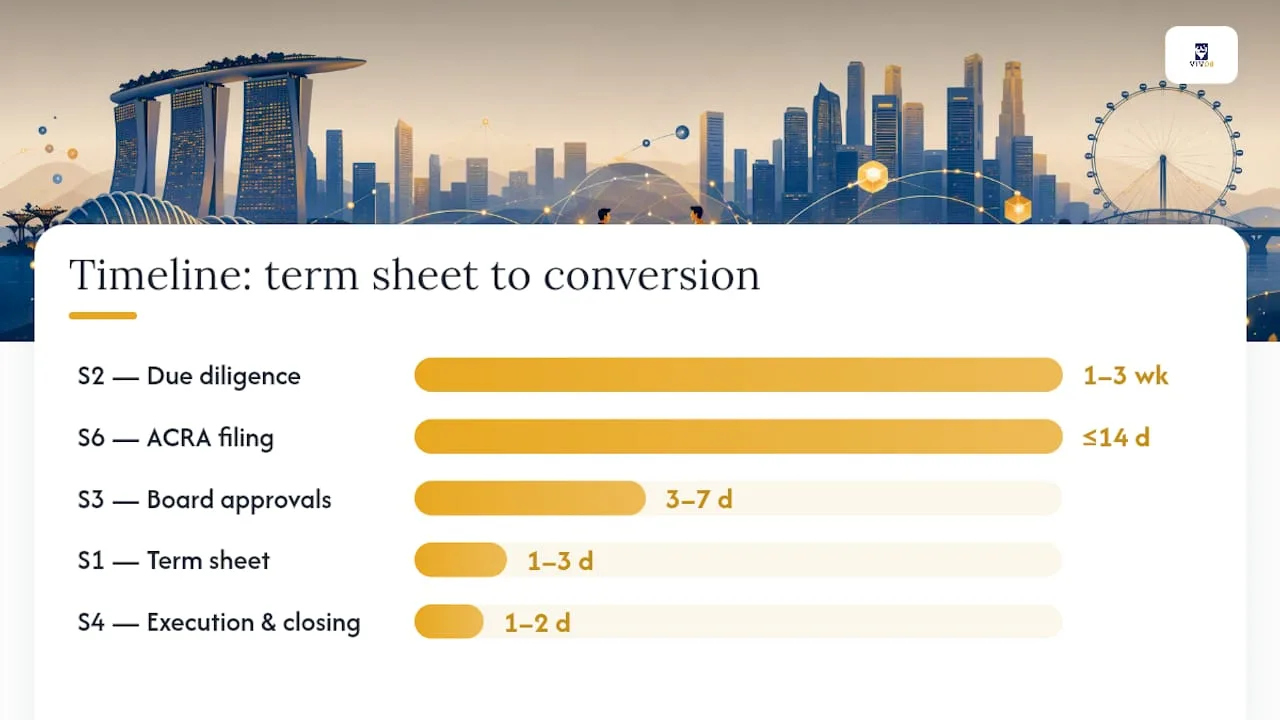
The typical convertible-note round in Singapore moves through six stages. Each stage has a defined document set and a practical time estimate.
Stage 1: Term sheet (1–3 days)
Stage 2: Due diligence and legal drafting (1–3 weeks)
Stage 3: Board and shareholder approvals (3–7 days)
Stage 4: Execution and closing (1–2 days)
Stage 5: Conversion event (1–5 days after trigger)
Stage 6: ACRA filing and register update (within 14 days of allotment)
Practical guidance for fundraising in Singapore: Build the ACRA filing deadline into the closing checklist from day one. Missing the 14-day window is a statutory breach, even when the conversion itself is commercially straightforward.
SVCA VIMA 2.0 Model Convertible Note Purchase Agreement is the most widely used Singapore-oriented template among practitioners. It includes local SFA-exemption language, section 161 references, and conversion mechanics drafted for Singapore law. Use it as the base document, but expect to customize the qualified-financing definition, cap, and discount for each deal.
CooleyGo Singapore Convertible Promissory Note and Term Sheet provides an English-language model with practical drafting notes on conversion events and investor protections. Useful for cross-border deals where investors are familiar with US-style note mechanics but the company is Singapore-incorporated.
Dentons Rodyk publicly filed convertible loan agreement (CytomEd Therapeutics / MDR Limited) shows real-world clause patterns: a percentage discount, conversion within 15 business days, and elective redemption rights. The conversion-timing clause is particularly instructive for drafting a tight notice mechanism.
The Captain Legal Singapore template documents the Companies Act and SFA interaction points and is a useful reference for the statutory checklist.
| Clause | Sample Language | Local Annotation |
|---|---|---|
| Conversion notice | “The Investor shall deliver a Conversion Notice to the Company within [5] Business Days of the occurrence of a Qualified Financing, specifying the Conversion Price and the number of Conversion Shares to be allotted.” | Insert the agreed notice period; 5–15 business days is market standard. Cross-reference the section 161 authority resolution. |
| Discount formula | “The Conversion Price shall be the lower of: (a) the price per share paid by investors in the Qualified Financing multiplied by (1 minus the Discount Rate); and (b) the Valuation Cap divided by the Fully Diluted Share Capital immediately prior to the Qualified Financing.” | Define “Fully Diluted Share Capital” to include all options, warrants, and convertible instruments to avoid disputes at conversion. |
| Maturity extension | “The Maturity Date may be extended by [12] months by written agreement of the Company and the Majority Noteholders, provided that no Event of Default has occurred and is continuing.” | Require majority noteholder consent (not unanimity) to avoid a single holdout blocking a commercially sensible extension. |
Red flags in template reuse:
Seek bespoke drafting when the deal involves multiple tranches, offshore investors, or a cap table with existing convertible instruments.
The core legal difference is straightforward. A convertible note is a debt instrument: it carries interest, has a maturity date, and creates a repayment obligation if conversion does not occur. A SAFE (Simple Agreement for Future Equity) or its Singapore equivalent, the CARE (Convertible Agreement Regarding Equity), is a contract for future equity with no maturity date and no interest accrual.
The SVCA CARE model (updated 2025) is the Singapore-specific instrument designed for this purpose. It functions as the local-law equivalent of the Y Combinator SAFE and is drafted to address Singapore Companies Act and SFA requirements.
When a convertible note is the better choice:
When a CARE or SAFE is the better choice:
Decision checklist:
The CARE is not always the simpler instrument from a legal perspective. Its conversion mechanics still require section 161 authority and an ACRA Return of Allotment at conversion, and SFA exemption analysis applies equally.
Singapore practitioners consistently identify the same failure modes across convertible-note transactions. Addressing them at drafting stage costs far less than resolving them in dispute.
Red flags to identify before signing:
Negotiation tactics:
Pro Tip: *Simulate the acquisition scenario at 1× the valuation cap.
The most consistent observation from working with Singapore startups on convertible-note transactions is that the legal complexity surfaces at conversion, not at signing. Founders treat the note as a simple loan and defer the hard questions — section 161 authority, SFA exemption documentation, cap-table modeling — until a priced round is imminent. By that point, fixing a defective allotment or a lapsed shareholder authority is expensive and time-consuming.
One pattern that recurs: a company issues a convertible note to three investors across two tranches over 18 months. The first tranche is documented carefully. The second tranche reuses the first tranche’s agreement with minimal changes, including the same cap, even though the company’s valuation has moved materially. At conversion, the first-tranche investors convert at a significantly lower price than the second-tranche investors, creating a cap table that the Series A lead finds difficult to accept. The fix requires renegotiating with all noteholders simultaneously, which delays the round by six to eight weeks.
The corrective steps are straightforward when applied from the outset: document each tranche separately, align caps to the company’s current stage, obtain fresh section 161 authority before each allotment, and file the Return of Allotment with ACRA within the statutory 14-day window. Triangle Legal’s guidance reinforces this point: Singapore courts enforce the written terms strictly, and contractual drafting determines outcomes at conversion.
Vivos supports clients through the corporate secretarial and compliance steps that are most frequently missed: board and shareholder resolutions, ACRA filings, cap-table updates, and coordination with tax advisors on IRAS stamp duty analysis.
Executing a convertible-note round involves more operational steps than most founders anticipate. Vivos provides the corporate infrastructure to run those steps without gaps.
Services covering the full note lifecycle:
Vivos works with founders, investors, and legal counsel across Singapore to close convertible-note rounds correctly the first time. Contact Vivos to confirm your compliance checklist and get the round moving.
The sources below are the primary references used in this article. Each is a starting point for drafting or compliance review. Deal-specific structuring requires advice from a Singapore-licensed lawyer and, where tax treatment is material, a qualified tax advisor.
Model documents:
Regulator pages:
Additional practitioner references:
This article is general information, not a substitute for advice from a qualified financial advisor. Consult a qualified financial professional about your own circumstances before acting on anything here.
 2 January, 2025
 2 January, 2025
ACRA大多在付款后即批准注册(名称15新元+注册300新元,通常当天完成)。真正拖慢创始人的是未决定的事项:财年、股权、注册地址、银行KYC文件。
ACRA approves most Singapore incorporations soon after payment (S$15 name + S$300). A true client story on what really slows founders down — and the…

了解新加坡公司注册费用:官方 315 新元起、首年第三方费用可明显上升,逐项报价与合规建议帮您控预算并加速开户,含处理时效与开户风险说明。