
InvoiceNow Mandatory by Apr 2031: Singapore GST Invoicing for Founders

Ray Tay
Singapore invoice guide: required GST fields (9%), the 2026 InvoiceNow rollout, plus a technical onboarding checklist for foreign founders.
Published: 8 August 2026 · Last reviewed: 30 September 2026 · Reviewed by Ray Tay, Co-Founder & Managing Director, VIVOS PTE. LTD. (ACRA Filing Agent FA20240323 · MOM EA Licence 24S2425)
Quick answer – best corporate credit cards in Singapore (2026): If you need a real credit line, the strongest options are bank-issued business cards: the American Express Singapore Airlines Business Credit Card for frequent flyers (KrisFlyer miles, lounge access), and the UOB and DBS business cards for cashback or points with credit terms. Popular fintech corporate cards from Aspire, Airwallex and Wise are debit or prepaid cards, not credit cards – they have no credit line but typically charge no annual fee and offer near-interbank FX, which makes them the most common alternative to a business credit card.
For most Singapore SMEs, a fintech multi-currency debit card is the fastest and most cost-effective starting point — while established businesses with travel-heavy spend or high credit needs will find more value in a bank-issued business credit card.
Shortlist by use case:
Immediate next step: Assign your finance manager or company director to pull three documents now: your ACRA business profile printout, the most recent Notice of Assessment (or audited accounts), and a copy of the director’s NRIC or passport. Those three items cover the baseline requirement for every issuer on this list.
For most Singapore SMEs, the right corporate card is determined by FX exposure and expense-control needs, not by headline rewards rates.
| Point | Details |
|---|---|
| Choose category first | Fintech debit for startups and FX-heavy SMEs; bank credit for travel, rewards, or credit-building needs. |
| FX cost dominates for cross-border spend | A 2.5–3% bank FX markup on S$200,000 annual overseas spend costs S$5,000–S$6,000 per year versus near-interbank fintech rates. |
| Controls beat marginal reward differences | Virtual cards, MCC locking, and direct accounting integrations save more than a 0.5% cashback differential at typical SME spend levels. |
| Document preparation determines timeline | Fintech cards approve in days; bank credit cards take 2–6 weeks, primarily due to credit assessment and document completeness. |
| Vivos supports bank onboarding | Vivos prepares board resolutions, document sets, and bank introductions for foreign-founded companies applying for Singapore corporate cards. |
The table below maps the core dimensions across the main card categories and representative issuers. Use it to narrow to two or three candidates, then read the per-category breakdowns in the next section.
| Card / Issuer | Best For | Card Type | Annual Fee (SGD) | FX / Foreign Transaction Fee | Rewards | Expense Management | Eligibility Highlights | Liability Type | Onboarding Speed |
|---|---|---|---|---|---|---|---|---|---|
| DBS World Business Card | Rewards + credit | Credit | Varies by tier | ~2.5–3% | Points / cashback | Basic controls | Min. income S$30,000; locally incorporated | Personal guarantee | 2–4 weeks |
| DBS Platinum Business Card | Entry-level bank credit | Credit | S$196.20 incl. GST | ~2.5–3% | Cashback | Basic | Min. income S$30,000 | Personal guarantee | 2–4 weeks |
| UOB Signature / World Business / Regal Business Metal | Rewards + prestige | Credit / Charge | Varies by tier | ~2.5–3% | Miles / cashback | Spend visibility, extended terms | Sole prop, LLP, Pte Ltd; docs by entity type | Personal guarantee | 2–4 weeks |
| OCBC Business Credit Card | Local SME with rebates | Credit | Varies | ~2.5–3% | Rebates | Basic | Min. 30% local ownership | Personal guarantee | 2–4 weeks |
| Maybank Business Platinum Mastercard | Mainstream bank credit | Credit | Varies | ~2.5–3% | Points | Basic | Locally incorporated | Personal guarantee | 2–4 weeks |
| HSBC Commercial Cards (incl. Virtual Card / World Corporate Mastercard) | Enterprise controls | Credit / Charge | Programme-based | ~2.5–3% | Points | Virtual cards, merchant controls, integrations | Corporate programme; revenue threshold | Corporate liability | 3–6 weeks |
| Citi Corporate Card | Corporate liability + insurance | Credit / Charge | Programme-based | ~2.5–3% | Points / rewards | Corporate liability waiver, insurance | Corporate programme | Corporate liability | 3–6 weeks |
| Amex Singapore Airlines Business | Travel + miles | Charge | Varies | ~2.5–3% | KrisFlyer miles | Virtual cards, spend controls | Locally incorporated; revenue threshold | Personal / corporate | 2–4 weeks |
| Aspire Corporate Card | Startups, fast approval | Debit (fintech) | None | ~0.5–1% (Visa rate) | Cashback on SaaS | Virtual cards, spend limits, Xero integration | Incorporated in SG; no min. revenue stated | Company | Days to 1 week |
| Airwallex Corporate Card | FX-heavy, cross-border | Debit (fintech) | None | Near-interbank | None / FX savings | Multi-currency wallets, virtual cards, API | Incorporated in SG; flexible ownership | Company | Days to 1 week |
| Wise Business Card | FX and multi-currency | Debit (fintech) | None | Mid-market rate + small fee | None | Multi-currency account, spend tracking | Incorporated in SG | Company | Days to 1 week |
How to weigh the columns for your profile:
Pick-by-use-case badges:
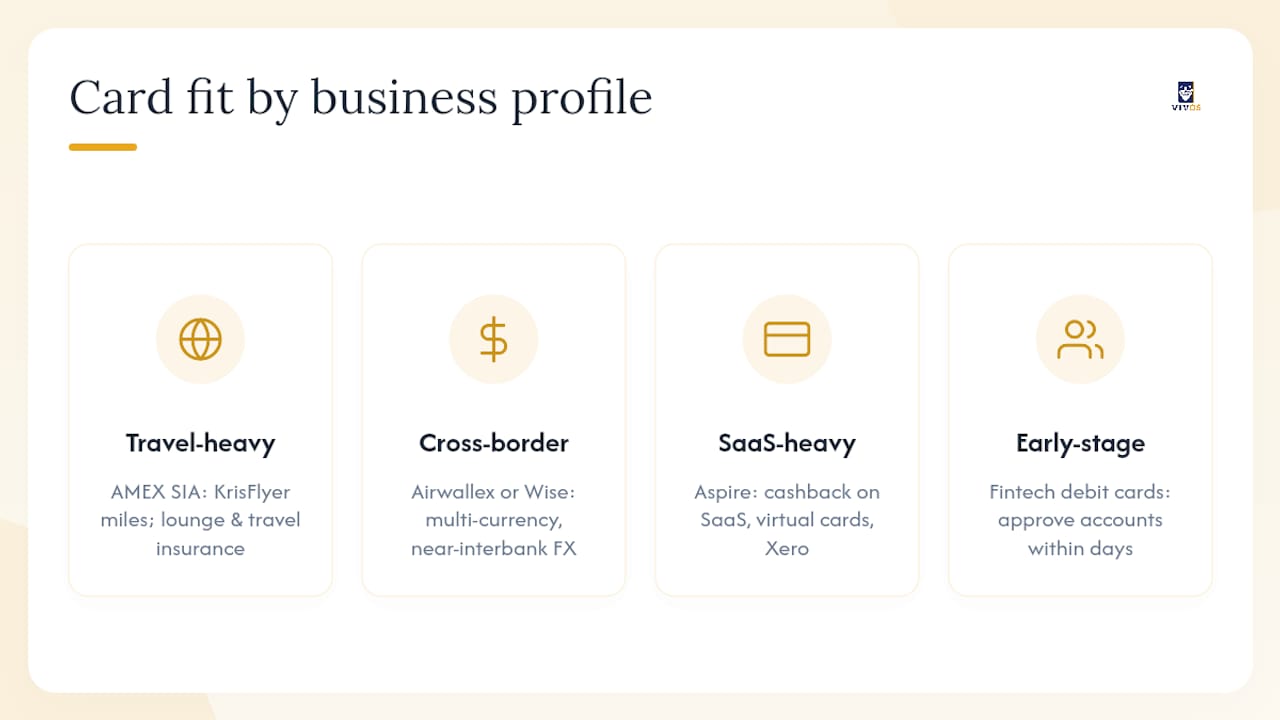
Travel-heavy SME (frequent flights, client entertainment)
The American Express Singapore Airlines Business Credit Card is the clearest fit. KrisFlyer miles accrue on every dollar of local and overseas spend, and the card includes travel insurance and lounge access. The trade-off: charge cards require full monthly settlement, and the annual fee is meaningful. This card rewards consistent high spenders; low-volume months dilute the miles value quickly.
Cross-border supplier business (paying overseas vendors, FX invoices)
Airwallex or Wise Business Card. Both hold balances in multiple currencies and convert at near-interbank rates, which eliminates the 2.5–3% FX markup that bank credit cards typically apply. Neither earns traditional rewards points, so you give up cashback in exchange for FX savings. For businesses with significant overseas payables, the FX saving almost always exceeds any cashback foregone.
Digital-marketing or SaaS-heavy SME
Aspire Corporate Card. It offers cashback specifically on SaaS and digital-marketing categories, issues virtual cards instantly, and integrates directly with Xero. No annual fee keeps the cost of ownership low. The limitation: it is a debit card, so it does not build a credit history with a bank, and credit limits are tied to the account balance rather than an underwritten credit line.
Early-stage startup with minimal revenue
Fintech debit cards (Aspire, Airwallex, Wise) are the practical first step. Traditional bank credit cards typically require a minimum annual income of S$30,000 and a track record of local incorporation, while fintech providers generally approve accounts within days based on basic business registration details. Once the business has 12–18 months of financial history, adding a bank credit card for credit-building and travel benefits becomes viable.
A structured checklist prevents the most common mistake: picking a card based on headline rewards while ignoring the fees and friction that accumulate over 12 months.
Step-by-step evaluation checklist:
Red flags to watch for in T&Cs:
Pro Tip: Ask the card provider specifically whether their expense feed uses a direct API connection to your accounting software or a manual CSV export. A direct API connection means transactions post automatically with merchant names and amounts; a CSV export means someone on your team uploads a file each month. That distinction typically saves 3–5 hours of bookkeeping per month at scale.
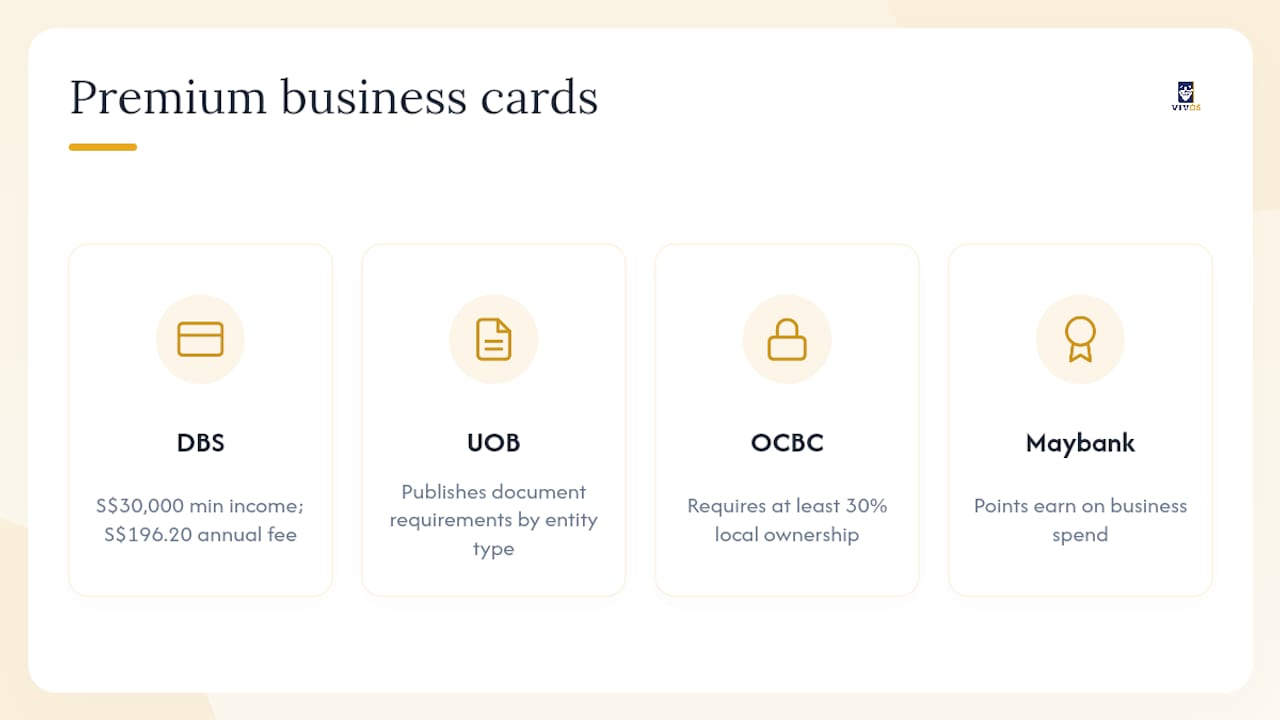
DBS World Business Card / DBS Platinum Business Card
DBS’s Platinum Business Card lists a minimum income requirement of S$30,000 and an annual fee of S$196.20 (inclusive of GST). The World Business Card sits above it in the DBS range, offering higher earn rates and a higher credit limit. Both cards carry a personal guarantee from the primary director. FX transactions attract the standard Visa cross-border fee plus a bank markup, typically in the 2.5–3% range. Expense management features are basic: online statements and transaction alerts, without native virtual card issuance or direct accounting integrations at the entry level.
UOB Signature / World Business / Regal Business Metal
UOB’s business card range spans from the Signature (entry-level) through the World Business to the Regal Business Metal at the premium end. UOB publishes document requirements by entity type on its product pages, making it one of the more transparent issuers for application preparation. Benefits include extended payment terms, spending visibility dashboards, and miles or cashback earn rates that vary by tier. Annual fees and promotional rebate periods are listed on the product page and change periodically.
OCBC Business Credit Card
OCBC’s business credit card includes a rebate structure on qualifying spend categories. A notable eligibility condition: the applying company must have at least 30% local ownership. This blocks some majority-foreign-owned entities that are otherwise legally incorporated in Singapore. For qualifying businesses, the rebate structure can offset the annual fee at moderate spend levels.
Maybank Business Platinum Mastercard
Maybank’s Business Platinum Mastercard targets locally incorporated SMEs seeking a mainstream bank credit card with points earn on business spend. Eligibility and fee details are listed on Maybank’s product page; the card follows the standard bank credit card model with personal guarantee liability.
HSBC Commercial Cards (including Virtual Card and World Corporate Mastercard)
HSBC’s Commercial Cards Programme is positioned explicitly as an expense-management platform rather than a simple payment card. Key features include merchant category controls, virtual card issuance, automated expense reporting, and integrations with major accounting systems. The World Corporate Mastercard sits at the premium end of the programme. Eligibility is programme-based, typically requiring a revenue threshold and a formal corporate account relationship with HSBC. Liability is corporate, not personal, which is a significant structural difference from standard business credit cards.
Citi Corporate Card
Citibank’s Corporate Card programme includes corporate liability waiver insurance, reward choices, and insurance benefits for cardholders. Citi publishes programme change timelines clearly, including product discontinuation notices with cut-off dates. The corporate liability structure means the company, not the individual cardholder, bears primary responsibility for balances — important for businesses issuing cards to multiple employees.
American Express Singapore Airlines Business Credit Card
American Express’s corporate card programmes emphasize visibility and control features alongside rewards. The Singapore Airlines co-branded business card earns KrisFlyer miles on local and overseas spend, includes travel insurance, and offers lounge access. Amex also issues virtual cards and supports per-card spend controls. The card operates on a charge or credit basis depending on the product variant; full monthly settlement is required for charge variants.
Aspire Corporate Card
No annual fee. Virtual cards issued immediately on account approval. Cashback on SaaS and digital-marketing spend categories. Direct Xero integration. Aspire is MAS-notified under the Payment Services Act, confirming its regulatory standing. Approval typically takes days rather than weeks, and the platform accepts a wider range of ownership structures than most bank credit products. The debit model means spend is drawn from the account balance, not a credit line.
Airwallex Corporate Card
Multi-currency wallets in major currencies, near-interbank FX conversion, virtual card issuance, and API-level integrations with accounting platforms. Airwallex is also notified under MAS’s Payment Services Act amendments, providing regulatory assurance for businesses onboarding a fintech provider. No annual fee. Best suited to businesses with material overseas payables or receivables in multiple currencies.
Wise Business Card
Wise holds balances in multiple currencies and converts at the mid-market rate plus a small transparent conversion fee. The Business Card draws from the Wise multi-currency account. No annual fee. Spend tracking and basic expense categorization are available in the Wise dashboard. Wise does not offer the same depth of accounting integrations as Aspire or Airwallex, but its FX transparency is among the clearest of any provider in this category.
Representative fee and eligibility summary:
| Card / Issuer | Annual Fee | FX Fee | Min. Income / Revenue | Liability |
|---|---|---|---|---|
| DBS Platinum Business Card | S$196.20 (incl. GST) | ~2.5–3% | S$30,000 min. income | Personal guarantee |
| UOB Business Card range | Listed on product page | ~2.5–3% | Listed by entity type | Personal guarantee |
| OCBC Business Credit Card | Listed on product page | ~2.5–3% | 30% local ownership required | Personal guarantee |
| HSBC Commercial Cards | Programme-based | ~2.5–3% | Revenue threshold (programme) | Corporate |
| Citi Corporate Card | Programme-based | ~2.5–3% | Corporate programme | Corporate |
| Aspire Corporate Card | None | ~0.5–1% | No stated minimum | Company (debit) |
| Airwallex Corporate Card | None | Near-interbank | No stated minimum | Company (debit) |
| Wise Business Card | None | Mid-market + small fee | No stated minimum | Company (debit) |
Sole proprietor / self-employed:
LLP or general partnership:
Private limited company (Pte Ltd):
For board resolutions and specimen signature forms, a corporate secretary can prepare compliant documents that match each bank’s specific format requirements — a step that frequently causes delays when handled ad hoc.
| Application Type | Typical Timeline | Main Delay Factors |
|---|---|---|
| Fintech debit (Aspire, Airwallex, Wise) | 1–5 business days | Digital KYC; document completeness |
| Mainstream bank credit (DBS, UOB, OCBC, Maybank) | 2–4 weeks | Credit assessment; local ownership checks |
| Enterprise corporate programme (HSBC, Citi, Amex) | 3–6 weeks | Programme underwriting; relationship manager review |
The framing of corporate card selection as a “rewards race” misses where the real value sits for most SMEs. HSBC’s Commercial Cards Programme positions its card suite explicitly as an expense-management platform: merchant category controls, virtual card issuance, automated expense reporting, and direct accounting integrations are the headline features, not the points earn rate.
American Express reinforces this directly:
The practical implication: a 0.5% difference in cashback rate between two cards is worth roughly S$500 per year on S$100,000 of spend. A single month of undetected unauthorized spend, or a manual reconciliation process that takes a finance manager four hours per month, costs far more. Virtual cards with per-transaction limits and merchant category locking prevent the first problem; direct accounting integrations solve the second.
Key control and integration features to verify before choosing:
MAS oversight adds a further layer of assurance. Verifying that a fintech card provider appears on MAS’s list of notified payment entities confirms it operates under the Payment Services Act framework, which governs safeguarding of customer funds and conduct standards. For businesses onboarding a new fintech provider, this check takes two minutes and removes meaningful counterparty risk.
For businesses managing digital marketing budgets across multiple platforms, pairing card controls with local digital spend management tools can further tighten oversight of SaaS and advertising categories.
The most common mistake is optimizing for the rewards brochure rather than the fee schedule and control architecture. A card that earns 1.5% cashback but applies a 2.8% FX markup on overseas spend is a net cost for any business with meaningful cross-border payments. The math is straightforward, yet most SME owners never run it before signing.
The second blind spot is liability structure. Many founders assume their business credit card carries company liability. Most standard business credit cards in Singapore carry a personal guarantee from the primary director. That distinction matters when the card is issued to employees and the director has limited visibility into daily spend. Corporate liability programmes from HSBC and Citi exist precisely to address this, but they require a formal programme application and a revenue threshold most early-stage companies have not yet reached.
A corporate-services partner is worth considering specifically at the bank onboarding stage. Foreign-founded companies without an established local banking relationship often face longer review timelines and additional document requests. A partner with existing bank relationships can facilitate introductions, prepare documents in the format each bank expects, and flag eligibility issues before the application is submitted rather than after a rejection.
Selecting the right card is one step. Getting the application approved, especially for foreign-founded or newly incorporated companies, is where the process often stalls. Vivos provides banking and finance support that covers the full onboarding process: bank introductions, document preparation, board resolution drafting, and compliance paperwork aligned to each issuer’s requirements.
Specific support Vivos provides:
Foreign founders and international entrepreneurs establishing operations in Singapore can contact Vivos for a quick eligibility check and bank introduction through the corporate secretarial services page.
Before applying, verify current fees, eligibility thresholds, and T&Cs directly with each issuer. Tariffs and promotional terms change; the figures in this guide reflect published information and should be confirmed at the point of application.
Check the MAS notification lists before onboarding any fintech card provider. Confirmed MAS notification is the baseline trust signal for regulated payment service providers in Singapore.
This article provides general information only and does not constitute financial or legal advice. Confirm current fees, eligibility rules, and regulatory status directly with each issuer and with MAS before applying.

 2 January, 2025
 2 January, 2025
Singapore invoice guide: required GST fields (9%), the 2026 InvoiceNow rollout, plus a technical onboarding checklist for foreign founders.
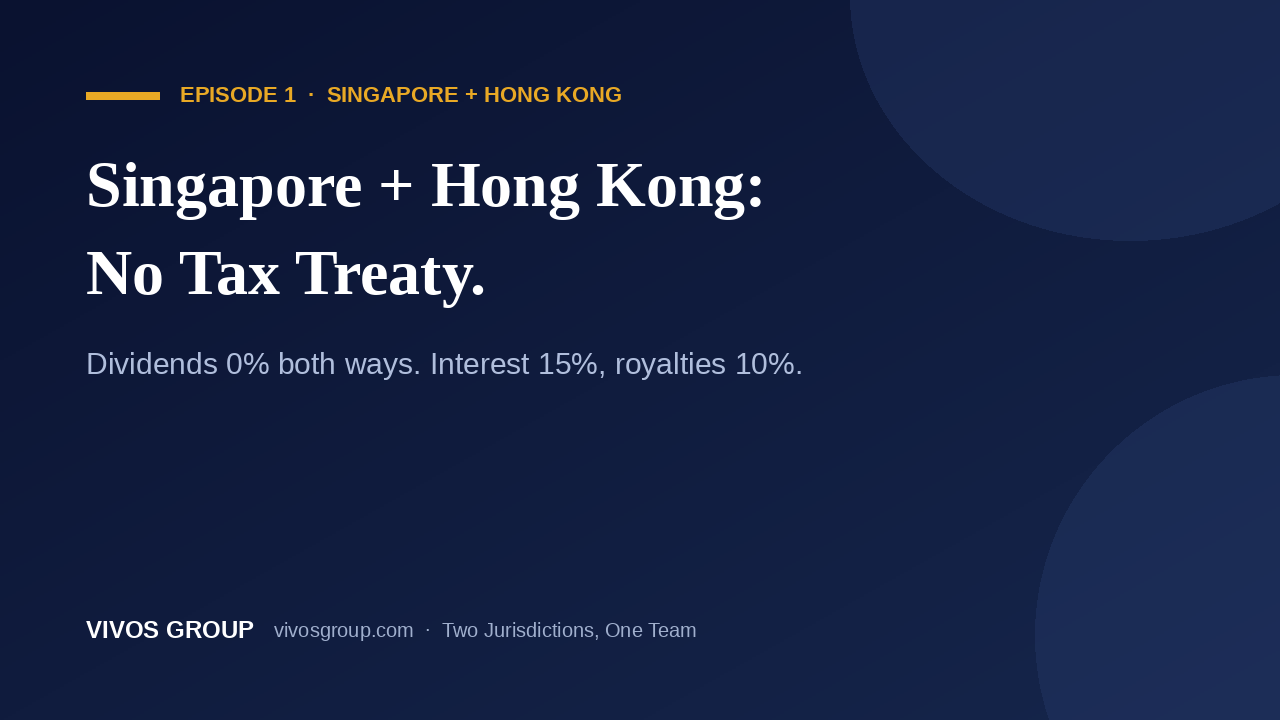
A Singapore company paying its Hong Kong sister company must withhold 15% on interest and 10% on royalties, and file and pay that tax to…