Company Valuation in Singapore: A Guide for Entrepreneurs
Published: 30 July 2026 · Last reviewed: 15 September 2026
A company valuation is a professional estimate of your firm’s fair market value. For international entrepreneurs operating in Singapore, the process starts with two decisions: define the purpose of the valuation, then gather three years of financial statements and supporting contracts.
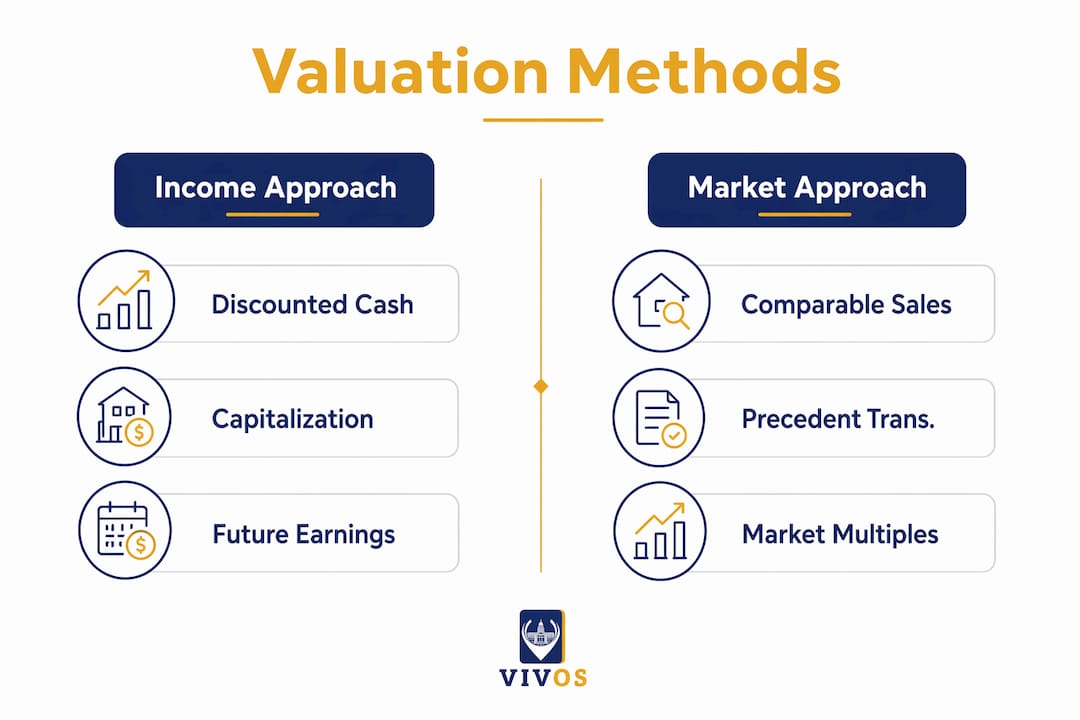
Three methods form the foundation of any Singapore business valuation:
Discounted cash flow (DCF) / income approach — best for businesses with predictable, recurring cash flows; projects future earnings and discounts them to present value
Market comparables — benchmarks your company against similar transactions or listed peers on SGX; well-suited for M&A and fundraising contexts
Asset-based approach — appropriate for asset-heavy or property-holding companies; accounts for leasehold tenure and local market comparables in Singapore
Purpose determines which method applies. Fundraising and M&A engagements typically favor forward-looking income or multiples approaches, while IRAS tax compliance or accounting-driven valuations often require an asset-based methodology.
Common triggers for a Singapore company appraisal include fundraising rounds, mergers and acquisitions, ESOP structuring, bank financing, and regulatory compliance with IRAS or ACRA. ISCA-credentialed professionals and CFA/CVA holders are the recognized standard for signing off on reports accepted by Singapore regulators and investors.
On frequency: actively growing businesses should commission a valuation annually, particularly when fundraising or approaching a sale. Stable businesses can operate on a three-to-five-year cycle.
Immediate next steps:
Gather three years of audited or management financials, your cap table, and key contracts
Define the purpose of the valuation before engaging a valuator
Request a sample report from any prospective valuator to assess methodology and depth
How Vivos Supports Your Company Valuation in Singapore
Vivos provides the corporate infrastructure that makes a valuation engagement run cleanly. Services span company incorporation, corporate secretarial, accounting, tax compliance, and corporate advisory — all the functions that generate and maintain the records a valuator needs.
What a Singapore valuation engagement typically includes:
A defined scope and valuation date confirmed at the outset
Explicit assumptions documented in the model
Sensitivity analysis and scenario testing across key variables
A signed report with an independence statement
Supporting schedules tied to ACRA-filed financials and IRAS tax records
Documents to prepare before engaging a valuator:
Three years of audited or management accounts
Current cap table and shareholder agreements
Revenue forecasts and business plan
IP documentation (patents, trademarks, licensing agreements — IP registration affects value materially)
ACRA corporate records and IRAS tax filings
Singapore valuations require adjustments that global templates miss: government grants, R&D subsidies, MAS licensing impacts, and transfer pricing rules can all shift the final figure. Intangibles such as brand equity and recurring revenue models also carry material weight with Singapore investors.
How to choose a credible valuator in Singapore:
ISCA membership or CPA/CVA/CFA credentials
Demonstrated independence and a clear conflict-of-interest disclosure
Local Singapore experience with comparable transactions
Sample reports showing sensitivity analysis and explicit assumptions
References or documented case examples
Pro Tip:Always request a sensitivity analysis table in the draft report. If a valuator cannot show how the conclusion shifts under two or three alternate assumptions, that is a methodological gap worth addressing before the report is signed.
Vivos’s financial and business advisory services support the full preparation cycle: clean financials, compliant tax records, and organized corporate documents. Contact Vivos to request a consultation or a service overview tailored to your valuation timeline.
Key Takeaways
A credible Singapore company valuation requires the right method for your purpose, locally adjusted assumptions, and a signed report from a credentialed professional.
Annual for actively growing businesses; every three to five years for stable companies.
Singapore-specific adjustments
Grants, R&D subsidies, transfer pricing, and MAS licensing impacts must be reflected in the model.
Report quality signals
A credible report includes a valuation date, explicit assumptions, sensitivity analysis, and a signed independence statement.
Vivos as your preparation partner
Vivos provides incorporation, corporate secretarial, accounting, tax, and advisory services to prepare your company for a valuation engagement in Singapore.
Master the cap versus discount crossover. Calculate the $12.5M breakpoint from a $10M cap and 20% discount, model conversions, and avoid Singapore filing...
Which consulting niches need a licence in Singapore, PDPA obligations every consulting firm carries, and the SS 680:2021 standard that replaced TR 43:2015 for Enterprise…