Singapore Directors: Avoid a $5,000 Fine on Register of Controllers

For Singapore directors: who qualifies as a registrable controller, what to file, and how to meet the 7 days and 2 business days filing deadlines.

| Area | Requirement |
|---|---|
| Eligibility | At least 18 years old, of sound mind; Singapore citizen, PR or EntrePass holder (EP holders may qualify with a Letter of Consent from MOM) |
| Fiduciary duties | Loyalty, care and good faith - acting in the company's best interests |
| Company secretary | Must be appointed within six months of incorporation |
| Auditor | Must be appointed within three months of incorporation, unless the company qualifies for audit exemption |
| Meetings | AGM at least once a year; EGM if requested by shareholders holding at least 10 percent of shares |
| Loans to directors | Generally prohibited under Section 162 of the Companies Act; breaches can attract fines of up to $20,000 or up to two years' imprisonment |
A director must be at least 18 years old, of sound mind, and a Singapore citizen, permanent resident or EntrePass holder; Employment Pass holders can also qualify with a Letter of Consent from the Ministry of Manpower. Undischarged bankrupts and persons convicted of serious offences are disqualified.
Directors owe duties of loyalty, care and good faith: they must put the company's interests ahead of personal gain, make informed decisions with reasonable care and diligence, and act honestly while avoiding conflicts of interest.
Directors must keep accurate accounting records, prepare annual financial statements for shareholders, hold an AGM at least once a year, appoint a company secretary within six months and an auditor within three months of incorporation (unless exempt), pay dividends only from profits, and disclose any conflicts of interest.
Generally no. Under Section 162 of the Companies Act, loans to directors are prohibited except in specific circumstances, and violations can lead to fines of up to $20,000 or imprisonment of up to two years.
Directors can face financial liability for losses caused by their failures, criminal liability including fines or imprisonment for serious violations such as fraud, and civil liability requiring them to compensate the company for damages.
The director must immediately disclose the personal interest to the company and recuse themselves from the related decision-making process to ensure decisions are made in the company's best interests.
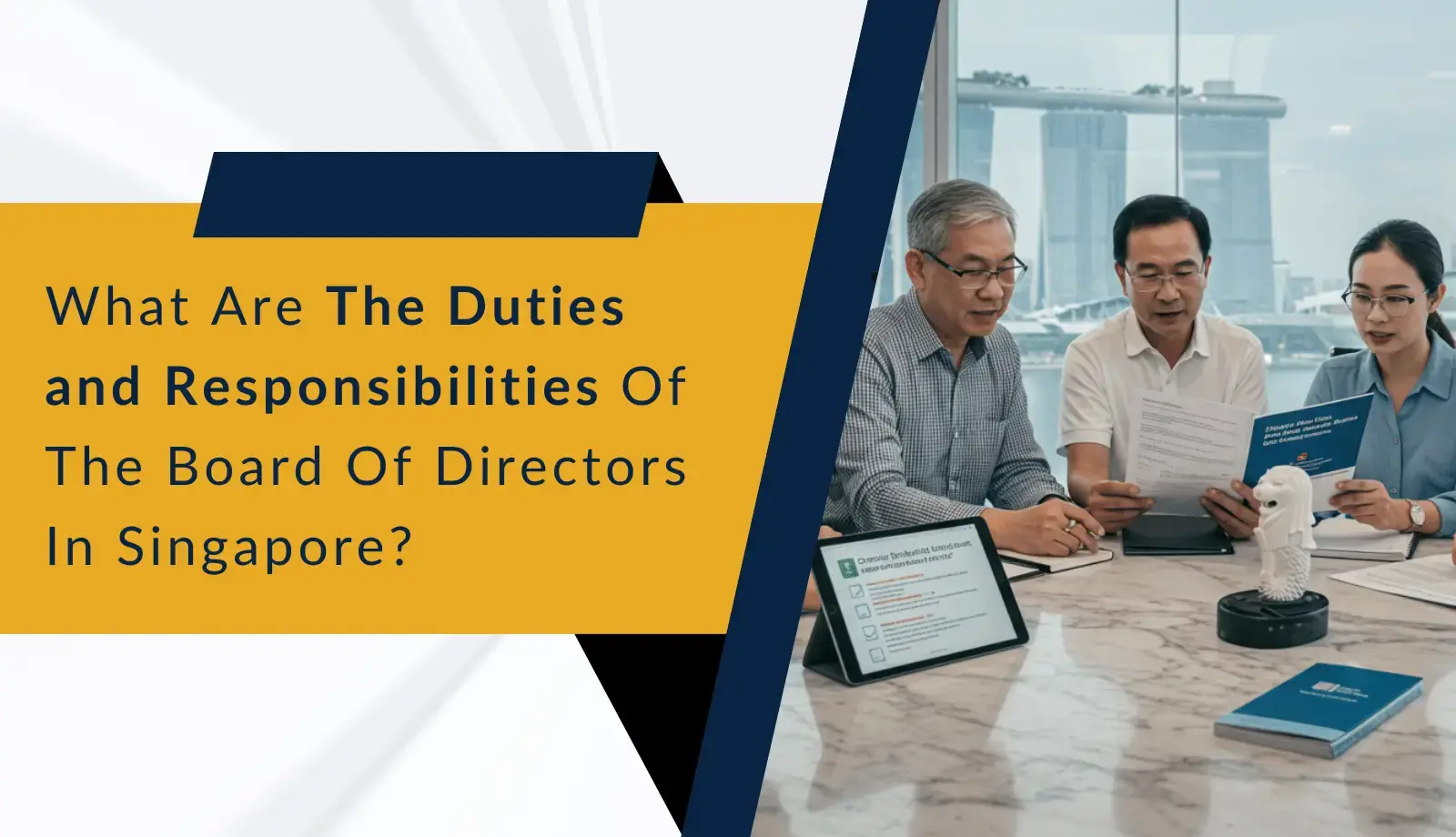
In Singapore, company directors are entrusted with significant responsibilities that ensure the smooth operation, compliance, and governance of their business. As the ultimate decision-makers, directors are legally required to adhere to a range of statutory and fiduciary duties outlined under the Companies Act. These duties are not only critical for the company’s legal standing but also play a pivotal role in its long-term sustainability and growth.
From maintaining proper accounting records to holding mandatory meetings, directors must navigate complex regulations while making informed decisions that align with the company’s best interests. Understanding these obligations is essential to avoid potential legal pitfalls, personal liability, and reputational damage.
This comprehensive guide aims to provide clarity on the roles, duties, and legal requirements for the board of directors in Singapore, ensuring they can fulfil their responsibilities with confidence and compliance.
A board of directors’ role is essential to the management of a company. Key functions include:
To be eligible as a director in Singapore, an individual must meet these criteria:
Disqualification: Individuals who are undischarged bankrupts or convicted of serious offences are disqualified.
Directors in Singapore must fulfil both fiduciary duties and statutory duties. These duties ensure that the director acts in the best interest of the company and complies with all relevant legal regulations.
Here are the duties of board of directors in brief:
Fiduciary duties refer to the responsibility of a board of director to act in good faith and with loyalty to the company. Key fiduciary duties include:
Directors in Singapore are required to fulfill various statutory obligations under the Companies Act to ensure compliance with legal and regulatory standards. These statutory duties are designed to promote transparency, accountability, and good governance. Key statutory duties of directors include:
In addition to fiduciary and statutory duties of board of directors, also have specific restrictions, known as “negative duties.” These duties impose restrictions on actions directors can take, such as:
Failure to comply with duties can result in significant liabilities for directors:
Directors must avoid conflicts of interest where personal gains could influence their decision-making. If a conflict arises, the director must:
Related Read: How Can Director Disputes and Stalemates Be Resolved? – Explore how conflicts and disagreements among directors can be resolved effectively to maintain corporate governance.
Being a board director in Singapore comes with significant responsibilities. Board of Directors must understand both their fiduciary and statutory duties, along with the legal consequences of non-compliance. To ensure that your business runs smoothly and adheres to all legal obligations, it is crucial to consult with experts who can guide you through the complex requirements of corporate governance.
At VIVOS, we provide comprehensive support to directors, helping them navigate the board of directors responsibilities and mitigate risks. Whether you need advice on director appointments, conflict resolution, or compliance strategies, our team is here to assist.
Contact VIVOS today to ensure you meet all your obligations and responsibilities as a director in Singapore.

As a director in Singapore, it’s essential to be fully aware of your duties and obligations. Let VIVOS help guide you through the legal landscape to ensure compliance and protect your business.
 2 January, 2025
 2 January, 2025
What Are the Key Responsibilities of a Director in Singapore?
Directors in Singapore must manage the company’s affairs, make strategic decisions, and ensure compliance with statutory and fiduciary duties, including maintaining financial records and holding annual meetings.
Who Can Act as a Director in Singapore?
To act as a director in Singapore, a person must be at least 18 years old, legally capable, a resident, and not disqualified due to bankruptcy or criminal convictions.
What Are the Fiduciary Duties of a Director?
Directors must act in good faith, avoid conflicts of interest, and ensure that their decisions are in the best interests of the company, maintaining transparency and integrity.
What Happens if a Director Fails to Meet Their Responsibilities?
A director who breaches their duties can face severe legal consequences, including fines, imprisonment, and personal liability for the company’s losses.
How Can Directors Handle Conflicts of Interest?
Directors must disclose any conflicts and recuse themselves from decision-making to ensure fairness. Transparency is key in maintaining trust and compliance.
What is the Difference Between Advisory Boards and Board of Directors?
An Advisory Board provides non-binding advice and has no legal authority, while a Board of Directors has formal governance power, makes key decisions, and is legally responsible for the company.

For Singapore directors: who qualifies as a registrable controller, what to file, and how to meet the 7 days and 2 business days filing deadlines.

Foreign founders must appoint a resident Singapore company secretary within six months to avoid ACRA flags and fines. Learn outsourcing options and Vivos'...
Compare bank and fintech multi-currency accounts in Singapore for foreign founders. See a US$10,000 FX example, typical fee gaps, and how Vivos speeds...


Incorporated in Singapore under the Companies Act 1967 UEN 202416468C | ACRA Registered Filing Agent FA20240323 | MOM Employment Agency Licence 24S2425
Malaysia – VIVOS (M) Sdn. Bhd. | Registration Number:
People’s Republic of China, Hong Kong – VIVOS CORPORATE SERVICES (HK) LTD. | Business Registration Number: 80545137
United Arab Emirates, Dubai – VIVOS CORPORATE SERVICES L.L.C. | Commercial Licence Number: 1638200