
去印尼扩张为何要先设新加坡控股公司?直接持股最多损失37.6%(2026年算法)

Ray Tay
直接持有印尼公司:22%企业所得税+20%股息预提税=37.6%;通过持股≥25%的新加坡控股公司,协定税率10%,合计29.8%,且退出时印尼不征税。
Published: 1 October 2026 · Reviewed by Ray Tay, Co-Founder & Managing Director, VIVOS PTE. LTD. (ACRA Filing Agent FA20240323 · MOM EA Licence 24S2425)
Singapore companies report under the Singapore Financial Reporting Standards (SFRS), which are aligned with IFRS. Qualifying small entities may instead use SFRS for Small Entities, a simplified framework. As of 2026, the Accounting and Corporate Regulatory Authority (ACRA) enforces compliance through mandatory annual XBRL filings, and VIVOS, an ACRA-registered filing agent, supports foreign founders through incorporation and SFRS-compliant accounting.
TL;DR:
- Small companies in Singapore can qualify for SFRS for Small Entities if they meet size and ownership thresholds for two consecutive periods, reducing disclosure and audit requirements.
- The 2026 standard update aligns SFRS(I) and FRS with IFRS, with the 2027 changes tightening disclosure requirements for small-entity relief.
- Foreign founders should confirm small-entity eligibility early, prepare authorized financial statements first, and select the correct XBRL template before filing with ACRA.
- Most compliance issues stem from errors in XBRL taxonomy mapping, which can be mitigated with professional help and early preparation.
- Financial statements filed with ACRA are different from tax reports, requiring separate processes and compliance checks for each filing.
The Accounting Standards Council (ASC) issues Singapore’s financial reporting frameworks, and ACRA enforces them through statutory filing requirements. As of 2026, three main frameworks exist, each built for a different type of entity.
Publicly accountable companies, such as listed entities and financial institutions, generally use SFRS(I) or FRS depending on their structure. Private companies without public accountability typically use FRS, and many qualify to move to SFRS for Small Entities once they meet the relevant thresholds. Statutory boards sit outside this commercial framework entirely, reporting instead under SB-FRS.
Foreign founders choosing a framework in year one need a quick side-by-side view before digging into the statutory text.
| Framework | Typical users | Key thresholds | Disclosure complexity | IFRS compliance statement |
|---|---|---|---|---|
| SFRS(I) | Publicly accountable entities, companies seeking international comparability | None, based on public accountability status | High | Yes, entities may elect an explicit statement of compliance with IFRS Accounting Standards |
| FRS | Private companies without public accountability | None, based on public accountability status | Moderate to high | No explicit IFRS statement option |
| SFRS for Small Entities | Qualifying small entities without public accountability | Meets qualifying size and ownership criteria for two consecutive periods | Low | No |
The ASC treats SFRS(I) as equivalent to IFRS Accounting Standards, which matters for founders planning to raise capital abroad or list overseas. FRS remains the default for domestic private companies, while SFRS for Small Entities strips out disclosures that add cost without adding value for smaller operations. Moving between frameworks requires meeting the criteria consistently, not just in a single good year.
Qualifying for SFRS for Small Entities depends on both qualitative and quantitative tests, and a startup must clear both.
Qualifying reduces disclosure volume significantly and, combined with separate audit-exemption criteria, can remove the audit requirement for very small private companies. Relief ends once a company breaches the thresholds for two consecutive periods, at which point it must revert to full FRS reporting. Our guide to unaudited financial statements covers how small-entity status interacts with audit exemption in more detail.
Every Singapore company must file its financial statements with ACRA in XBRL format as part of its annual return, and the mechanics catch out many first-time filers.
Common rejection causes include mismatched currency indicators, incorrect rounding, and selecting the wrong template for the company’s size. ACRA’s own filing tips list these errors specifically, and most are avoidable with a pre-submission checklist.
Pro Tip: Reconcile currency and rounding settings in your source financial statements before opening BizFinx, since taxonomy mapping errors often start upstream.
Two sets of updates matter for anyone choosing a framework this year.
Founders incorporating in 2026 should build their first set of accounts against the current standards while noting that the 2027 changes will tighten disclosure alignment between small-entity relief and full FRS. Companies planning to grow past the small-entity thresholds within a year or two may want to model both sets of requirements now rather than switching frameworks twice.
A new Singapore company has a narrow window to get its reporting framework right before the first XBRL filing comes due.
Ray Tay, Managing Director of VIVOS, notes that mapping is where most companies stumble: “Mapping to the ACRA taxonomy is where most rejections happen, and getting professional help early removes that risk before the filing window closes.”
Pro Tip: Treat XBRL mapping as its own deliverable with its own deadline, separate from finalizing your accounts.
Beyond the general SFRS framework, certain regulated industries carry additional reporting layers. Banks and other financial institutions fall under the Monetary Authority of Singapore’s regulatory reporting regime on top of SFRS(I) or FRS, with additional disclosures around capital adequacy and risk exposure. Insurers face similar layering, with sector-specific reserving and solvency reporting sitting alongside standard financial statements.

Real estate and property development companies generally apply the standard SFRS or FRS framework but face particular attention on revenue recognition timing, given the long development cycles and staged payment structures common in the sector. Investment holding companies and fund structures often intersect with additional regulatory reporting depending on their licensing status.
For most foreign founders setting up an operating company, trading business or professional services firm, these industry overlays will not apply, and the standard SFRS, SFRS(I) or SFRS for Small Entities pathway covers the full reporting obligation. Founders entering a regulated sector should factor in the additional layer from the outset, since it affects both the accounting system chosen and the internal reporting cadence needed to support it.
ACRA enforces accounting standards primarily through the annual return process, which requires every company to file XBRL financial statements alongside its return. Failure to file, or filing inaccurate statements, exposes a company and its officers to penalties and can affect the company’s standing on the public register that investors, banks and partners check before doing business.
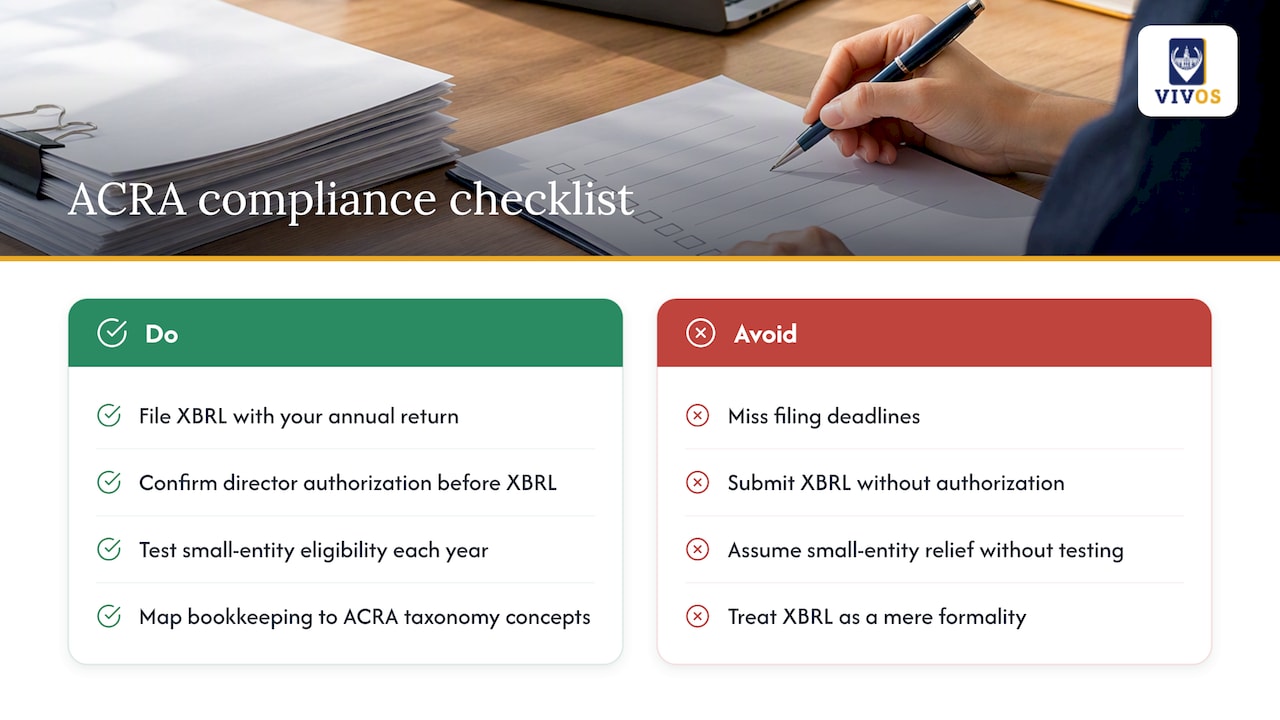
The most common compliance issues are practical rather than technical: missed filing deadlines, financial statements prepared without proper director authorization before XBRL conversion, and mismatches between the accounting standard applied and the template selected during filing. Companies that assume the small-entity relief applies without testing eligibility each year also risk under-disclosing, which can trigger queries or resubmission requirements.
A second recurring issue is treating XBRL filing as a formality rather than a technical mapping exercise. Because the ACRA taxonomy requires each line item to be matched to a specific concept, errors compound when bookkeeping categories do not align cleanly with taxonomy structure. Our guide to avoiding rejected XBRL uploads covers the specific error patterns founders encounter most often.
Financial reporting under SFRS and tax reporting to the Inland Revenue Authority of Singapore serve different purposes and often produce different figures for the same period. Financial statements follow SFRS recognition and measurement principles, aimed at giving a fair picture of financial position and performance to shareholders, lenders and other stakeholders. Tax computations start from those financial statements but apply adjustments required under tax law, such as different depreciation treatment, non-deductible expenses and specific timing rules for income recognition.
A company’s XBRL-filed financial statements and its annual tax return are therefore related but not identical documents, and founders sometimes assume that submitting one satisfies the other. It does not: ACRA’s filing requirement and IRAS’s tax filing requirement run on separate tracks with separate deadlines and separate penalties for non-compliance. Keeping accounting records structured around SFRS from the outset makes the tax adjustment process more straightforward, since every reconciling item is traceable back to a specific line item rather than reconstructed at filing time.
SFRS and SFRS(I) rest on a small set of principles that shape every specific standard within the framework. Financial statements aim to give a fair and accurate view of a company’s financial position, performance and cash flows, rather than simply satisfying a compliance checklist. Recognition and measurement follow accrual accounting, meaning transactions are recorded when they occur rather than when cash changes hands.
Consistency and comparability matter throughout: once a company selects an accounting policy, such as a depreciation method or inventory valuation approach, it applies that policy consistently across periods unless a genuine change in circumstances justifies a switch. Materiality determines the level of detail required in disclosures, so smaller or less significant items receive lighter treatment than transactions that could influence a reader’s decisions. These principles are what SFRS for Small Entities preserves while stripping away disclosure volume, and what makes the framework choice a genuine strategic decision rather than a paperwork exercise for a growing company.
The most common mistake foreign founders make is not the framework itself, it is the timing. Many choose an accounting system and bookkeeping structure before confirming whether they qualify for SFRS for Small Entities, then discover during their first XBRL filing that their records do not map cleanly to the taxonomy they actually need.
An ACRA-registered filing agent has experience guiding incorporation, nominee director appointment, corporate secretarial work and SFRS-compliant accounting for foreign founders in several jurisdictions, with service offered in English and Mandarin.
Ray Tay, Managing Director of VIVOS, puts it plainly: “The founders who avoid rejected filings are the ones who set up their bookkeeping against the reporting standard from day one, not the ones who fix it retroactively.”
— Ray
Choosing between SFRS, SFRS(I) and SFRS for Small Entities is only the first decision. Getting the bookkeeping, financial statements and XBRL filing right every year is the ongoing work, and that is where a dedicated team removes the guesswork from a founder’s plate.
An ACRA-registered filing agent provides company incorporation services for foreign founders, including nominee resident director, registered address, corporate secretary and SFRS-compliant accounting, with similar services available in multiple jurisdictions and support in English and Mandarin. Our accounting team handles bookkeeping and compliance, prepares statutory accounts against the correct SFRS framework, and manages XBRL preparation and filing directly through BizFinx and the ACRA taxonomy, so mapping errors get caught before submission rather than after rejection.
If you are setting up a Singapore company and need a framework decision made correctly from the start, see our pricing for incorporation and corporate secretarial services or explore our full accounting services to get your first year of reporting on solid footing.
SFRS is not identical to IFRS, but SFRS(I), the international variant, is treated as equivalent to IFRS Accounting Standards by the ASC. Companies complying with SFRS(I) may elect to state explicit compliance with IFRS, which supports international comparability for founders seeking funding abroad.
A company qualifies as a small entity if it has no public accountability and meets at least two of three thresholds: annual revenue of not more than S$10 million, total assets of not more than S$10 million, or no more than 50 employees. These conditions must hold for two consecutive reporting periods before the relief applies.
FRS is the full domestic reporting framework for companies without public accountability, requiring more extensive disclosures. SFRS for Small Entities is a simplified version based on IFRS for SMEs, available once a company meets the qualifying size and ownership criteria, and it reduces disclosure volume significantly compared to full FRS.
Yes, VIVOS is an ACRA-registered filing agent that prepares and files XBRL financial statements for foreign-owned Singapore companies through its accounting services. The team handles taxonomy mapping and template selection alongside incorporation, corporate secretarial and nominee director services.
 2 January, 2025
 2 January, 2025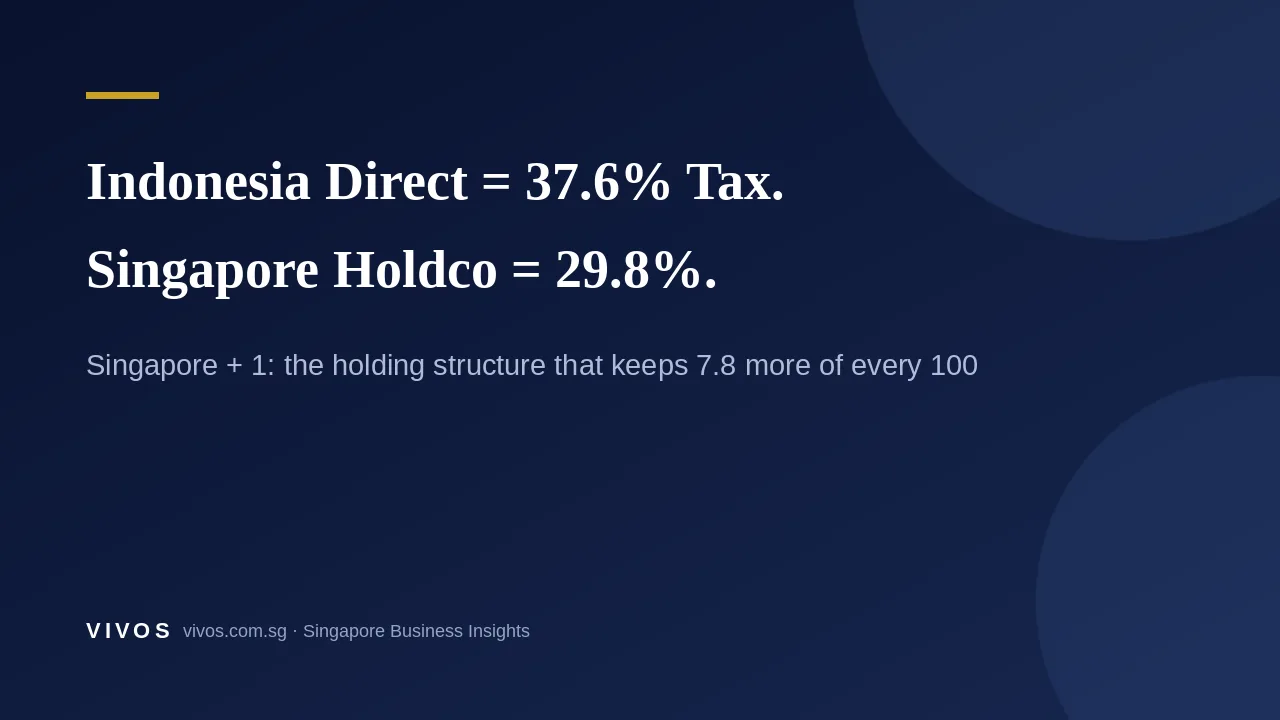
直接持有印尼公司:22%企业所得税+20%股息预提税=37.6%;通过持股≥25%的新加坡控股公司,协定税率10%,合计29.8%,且退出时印尼不征税。
Own an Indonesian company directly and up to 37.6% of profit is gone. A Singapore holding company (≥25%) cuts that to 29.8% and protects the…
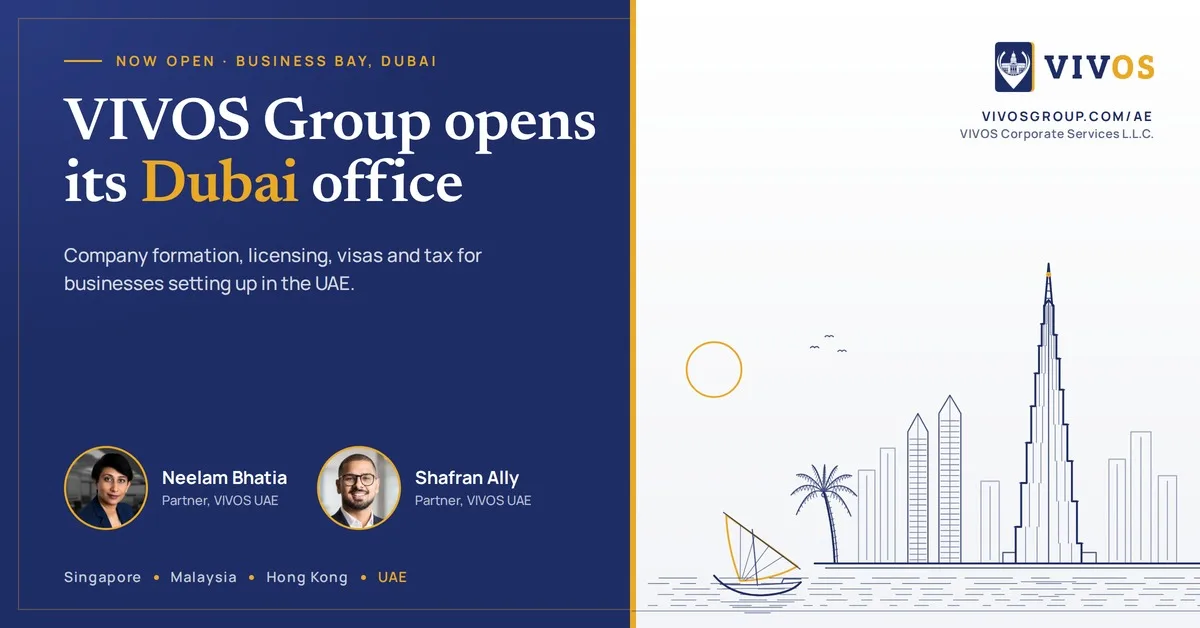
VIVOS Group has opened its Dubai office in Business Bay, led by Partners Neelam Bhatia and Shafran Ally, for UAE company formation, licensing and visas.