
Avoid Penalties: Verify Singapore Filing Agents Under the CSP Act 2026

Ray Tay
Verify and hire a registered filing agent in Singapore after the CSP Act 2024. Follow ACRA checks, practitioner-tested selection criteria, and review the...
Published: 28 September 2026 · Reviewed by Ray Tay, Co-Founder & Managing Director, VIVOS PTE. LTD. (ACRA Filing Agent FA20240323 · MOM EA Licence 24S2425)
An ACRA Business Profile is the official government record of a Singapore entity, covering its UEN, registration status, directors, shareholders, and paid-up capital. It costs S$5.50 per profile when bought through BizFile+, as of 2026. Banks, investors, landlords, and embassies request it most often as proof that a company exists and is in good standing.
TL;DR:
- Foreign founders should order a Business Profile early to avoid delays in meeting bank KYC deadlines and ensure it is verified and translated beforehand.
- The profile does not include financial data or litigation history and requires additional reports like CCFP for deeper compliance or financial analysis.
- Most key risk signals come from cross-field patterns, such as outdated filing dates or shared addresses, not from individual data points.
- Verification via trustBar confirms authenticity but does not guarantee the profile’s data is current, making timely updates essential before foreign authorities require certified copies.
- Using the Business Profile API provides automated, volume-based access for large-scale checks, reducing manual efforts and increasing consistency.
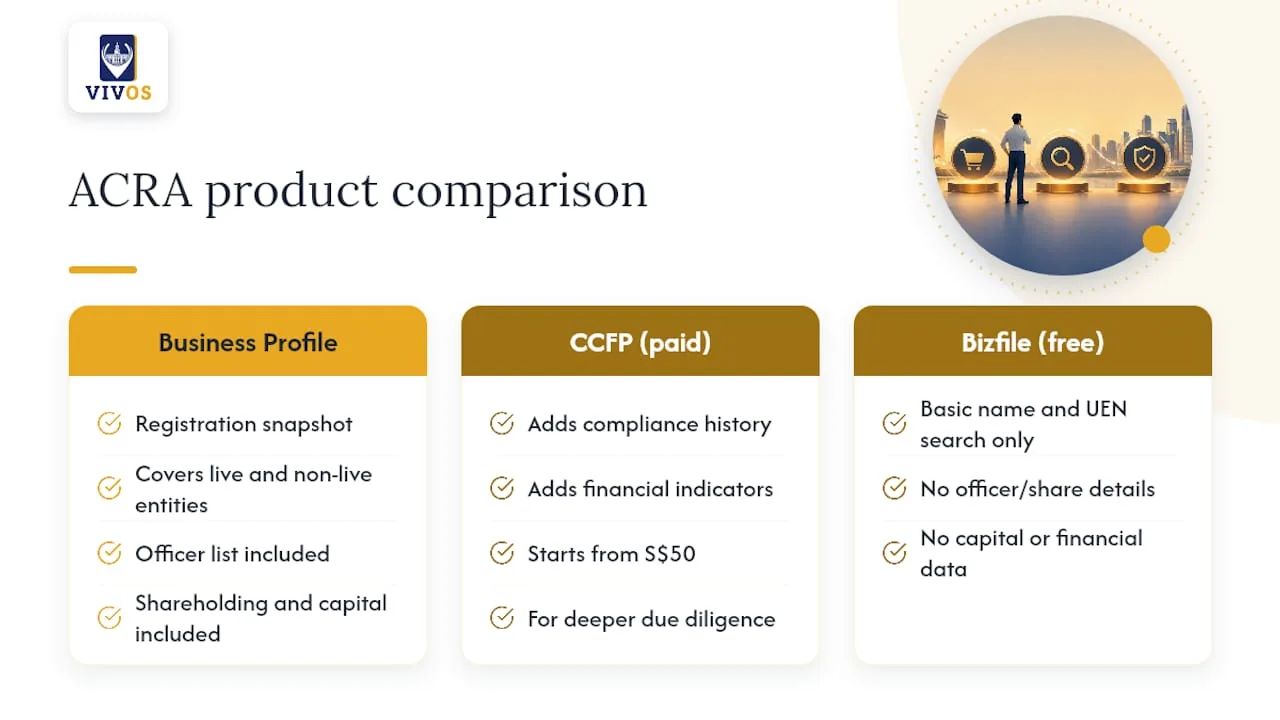
The Business Profile is one of several information products the Accounting and Corporate Regulatory Authority sells to the public. It sits at the entry level: a snapshot of registration data suited to quick checks rather than deep financial review. ACRA’s product table lists it alongside the Corporate Compliance and Financial Profile, or CCFP, which starts from S$50 and adds compliance history and financial indicators for readers who need more than a name-and-status check.
The Business Profile covers companies, limited liability partnerships, sole proprietorships, and partnerships registered in Singapore, whether the entity is active, struck off, or wound up. Non-live entities still generate a profile, though the fields shrink: a dissolved company’s record carries less officer and filing detail than an active one’s.
What it does not do matters just as much. The profile is not a financial statement, a credit report, or a certified audit trail. It will not show bank balances, litigation history, or tax arrears. Readers who need that depth order a CCFP or request financial extracts separately, and risk teams typically treat the Business Profile as the first pass before deciding whether a deeper pull is worth the cost.
A free version exists too. Anyone can run a basic name search on Bizfile to confirm an entity’s existence and UEN at no charge. The paid profile is what adds the officer list, shareholding structure, and capital figures that a bank or counterparty will actually ask to see.
Buying a profile through BizFile+ takes a few minutes once you know the entity’s name or UEN. ACRA’s own guide to buying a Business Profile via Bizfile lays out the flow for both guest users and account holders.
Foreign founders who lodged a filing themselves, such as an incorporation, an annual return, or a particulars change, may qualify for a free copy under ACRA’s free download rules. That copy lands in the Bizfile inbox tied to the transaction and stays available for a limited window, not indefinitely.
A related product, the People Profile, works the same way but centers on an individual rather than an entity. It is useful when a bank wants to confirm a director’s other appointments. Common snags on Bizfile include searching under a trading name instead of the registered name, forgetting that struck-off entities return partial data only, and letting the download link expire before saving the file. None of these are complicated once you know to check for them, but they are the reasons a first attempt sometimes stalls.
A Business Profile is organized into sections, and each one answers a different question a counterparty typically has.
| Information section | What it shows | Who asks for it |
|---|---|---|
| Entity details | UEN, entity type, incorporation date, status | Banks, embassies |
| Registered office address | Current registered address on file | Landlords, banks |
| Principal activity | SSIC codes describing the business activity | Investors, banks |
| Share capital | Issued and paid-up capital | Investors, banks |
| Officers | Directors, company secretary, and their appointment dates | Banks, embassies |
| Shareholders | Names and shareholding percentages | Investors |
| Filing history | Date of last annual general meeting and annual return | Investors, regulators |
The UEN and status fields tell a reader whether the entity is live, and the incorporation date establishes how long it has existed, both of which matter to a bank running account-opening checks. The registered address is what a landlord or courier will cross-reference, while the SSIC activity code tells an investor or bank what the company is licensed to actually do. Issued and paid-up capital figures matter to investors sizing up commitment, and officer and shareholder listings are what most due diligence requests are really after.
Some information is deliberately incomplete. Residential addresses of officers are not published in full on the standard profile, and struck-off entities show a thinner officer history than active ones. That is a design choice, not a data error, and it is worth knowing before assuming a gap means something is wrong.
Different requesters want the same document for different reasons, and knowing which fields they will scan for saves a round of back-and-forth.
When any of these parties ask for more than a name-and-status confirmation, a CCFP or a financial extract fills the gap the Business Profile leaves, particularly for lenders assessing repayment capacity rather than existence.
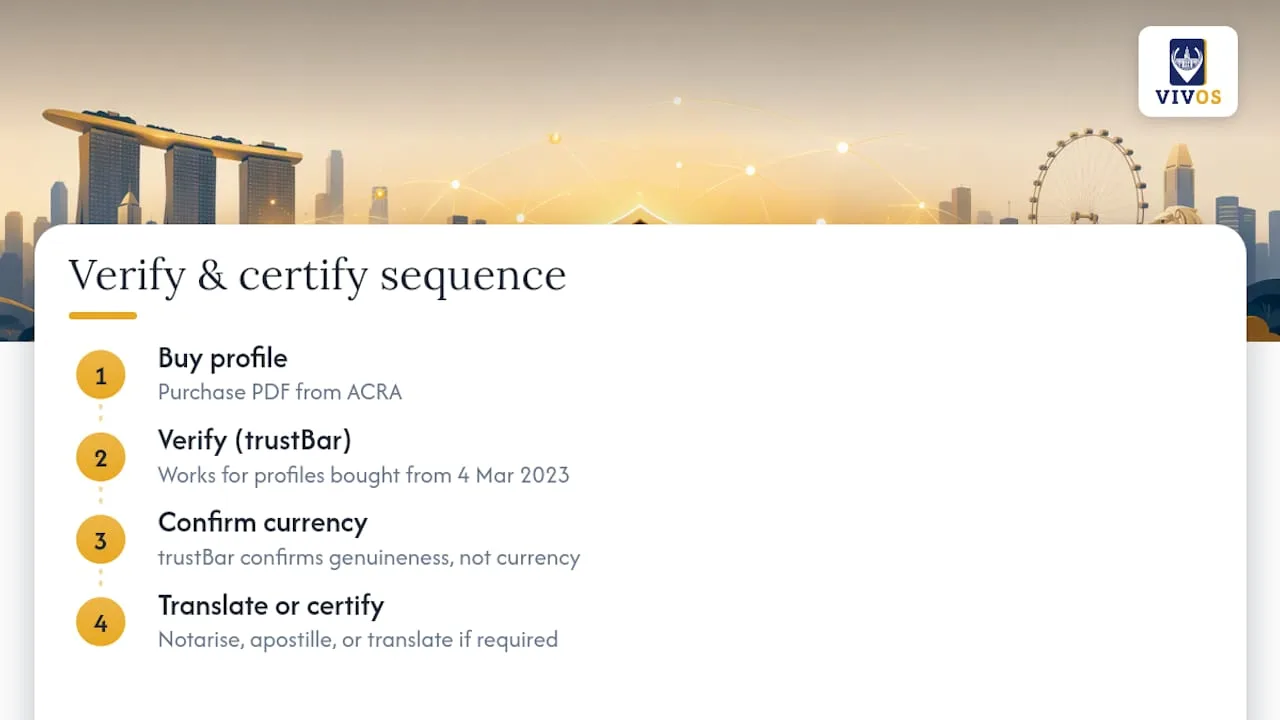
A downloaded PDF is only useful if the recipient trusts it came from ACRA. The authority’s trustBar verification tool lets anyone confirm a document’s authenticity, and it covers Business Profiles purchased from March 4, 2023 onwards. Older profiles fall outside that window and cannot be checked the same way.
Verification is not the same as certification for foreign use. ACRA’s guidance on verifying and certifying documents is explicit that electronic issuance by ACRA does not substitute for notarisation or apostille where a foreign authority demands one. A bank in Singapore will accept the PDF as issued. An embassy or overseas registrar often wants a certified true copy, a notarized translation, or an apostille stamp layered on top.
The practical sequence is buy, verify, then translate or certify as the receiving party requires. trustBar also has a limit worth flagging: it confirms the document is genuine, but it is less reliable for checking whether the underlying data is still current, a distinction that matters more for Business Profiles than for Business Certificates.
Pro Tip: Order translations and certified copies as soon as you know a foreign authority will need them. Turnaround for notarisation and apostille adds days that a same-week bank KYC deadline will not accommodate.
Organizations that pull dozens or hundreds of profiles a month have little use for the one-at-a-time BizFile+ checkout. ACRA’s Business Profile API, launched on November 18, 2025 as part of the EIQ Entity Information Query service, gives the same fields as the single-report profile but returns them programmatically.
The API suits banks, credit bureaus, and compliance platforms running automated checks at volume rather than a founder pulling one profile for a bank meeting. Benefits center on speed and consistency: no manual search, no repeated checkout, and a data feed that plugs directly into an onboarding or monitoring system. Getting started requires an EIQ subscription rather than a Bizfile account. Readers who only want aggregate statistics rather than entity-level records have a lighter option in ACRA’s Open Data portal, which carries no per-record charge.
Most of the value in a Business Profile comes from reading fields against each other rather than in isolation. ACRA itself notes that meaningful risk signals show up in cross-field patterns, such as filing cadence measured against paid-up capital and activity, or officer continuity over time, not in any single line.
None of these signals condemn a company on their own. A startup can have thin paid-up capital and still be legitimate, and a registered address at a secretarial firm is standard practice for most Singapore private companies. The point of the checklist is to know which fields deserve a second question, not to reject on sight.
Pro Tip: Treat a stale filing date as a prompt to ask for the latest financials directly, rather than assuming the worst from the profile alone.
When a profile raises more questions than it answers, the next step is usually to order a CCFP for financial and compliance depth, cross-check the filing history against ACRA’s own records, or bring in a corporate secretary or adviser who reviews these documents routinely. A structured approach to corporate records due diligence helps standardize what gets checked and in what order, particularly for anyone reviewing more than a handful of counterparties a year.
The recurring mistake among foreign founders is ordering the Business Profile only after a bank has already asked for it, which turns a five-minute purchase into a scramble against a KYC deadline. The second most common error is assuming the electronic PDF satisfies every foreign authority, then discovering days later that an embassy or overseas registrar wants a notarized translation instead.
A founder who orders the profile early, checks it against what the bank’s checklist actually requires, and lines up translation or apostille before it becomes urgent avoids most of the delay entirely. Keep the payment receipt and the trustBar verification result alongside the downloaded PDF: a bank officer or lawyer asking “was this really issued by ACRA” is a common enough question that having the proof ready saves a second round of correspondence.
— Ray
A corporate service provider offers Singapore company incorporation for foreign founders, including nominee resident director, registered address, and corporate secretarial support that covers supplying Business Profiles and certified extracts on request. The same setup extends to Malaysia, Hong Kong, and UAE for founders building across more than one jurisdiction.

Foreign founders working through bank KYC often need more than a downloaded PDF: they need the timing right, the certification sorted, and the officer list on the profile matching what the bank’s compliance team expects. VIVOS’s corporate secretarial team obtains and prepares these extracts as part of ongoing compliance work, and coordinates translation or notarisation when an overseas authority requires it. As Ray Tay, Managing Director of VIVOS, puts it: “A Business Profile only helps you if it lands in the bank’s inbox at the right moment, already verified and already translated if that’s what’s needed.”
Founders who want the profile, the certification, and the bank introduction handled as one package can start from the pricing page or review the full incorporation service for what VIVOS covers end to end.
Search the entity by name or UEN on Bizfile, add the Business Profile to your cart, and pay S$5.50 as a guest or logged-in user. The PDF downloads immediately, so save it before the link expires.
Run a free basic search on Bizfile using the company name or UEN to confirm registration and status at no cost. A paid Business Profile adds officer, shareholder, and capital details beyond that basic confirmation.
A Business Profile covers core registration facts such as UEN, officers, and capital, while the Corporate Compliance and Financial Profile adds financial and compliance indicators for deeper review. The CCFP starts from S$50, compared with S$5.50 for a standard profile.
A single Business Profile costs S$5.50 when purchased through BizFile+. Founders who filed the underlying transaction themselves may qualify for a free copy delivered to their Bizfile inbox for a limited time.

 2 January, 2025
 2 January, 2025
Verify and hire a registered filing agent in Singapore after the CSP Act 2024. Follow ACRA checks, practitioner-tested selection criteria, and review the...

Checklist for founders and finance leaders in SG, MY, HK and UAE: control tests, FX translation, intercompany eliminations and a 7 step close.

Singapore guide for founders on shareholders agreements: key clauses, Companies Act limits, drafting steps and realistic timelines of 2–6 weeks.