GST Registration Singapore: Guide for Business Owners
Published: 9 August 2026 · Last reviewed: 17 September 2026 · Reviewed byRay Tay, Co-Founder & Managing Director, VIVOS PTE. LTD. (ACRA Filing Agent FA20240323 · MOM EA Licence 24S2425)
Any Singapore business whose taxable turnover exceeds S$1 million is required to register for Goods and Services Tax (GST) with the Inland Revenue Authority of Singapore (IRAS). That threshold applies under two legal tests: the retrospective view (turnover exceeded S$1 million in the past 12 months) and the prospective view (you reasonably expect turnover to exceed S$1 million in the next 12 months). Overseas suppliers and marketplace operators may also face registration obligations under the Overseas Vendor Registration (OVR) regime or reverse charge rules, even without a local presence.
Key facts at a glance:
Compulsory registration threshold: S$1 million in taxable turnover (standard-rated and zero-rated supplies combined), per IRAS/gst-registration-deregistration/do-i-need-to-register-for-gst)
Exemption available: If zero-rated supplies exceed 90% of taxable supplies and you would be in a net refund position, you may apply for exemption even above the threshold
Voluntary registration: Available to businesses below S$1 million, subject to a two-year commitment and mandatory e-Learning
Late registration risk: IRAS uncovers around 100 late registrants annually, with an average combined GST liability and penalties of approximately S$100,000 per business
Immediate next steps: compute your taxable turnover using the IRAS GST Registration Calculator on myTax Portal, gather supporting contracts and invoices, and apply via myTax Portal if you are liable.
Key Takeaways
Compulsory GST registration in Singapore applies when taxable turnover exceeds S$1 million under either the retrospective or prospective view, with a 30-day application window and significant penalties for late notification.
Point
Details
Compulsory threshold
Taxable turnover above S$1 million triggers mandatory registration under retrospective or prospective rules.
Late registration risk
IRAS uncovers around 100 late registrants annually, with average combined GST and penalties of approximately S$100,000.
Voluntary registration commitment
Voluntary registration is binding for two years; complete the IRAS e-Learning course before applying.
Turnover computation
Include standard-rated and zero-rated supplies; exclude exempt supplies, out-of-scope supplies, and capital asset sales.
Vivos GST services
Vivos provides end-to-end GST registration, filing, and advisory support for Singapore businesses.
Under the retrospective view, a business must register when its taxable turnover for the past 12 calendar months exceeds S$1 million. The 12-month period is assessed on a rolling basis at the end of each calendar month. If you breach the threshold at the end of December, you must apply by January 31, and your effective registration date will be March 1.
The prospective view
The prospective view applies when you have reasonable grounds to expect your taxable turnover to exceed S$1 million in the next 12 months, even if you have not yet crossed it historically. Under this test, you must apply within 30 days of the date you first formed that expectation, and IRAS will register you effective 31 days from that forecast date. Acceptable evidence includes signed contracts, purchase orders, and confirmed invoices. Note that transitional rules apply for liabilities arising on or after July 1, 2025, per the IRAS e-Learning Module 1.
Key exceptions
Not every business above S$1 million must register. The following supplies are excluded from the taxable turnover computation entirely:
Exempt supplies: Financial services, residential property rental, and sale of investment precious metals
Out-of-scope supplies: Supplies made outside Singapore
Sale of capital assets: Proceeds from selling business assets used in the business (not inventory)
Beyond exclusions from the computation, a business may also qualify for a formal exemption from registration. If zero-rated supplies represent more than 90% of total taxable supplies and registration would put you in a net refund position, you may apply for exemption from GST registration even when turnover exceeds S$1 million.
Pro Tip:Keep a rolling 12-month turnover tracker updated monthly. Many businesses miss the retrospective trigger because they only review revenue annually.
Application timeline summary
Retrospective trigger: Apply by the last day of the month following the month you exceeded S$1 million (e.g., January 31 for a December breach). Effective date: March 1.
Prospective trigger: Apply within 30 days of the forecast date. Effective date: 31 days from the forecast date.
Voluntary registration: No deadline, but a two-year commitment applies from the effective date.
How to compute taxable turnover accurately
Taxable turnover for GST registration purposes includes the value of standard-rated supplies (currently taxed at 9%) and zero-rated supplies (taxed at 0%). It does not include exempt supplies, out-of-scope supplies, or proceeds from selling capital assets used in the business.
What counts toward the S$1 million threshold
Standard-rated supplies: local sales of goods and services at 9% GST
Zero-rated supplies: exports of goods, international services, and supplies to overseas customers meeting zero-rating conditions
Imported services subject to reverse charge (where applicable to the business’s profile)
Sale of capital assets (machinery, vehicles, equipment used in the business)
Disbursements received on behalf of third parties
Use the IRAS GST Registration Calculator on myTax Portal to run the computation with your actual revenue figures. It requires your Unique Entity Number (UEN) and monthly revenue data.
Worked example
A Singapore-based software consultancy has the following 12-month revenue:
Local consulting services (standard-rated): S$700,000
Export services to overseas clients (zero-rated): S$350,000
Rental income from residential unit (exempt): S$60,000
Proceeds from selling old office equipment (capital asset): S$20,000
Taxable turnover = S$700,000 + S$350,000 = S$1,050,000. The business exceeds the threshold and must register. The residential rental and capital asset sale are excluded from the computation.
Supply Type
Included in Taxable Turnover?
Standard-rated supplies (9% GST)
Yes
Zero-rated supplies (0% GST)
Yes
Exempt supplies
No
Out-of-scope supplies
No
Sale of capital assets
No
Disbursements
No
Pro Tip:If your business has significant zero-rated exports, run the 90% zero-rated test before registering. You may qualify for an exemption and avoid the compliance burden entirely.
Voluntary GST registration: who should consider it and what it costs
Businesses below the S$1 million threshold may register voluntarily if they make taxable supplies, intend to make taxable supplies, or procure services from overseas suppliers where input tax recovery would be beneficial. Voluntary registration is also available to businesses that make only out-of-scope supplies or import goods for business use.
Prerequisites and commitments
Two-year binding commitment: Voluntary registration locks you in for a minimum of two years. Deregistration before that period is not permitted unless the business ceases trading.
GIRO setup: Voluntary registrants must set up a GIRO arrangement for GST payments and refunds, the same as compulsory registrants.
If you have not yet started making taxable supplies at the time of voluntary registration, you must begin within two years (or an IRAS-approved longer period), or you risk deregistration.
Pros and cons checklist
Reasons voluntary registration may benefit your business:
Ability to claim input tax on GST paid to GST-registered suppliers
Ability to recover import GST on goods brought into Singapore
Enhanced credibility with GST-registered corporate clients who prefer to deal with registered suppliers
Recovery of GST on startup costs before revenue begins
Reasons to proceed with caution:
Two-year lock-in regardless of whether the business performs as expected
Quarterly filing and invoicing obligations add administrative overhead
Businesses selling primarily to end consumers (who cannot claim input tax) may find the 9% GST charge reduces competitiveness
If input tax recovery is minimal, the compliance cost may outweigh the benefit
Pro Tip:Run a two-year financial model before applying voluntarily. Map your GST-registered supplier spend against your customer mix. If most of your customers are end consumers, voluntary registration often costs more in administration than it recovers in input tax.
Step-by-step: how to apply for GST registration on myTax Portal
The GST registration application is completed entirely online via myTax Portal using CorpPass authorization. Prepare all supporting documents in softcopy before starting, as the portal accepts attachments and saves drafts but does not auto-populate revenue data.
Application steps
Log in to myTax Portal at mytax.iras.gov.sg using CorpPass. Ensure the authorized person has the correct access level for GST registration transactions.
Select “Register for GST” under the GST section of the portal dashboard.
Complete the business profile section: legal name, UEN, business activity, accounting period (monthly or quarterly), and contact details.
Declare taxable supplies: enter the value of standard-rated and zero-rated supplies for the relevant 12-month period, or the prospective forecast with supporting evidence.
Declare imported services and reverse charge items if applicable to your business model.
Confirm InvoiceNow/Peppol readiness: as of April 2026, new voluntary registrants must comply with the InvoiceNow requirement. From April 2028, the requirement extends to all new registrants. Confirm your Peppol ID status in this section, per the IRAS guide to completing the GST registration form.
Upload supporting documents: signed contracts, purchase orders, invoices, business licenses, and rental agreements where relevant.
Complete e-Learning (voluntary applicants only): upload proof of completion before submitting.
Set up GIRO: provide bank account details for GST payment and refund processing.
Submit and note the application reference number.
Forms reference
Form
Purpose
GST F1 (myTax Portal e-service)
Standard local business registration
GST F2
Exemption from GST registration
GST G1
Group registration application
GST F11 / F12
Divisional registration
OVR Form (FormSG)
Overseas Vendor Registration for foreign suppliers
Processing time is typically four to six weeks from the date IRAS receives a complete application. The effective registration date follows the retrospective or prospective rules described above, not the date IRAS approves the application.
After registration: charging GST, filing returns, and claiming input tax
Once registered, a business must charge GST on all standard-rated supplies from the effective registration date. The current GST rate is 9%. Zero-rated supplies remain at 0% but must still be reported in GST returns.
Core ongoing obligations
Tax invoices: Issue a tax invoice for every standard-rated supply to a GST-registered customer. The invoice must include your GST registration number, the GST amount charged, and the total payable.
InvoiceNow compliance: New voluntary registrants from April 2026 must transmit invoices via the Peppol network (InvoiceNow). Plan your accounting system integration before your effective date.
GST returns: File GST F5 returns on a quarterly basis (or monthly if approved). Returns are due within one month of the end of each accounting period.
GIRO payments: GST payable is deducted via GIRO on the due date. Refunds are credited to the same account.
Claiming input tax
Input tax is the GST you pay on business purchases and imports. You may claim it against output tax (GST collected from customers) in each GST return. Key conditions:
The purchase must be used for making taxable supplies (not exempt supplies)
You must hold a valid tax invoice or import permit (for imports)
The claim must be made within five years of the tax invoice date
Pro Tip:Align your supplier invoice collection cycle with your GST filing period. Missing invoices at the time of filing means deferring input tax claims, which affects cash flow. A simple monthly invoice reconciliation prevents this.
Cash flow and pricing considerations
GST collected from customers is held in trust for IRAS until the filing due date. Do not treat it as operating revenue.
Businesses selling to end consumers must decide whether to absorb GST or pass it on through price adjustments.
Businesses selling primarily to GST-registered corporate clients face less pricing pressure, as those clients can recover the GST they pay.
Import GST on goods brought into Singapore is claimable as input tax, which can improve cash flow for import-heavy businesses.
Special registration types: OVR, reverse charge, and group registration
Overseas Vendor Registration (OVR)
The OVR regime applies to overseas suppliers of digital services and low-value goods (goods valued at S$400 or below) sold to consumers in Singapore. An overseas supplier must register under OVR if its global turnover exceeds S$1 million and its supplies to Singapore consumers exceed S$100,000 in a 12-month period. Marketplace operators facilitating such sales may also be required to register and account for GST in place of the underlying seller. Registration is completed via a separate FormSG process, not the standard myTax Portal F1 flow, per the IRAS GST registration overview.
Reverse charge
Local businesses that import services (e.g., consulting, software subscriptions, cloud services) from overseas suppliers may be subject to reverse charge. Under reverse charge, the local business accounts for GST on the imported service as if it were the supplier. This applies to businesses that are not entitled to full input tax credit (e.g., those making exempt supplies). Businesses fully entitled to input tax credit are generally not required to account for reverse charge on imported services, though they must still assess their position.
Group and divisional registration
Group registration (Form G1): Two or more related companies under common ownership may register as a single GST group. Intra-group supplies are disregarded for GST purposes, reducing administrative complexity. A representative member is responsible for all GST obligations.
Divisional registration (Forms F11/F12): A single legal entity with distinct business divisions may register each division separately, allowing each to file its own GST returns. This is useful for businesses with divisions that have materially different supply profiles.
Common questions:
Can a sole proprietor use group registration? No. Group registration is available only to companies (incorporated entities) under common control.
Does OVR registration give overseas suppliers a Singapore GST number? Yes. An OVR-registered supplier receives a GST registration number and must issue receipts showing the GST charged.
Does reverse charge create a registration obligation? Not directly. Reverse charge is an accounting obligation, not a registration trigger, unless the business’s taxable turnover also exceeds S$1 million.
When and how to deregister or notify IRAS of changes
Conditions for deregistration
A business may apply to deregister when:
Taxable turnover has permanently fallen below S$1 million and is not expected to recover above the threshold
The business has ceased making taxable supplies
The business has been sold, transferred, or wound up
Voluntary registrants cannot deregister within the two-year commitment period unless the business ceases trading entirely.
How to apply
Deregistration is completed via myTax Portal. The business must submit evidence that turnover has fallen below the threshold or that trading has ceased (e.g., cessation notice, sale agreement, or ACRA deregistration documents). IRAS will confirm the effective deregistration date.
Events requiring notification
Sale or transfer of the business as a going concern
Cessation of taxable supplies
Change in business structure (e.g., sole proprietorship converting to a company)
Acquisition by another GST-registered entity
Consequences of late notification
Late notification is treated seriously by IRAS. Consequences include:
Backdated registration to the date liability first arose
GST payable on all taxable supplies made during the unregistered period
Fines and financial penalties
IRAS identifies around 100 late registrants annually, with an average combined GST and penalties of approximately S$100,000 per business. Voluntary disclosure before IRAS detection typically results in more lenient treatment.
Common mistakes businesses make during GST registration
Calculation errors
Including exempt supplies in taxable turnover: Residential rental income and financial services revenue must be excluded. Including them inflates the turnover figure and may trigger unnecessary registration.
Excluding zero-rated exports: Some businesses incorrectly treat zero-rated supplies as outside the computation. They count toward the S$1 million threshold.
Ignoring reverse charge items: Businesses that import services may need to include the value of those services in their GST accounting, even if not in the registration threshold computation.
Forecasting and documentation gaps
Weak prospective evidence: A verbal commitment from a client does not satisfy IRAS’s documentary evidence requirement. Signed contracts, confirmed purchase orders, or formal letters of intent are required.
No rolling turnover tracker: Businesses that review revenue only at year-end frequently miss the monthly retrospective trigger.
Missing import documentation: Import permits (e.g., Customs IN permits) are required to claim import GST as input tax. Businesses that do not retain these documents lose the ability to recover that GST.
Invoicing and filing errors
Issuing invoices without a GST registration number: Once registered, every tax invoice must include your GST registration number. Invoices issued without it are non-compliant.
Charging GST before the effective registration date: GST collected before the effective date cannot be remitted to IRAS and creates a liability to refund customers.
Missing the InvoiceNow requirement: New voluntary registrants from April 2026 must transmit invoices via Peppol. Non-compliance affects registration standing.
Pro Tip:Use accounting software with GST tagging (such as Xero or QuickBooks with Singapore GST configuration) from day one. Proper tax code mapping prevents the most common filing errors and makes audit preparation straightforward.
When to handle GST registration yourself vs. when to bring in professional help
GST registration in Singapore is well-documented by IRAS, and the myTax Portal process is structured enough that many businesses can complete it without external help. The IRAS e-Learning module, the registration calculator, and the guide to completing the registration form together cover the standard application path clearly.
DIY registration is reasonable when the business has a straightforward supply profile (local sales only, no imports, no exempt supplies), clean financial records, and an accounting system already configured for GST. A sole proprietor selling goods locally, or a small company with a single revenue stream, typically has everything needed to self-register without professional assistance.
The calculus shifts when complexity enters the picture. Businesses with significant import activity, cross-border service procurement, or a mix of taxable and exempt supplies face a higher risk of misclassifying supplies or missing reverse charge obligations. Group registration, divisional registration, and OVR applications each involve additional forms and IRAS correspondence that benefit from structured advisory support. The highest-risk scenario is a business that suspects it may have crossed the S$1 million threshold in a prior period without registering. Backdated registration with a large GST liability and potential penalties is a situation where professional representation and voluntary disclosure management can materially reduce the financial outcome.
Practical signals that professional help is worth the cost:
Importing services from multiple overseas suppliers
Need to adopt InvoiceNow and integrate Peppol ID with existing systems
Group structure with multiple related entities
Vivos handles GST registration and filing so you can focus on your business
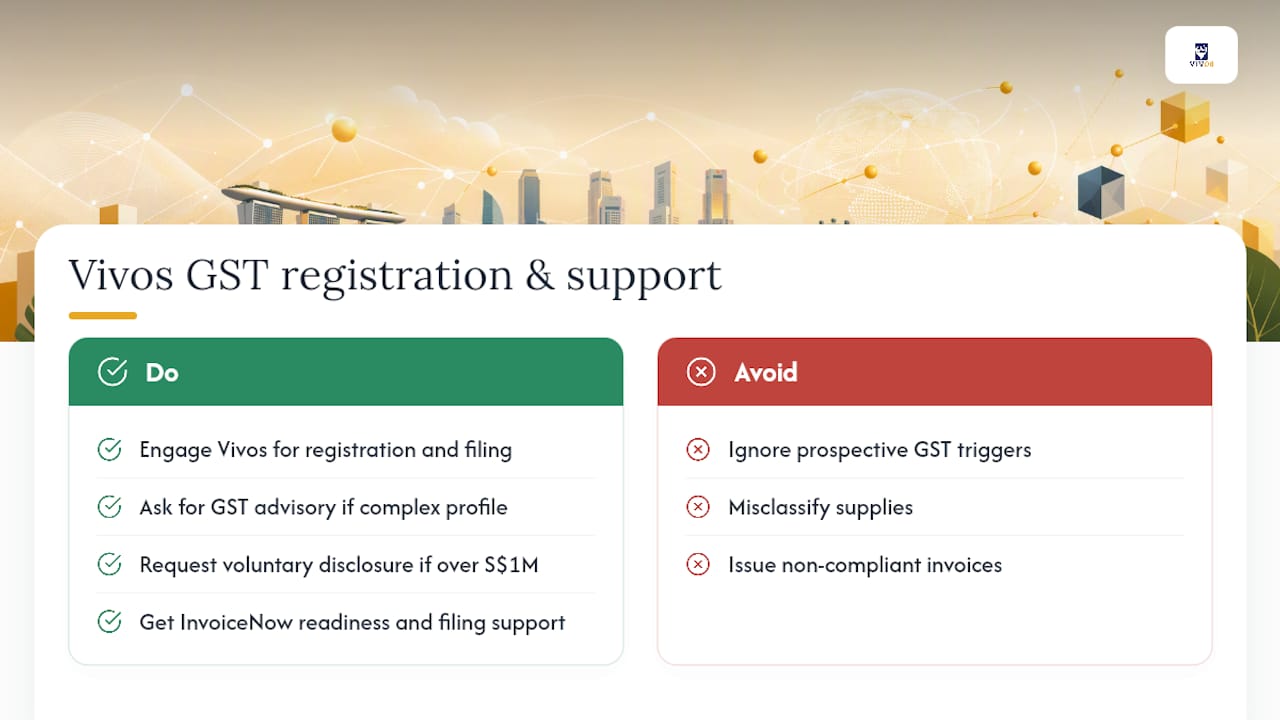
GST registration in Singapore carries real financial risk when handled incorrectly. Vivos offers GST registration and filing services that cover the full process: threshold assessment, application preparation, myTax Portal submission, e-Learning coordination, and GIRO setup. For businesses with more complex profiles, Vivos provides GST advisory services including voluntary registration cost-benefit analysis, InvoiceNow readiness planning, and ongoing filing support.
Vivos Pte. Ltd. is an ACRA Registered Filing Agent (Licence FA20240323) and MOM-licensed Employment Agency (Licence 24S2425), advising Singapore businesses on GST, incorporation, and compliance under one team.
The practical advantage is reduced penalty exposure and a correctly configured accounting setup from the start. Businesses that engage Vivos avoid the most common errors: missed prospective triggers, incorrect supply classification, and non-compliant invoicing. For businesses already past the S$1 million threshold without having registered, Vivos manages voluntary disclosure and backdated registration to minimize financial impact. Contact Vivos to assess your GST registration position and get the application right the first time.
Official IRAS resources to bookmark
The following IRAS pages and tools are the primary references for GST registration in Singapore:
GST Registration Number Verification (ClearTax): Explains how to verify or retrieve your GST registration number via myTax Portal after registration is confirmed.
This article is general information, not a substitute for advice from a qualified financial advisor. Consult a qualified financial professional about your own circumstances before acting on anything here.