Transfer Pricing in Singapore: 2026 Compliance Guide
Published: 23 July 2026
What is transfer pricing in Singapore?
Transfer pricing in Singapore is the application of the arm’s length principle to transactions between related parties, such as the sale of goods, provision of services, use of intangibles, and financial arrangements. The Inland Revenue Authority of Singapore (IRAS) enforces these rules to align profit taxation with genuine economic activity and value creation.
Key compliance principles under Singapore’s framework:
Related parties include any entities where one controls the other, or both are under common control, directly or indirectly. Branches and head offices are included.
Arm’s length principle: Transfer prices must reflect what unrelated parties would charge under comparable circumstances.
IRAS enforcement: Where related-party pricing understates profit, IRAS adjusts taxable income upward under Section 34D(1A) of the Income Tax Act 1947.
Local substance: Singapore entities must validate that group-wide transfer pricing policies satisfy IRAS guidelines at the entity level.
OECD alignment: Singapore’s framework follows OECD Transfer Pricing Guidelines, with local adaptations published in the Singapore Transfer Pricing Guidelines (currently the 8th Edition, issued November 2025).
What are the documentation requirements for transfer pricing?
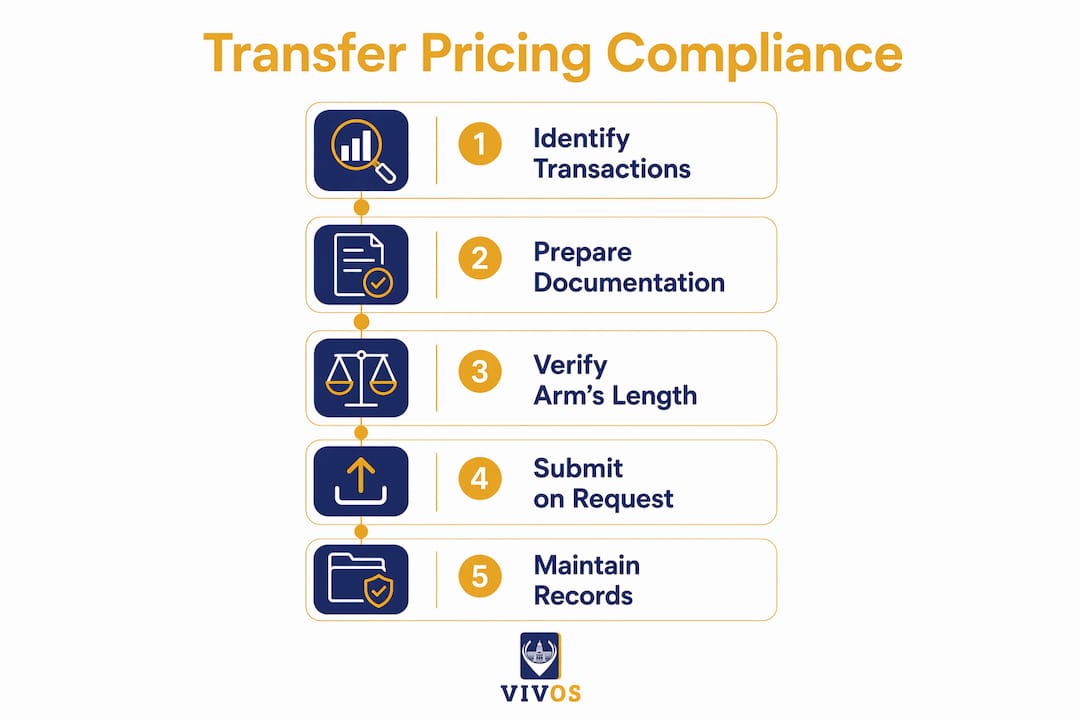
Contemporaneous transfer pricing documentation must be prepared before or by the corporate income tax filing deadline for the relevant financial year. Documentation prepared only after an audit begins is non-compliant and triggers penalties.
Required documentation content per the Income Tax (Transfer Pricing Documentation) Rules 2018:
Description of the business, industry, and related-party transactions
Functional analysis covering functions performed, assets used, and risks assumed
Transfer pricing method selected and rationale for its selection
Comparability analysis and benchmarking data
Arm’s length conditions and how the pricing satisfies them
Exemptions from mandatory documentation apply when:
Each party to the transaction is a Singapore taxpayer subject to the same tax rate
The transaction is a routine support service with a 5% cost mark-up applied
The transaction is covered by an Advance Pricing Arrangement (APA)
The total value of transactions in a category falls below prescribed thresholds
Taxpayers do not submit documentation with their tax return. IRAS may request it at any time, and submission is required within 30 days of that request.
What penalties apply for non-compliance with Singapore transfer pricing rules?
Non-compliance carries direct financial consequences. A surcharge applies on transfer pricing adjustments under Section 34E of the Income Tax Act 1947, regardless of whether additional tax is payable. The surcharge is calculated on the adjusted amount, not on the tax owed.
Additional consequences include:
Fines for failure to prepare or maintain required documentation
Double taxation risk when IRAS makes an adjustment that a foreign tax authority does not correspondingly relieve
Increased audit scrutiny for companies with inadequate or retrospective documentation
Recharacterization of transactions lacking economic substance, at IRAS’s discretion
Proactive documentation is the primary defense. Companies that cannot demonstrate arm’s length pricing face both the surcharge and the full adjustment to taxable income.
What are the ongoing compliance obligations for companies in Singapore?
Every Singapore entity transacting with related parties must apply the arm’s length principle consistently across all transaction types. This obligation applies regardless of whether the entity determines its own transfer prices or follows a group policy set by an overseas headquarters.
Core compliance responsibilities:
Apply arm’s length pricing to all related-party transactions, including goods, services, intangibles, and loans
Prepare and update contemporaneous documentation annually
Review group transfer pricing policies to confirm they satisfy IRAS guidelines at the Singapore entity level
Supplement group documentation with entity-level data where group files do not cover Singapore-specific facts
Singapore-headquartered multinational enterprises (MNEs) meeting prescribed conditions must file Country-by-Country (CbC) Reports with IRAS for financial years beginning on or after january 1, 2017
A Singapore subsidiary cannot simply rely on group documentation without verifying that it addresses the subsidiary’s specific transactions and functional profile.
How can companies prevent and resolve transfer pricing disputes in Singapore?
IRAS actively encourages early resolution through two formal mechanisms: Advance Pricing Arrangements (APAs) and Mutual Agreement Procedures (MAPs).
APAs are pre-emptive agreements with IRAS on the transfer pricing method for specific transactions over a defined period. They provide certainty and eliminate the risk of adjustment for covered transactions.
MAPs resolve cross-border disputes under Singapore’s tax treaties where double taxation arises from conflicting adjustments by two jurisdictions. Under the 8th Edition guidelines, companies may now submit a MAP request immediately within treaty timelines, without a mandatory pre-filing meeting.
Protective MAP applications are now explicitly recognized, allowing companies to preserve treaty timelines while pursuing domestic remedies concurrently.
Proactive documentation and regular policy reviews reduce the likelihood of disputes reaching the formal stage.
The APA and MAP processes are particularly relevant for MNEs with high-value or complex intercompany arrangements where pricing certainty has material tax implications.
What specific rules and concepts apply under Singapore’s transfer pricing guidelines?
Singapore’s guidelines include several practical rules that differ from generic OECD guidance:
5% cost mark-up for routine support services: Intra-group routine support services may apply a 5% mark-up on cost, provided the service is only provided to group entities and meets prescribed conditions.
Cost-pooling arrangements: No mark-up applies where costs are shared proportionately among related parties, subject to conditions including that the services are not provided to unrelated parties and the cost of provision does not exceed 15% of the service provider’s total expenses.
Strict pass-through costs: An invoice alone does not establish a pass-through arrangement. A written agreement or correspondence showing the related party is contractually obliged to bear the cost is required, and the documentation must explain why each item qualifies.
IRAS indicative margin for related-party loans: For loans not exceeding S$15 million, taxpayers may add the IRAS indicative margin to a base reference rate to derive an arm’s length interest rate. For domestic loans entered into on or after january 1, 2025, where neither party is in the lending business, this margin applies regardless of loan amount.
Capital transactions: Taxpayers must now substantiate why any gain, loss, or expense on a related-party transaction is capital in nature, with explicit documentation of the basis.
Which transfer pricing methods does IRAS recognize?
IRAS endorses five methods aligned with OECD guidelines. Taxpayers select the most appropriate method based on the facts and circumstances of each transaction.
Method
Best suited for
Comparable Uncontrolled Price (CUP)
Commodity transactions, loans, royalties with market comparables
Resale Price Method
Distribution arrangements where the reseller adds limited value
Cost Plus Method
Manufacturing and routine service arrangements
Transactional Net Margin Method (TNMM)
Complex transactions where traditional methods lack comparables
Singapore also permits other methods or combinations where they produce a more reliable arm’s length result. From january 1, 2026 through december 31, 2028, eligible distributors may elect the OECD Amount B Simplified and Streamlined Approach (SSA), which replaces detailed benchmarking with a prescribed return on sales for qualifying base-distribution activities.
How should you manage transfer pricing risk in Singapore?
Effective transfer pricing management in Singapore requires more than adopting a group policy. Local economic substance analysis, entity-level documentation, and annual reviews are the practical foundation of audit readiness.
Key practices:
Conduct Singapore-specific functional and comparability analyses, not just group-level studies
Maintain contemporaneous documentation updated before each tax filing deadline
Review intercompany agreements annually to confirm they reflect actual conduct
Assess whether group policies satisfy IRAS’s 8th Edition guidelines, particularly on capital transactions and pass-through costs
Engage local advisors for audit defense preparation and APA or MAP negotiations
Pro Tip:Document the business purpose of each intercompany arrangement explicitly. IRAS places significant weight on economic substance, and documentation that reads as a mechanical formula without commercial rationale is a common trigger for adjustment.
Vivos supports businesses with transfer pricing documentation, compliance reviews, and audit defense, drawing on deep familiarity with IRAS enforcement priorities and the 8th Edition guidelines.
Practical examples of common transfer pricing issues in Singapore
Scenario 1: Singapore subsidiary relying on group documentation. A Singapore entity uses its parent’s global transfer pricing study without verifying that it covers the subsidiary’s specific functions and risks. IRAS requests documentation and finds the group file does not address Singapore-level data. The entity faces a transfer pricing adjustment and the 5% surcharge.
Scenario 2: Intra-group service fee without a mark-up analysis. A Singapore company charges a related party for administrative support at cost, without applying the 5% mark-up or documenting that the arrangement qualifies as a cost-pooling arrangement. IRAS treats the pricing as non-arm’s length and adjusts the income upward.
Scenario 3: Related-party loan with no interest. A Singapore parent extends an interest-free loan to an overseas subsidiary. Under the 8th Edition guidelines, IRAS will not impute interest income on inbound interest-free loans to Singapore borrowers, but outbound arrangements require careful review of whether interest expenses funding the loan are deductible.
How do transfer pricing policies apply to different transaction types?
Transaction type determines both the appropriate pricing method and the documentation depth required.
Tangible goods: CUP is preferred where comparable market prices exist, particularly for commodities. The Singapore Transfer Pricing Guidelines (Special Topic) on Commodity Marketing and Trading Activities provide specific guidance.
Intangibles (royalties, licenses): Require detailed functional analysis of development, enhancement, maintenance, protection, and exploitation (DEMPE) functions. The Profit Split Method is often most appropriate where both parties contribute unique value.
Intra-group services: Routine services apply the 5% cost mark-up or cost-pooling rules. Non-routine or high-value services require a full arm’s length analysis with benchmarking.
Financial transactions (loans, guarantees): Interest rates must reflect arm’s length conditions. The IRAS indicative margin simplifies compliance for qualifying domestic loans; cross-border loans require full documentation unless an exemption applies.
For cross-border transactions, treaty relief and MAP access depend on maintaining documentation that satisfies both Singapore and the counterpart jurisdiction’s requirements.
What are the recent updates to Singapore’s transfer pricing regulations?
IRAS issued the 8th Edition Transfer Pricing Guidelines (TPG8) on november 19, 2025. Key changes effective for 2026:
Simplified documentation: Taxpayers may rely on prior-year contemporaneous reports (qualifying past TP documentation) for repeating transactions, with an explicit declaration of compliance.
Domestic loan relief: For domestic related-party loans entered on or after january 1, 2025, where neither party is in the lending business, IRAS will not make transfer pricing adjustments or require documentation, regardless of loan amount.
Amount B pilot: The OECD SSA for qualifying base-distribution activities is available from January 1, 2026 through December 31, 2028.
Capital transactions: Explicit requirement to document the basis for treating related-party transaction gains or losses as capital in nature.
Pass-through costs: Stricter evidence requirements, with invoices alone insufficient to establish a pass-through arrangement.
The 8th Edition guidelines reflect IRAS’s dual focus: compliance relief for low-risk routine arrangements, and tighter scrutiny on substance and documentation for complex transactions.
How does IRAS conduct transfer pricing audits and enforcement?
IRAS conducts Transfer Pricing Audits (TPAs) to review whether related-party transactions comply with the arm’s length principle and documentation requirements. The audit process follows a structured approach:
IRAS selects entities for review based on risk indicators, including high-value intercompany transactions, losses in Singapore entities, and inconsistencies between reported functions and pricing outcomes.
Upon selection, IRAS requests transfer pricing documentation within 30 days. Failure to produce compliant documentation within this period compounds the compliance risk.
Where pricing is found to be non-arm’s length, IRAS issues a transfer pricing adjustment under Section 34D, increasing taxable income and triggering the 5% surcharge under Section 34E.
IRAS retains authority to recharacterize or disregard transactions that lack commercial rationality or economic substance, particularly for hybrid instruments or arrangements structured primarily for tax outcomes.
Maintaining audit-ready documentation and conducting regular internal reviews of intercompany arrangements are the most effective ways to manage IRAS audit exposure.
Key Takeaways
Singapore’s transfer pricing framework requires arm’s length pricing, contemporaneous documentation, and local validation of group policies, with a 5% surcharge on adjustments for non-compliant entities.
Point
Details
Arm’s length principle
All related-party transactions must be priced as if between independent parties under comparable conditions.
Documentation timing
Contemporaneous documentation must be ready by the tax filing deadline, not after an audit begins.
5% surcharge
IRAS applies a 5% surcharge on transfer pricing adjustments under Section 34E, regardless of additional tax payable.
Local validation required
Group transfer pricing policies must be supplemented with Singapore entity-level analysis to satisfy IRAS guidelines.
8th Edition updates
TPG8 (november 2025) introduces domestic loan relief, simplified documentation rules, and the Amount B pilot from january 1, 2026.
Vivos provides end-to-end transfer pricing advisory services in Singapore, covering documentation preparation, compliance reviews, audit defense, and APA or MAP support. For businesses managing complex intercompany arrangements or preparing for IRAS scrutiny, Vivos’s advisory team offers practical, regulation-specific guidance aligned with the 8th Edition guidelines.
Contact Vivos to discuss your transfer pricing compliance requirements and how to structure your documentation for 2026.
Master the cap versus discount crossover. Calculate the $12.5M breakpoint from a $10M cap and 20% discount, model conversions, and avoid Singapore filing...
Which consulting niches need a licence in Singapore, PDPA obligations every consulting firm carries, and the SS 680:2021 standard that replaced TR 43:2015 for Enterprise…