


Audit Exemption Singapore: 2026 Guide for Directors

Learn about audit exemption in Singapore. Discover how your private company can qualify and the criteria to watch for in 2026.
Setting up a Pte Ltd in Singapore is a structured, government-regulated process administered by the Accounting and Corporate Regulatory Authority (ACRA) and completed primarily through the Bizfile portal. The Private Limited Company structure, formally a “private company limited by shares,” is the most widely used business entity for entrepreneurs and international investors in Singapore. Registration typically takes 1–3 business days for straightforward applications, with a government fee of S$300 payable online at submission.
Before you begin, prepare the following:
The mandatory requirements are non-negotiable: at least one locally resident director, a Singapore-based registered office address, and a company secretary appointed within six months of incorporation.
The Private Limited Company (Pte Ltd) is a private company limited by shares. It offers limited liability to shareholders, a separate legal identity, and the ability to hold assets and enter contracts in its own name. When you reserve your company name via Bizfile, you select the company type at that stage, and that selection must match the type used during full registration.

The Financial Year End is a separate but equally consequential decision. ACRA allows companies to set any date as their FYE, though December 31 and March 31 are the most common choices. The FYE determines when your Annual General Meeting (AGM) must be held and when corporate tax returns fall due. A poorly chosen FYE can create administrative bottlenecks, particularly if it coincides with peak operational periods.
Common FYE options and their implications:
Pro Tip: Select an FYE that falls during your business’s slower operational period. This gives your finance team adequate time to close accounts and prepare filings without competing with peak revenue activity.
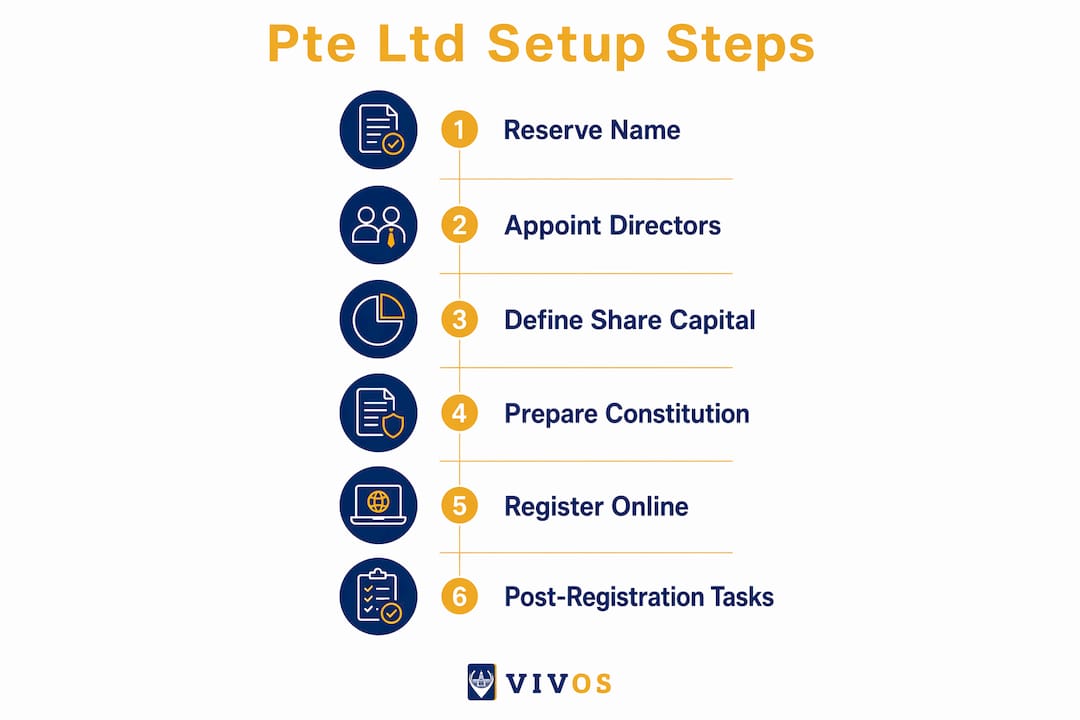
ACRA’s requirements for company officers and share structure are specific. Getting these right at the outset prevents costly amendments later.
Directors:
Shareholders:
Share capital:
Company secretary:
The company constitution is the foundational governance document for a Pte Ltd. It sets out the rules governing internal management, shareholder rights, director powers, meeting procedures, and share transfer restrictions.
During Bizfile registration, you have two options:
Key items typically covered in a constitution:
For most early-stage companies and startups, the model constitution is the practical choice. A customized constitution becomes necessary when institutional investors, venture capital terms, or multi-class share structures are involved.
The Bizfile portal is ACRA’s primary digital platform for company registration. Access requires a Singpass account for Singapore residents or a Corppass account for authorized corporate representatives and filing agents.
Step-by-step registration process:
| Required Detail | Description |
|---|---|
| Company name | Pre-reserved via Bizfile; must match registration type |
| Registered office address | Physical Singapore address; publicly accessible during business hours |
| Financial Year End | Any date; determines AGM and tax filing deadlines |
| Director details | Full name, ID/passport number, residential address, nationality |
| Shareholder details | Full name or company name, ID/UEN, share allotment |
| Company secretary details | Name, ID, Singapore residential address |
| Share capital | Total shares, paid-up amount, share class |
| Constitution | Model constitution or uploaded custom document |
Endorsement timeline: When an application is filed directly by the company (not through a registered filing agent), all appointed officers and shareholders must endorse the registration within 60 days. When a registered filing agent submits the application on the company’s behalf, this endorsement requirement is automatically waived, accelerating the process considerably.
Most straightforward applications are approved within 1–3 business days. Applications requiring referral to external authorities, such as the Ministry of Education or the Monetary Authority of Singapore for regulated activities, can take up to 60 days.

Incorporation is the starting point, not the finish line. A Pte Ltd in Singapore carries ongoing statutory obligations from day one.
Immediate post-registration priorities:
Ongoing compliance obligations:
Non-compliance with ACRA requirements can result in financial penalties, director disqualification, or striking off the company. Appointing a qualified corporate secretary from the outset is the most reliable way to stay current with all deadlines.
The FYE decision deserves more deliberation than most founders give it. Beyond the basic compliance implications, FYE selection directly affects cash flow timing, tax payment schedules, and the administrative load on your finance function.
A company with a December 31 FYE must file its ECI by March 31 of the following year, a period when accounting firms are at peak capacity. A March 31 FYE, by contrast, spreads the workload more evenly and often results in faster turnaround from service providers.
For companies with a parent entity overseas, aligning the Singapore FYE with the parent’s reporting period simplifies consolidated financial reporting and reduces the risk of intercompany reconciliation errors. For standalone businesses, the more practical consideration is operational rhythm: avoid setting an FYE during your busiest trading months.
Common pitfalls to avoid:
Pro Tip: Consult a corporate advisory professional before finalizing your FYE. A one-time advisory session can prevent years of avoidable compliance friction and misaligned tax payment timing.
Incorporating a Pte Ltd involves precise sequencing, statutory deadlines, and regulatory details that vary by industry and ownership structure. Vivos provides end-to-end Singapore company incorporation services, covering name reservation, Bizfile submission, constitution preparation, officer appointments, and post-registration compliance, all handled by a team with direct experience in ACRA requirements.
As a registered filing agent, Vivos automatically waives the 60-day endorsement requirement for company officers, cutting weeks off the typical incorporation timeline. Beyond incorporation, Vivos supports corporate secretarial compliance, corporate advisory, banking facilitation, and tax filing, giving founders a single point of contact for the full setup process.
Entrepreneurs who want their Pte Ltd structured correctly from day one, without navigating ACRA’s requirements alone, can start by contacting Vivos directly at vivos.com.sg/singapore.
Setting up a Pte Ltd in Singapore requires at least one locally resident director, a minimum paid-up capital of SGD 1, a registered Singapore office address, and registration via ACRA’s Bizfile portal with a government fee of S$300.
| Point | Details |
|---|---|
| Government registration fee | S$300, paid online at submission via Bizfile |
| Minimum paid-up capital | SGD 1 is sufficient to incorporate a Pte Ltd in Singapore |
| Resident director requirement | At least one director must be ordinarily resident in Singapore |
| Company secretary deadline | Must be appointed within six months of incorporation |
| Vivos incorporation support | Vivos handles end-to-end Pte Ltd setup as a registered ACRA filing agent, waiving the 60-day endorsement requirement |

 2 January, 2025
 2 January, 2025
Learn about audit exemption in Singapore. Discover how your private company can qualify and the criteria to watch for in 2026.

Learn about capital reduction in Singapore in 2026. Understand the methods, requirements, and benefits for your company. Get compliant today!

Discover the essential guide to seed funding in Singapore for startups. Learn about key players and strategies to secure early-stage capital.