
新加坡就业准证(EP)2027年门槛上调:创始人应在2026年还是2027年申请?按年龄计算

Ray Tay
2027年1月1日起EP薪资门槛上调:35岁从8,382新元升至9,000新元,45岁以上从10,700升至11,500新元。按MOM时程推算,2026年规则下最迟何时启动。
Published: 30 September 2026 · Reviewed by Ray Tay, Co-Founder & Managing Director, VIVOS PTE. LTD. (ACRA Filing Agent FA20240323 · MOM EA Licence 24S2425)
A Singapore private company is audit-exempt as a “small company” if it meets at least two of three criteria for the past two financial years: revenue not above S$10 million, total assets not above S$10 million, and no more than 50 employees. Group companies assess these thresholds group-wide, not entity by entity. This is set out under the Companies Act and ACRA guidance, as of 2026.
TL;DR:
- The small company exemption covers firms with at least two of three criteria: revenue, assets, and employee count, assessed over two years on a group-wide basis for groups.
- A company loses exemption if it breaches two of the three thresholds for two consecutive years on a consolidated basis, especially when part of a group with overseas subsidiaries.
- When audits are required, directors must appoint an auditor within three months of setup, and first-year audits involve verifying opening balances without prior audit history.
- Auditors have rights to full access to records and must follow Singapore Standards on Auditing, with recent amendments strengthening reporting and cooperation requirements.
- Dormant companies with no significant transactions may be exempt from preparing or filing statements, but failure to comply can lead to penalties or directives from the Registrar.
Every Singapore company, private or public, must prepare financial statements. Unless a specific exemption applies, those statements must be audited before being tabled at the annual general meeting, under requirements set out in the Companies Act 1967.
Certain company types cannot rely on the small-company exemption regardless of size:
Dormant companies sit apart from this test entirely. A dormant company with no significant accounting transactions may qualify for its own exemption from preparing financial statements, separate from the small-company route. For most new companies set up by foreign founders, the small-company exemption is the relevant path, and most qualify in their first two years simply because revenue and headcount start low. Directors weighing the two routes can review the audit exemption criteria in more detail before assuming either applies automatically.
The exemption rests on three measurable criteria, checked against the immediate past two consecutive financial years. Revenue and total assets are read from the financial statements; employee count is a headcount of full-time staff at financial year end.
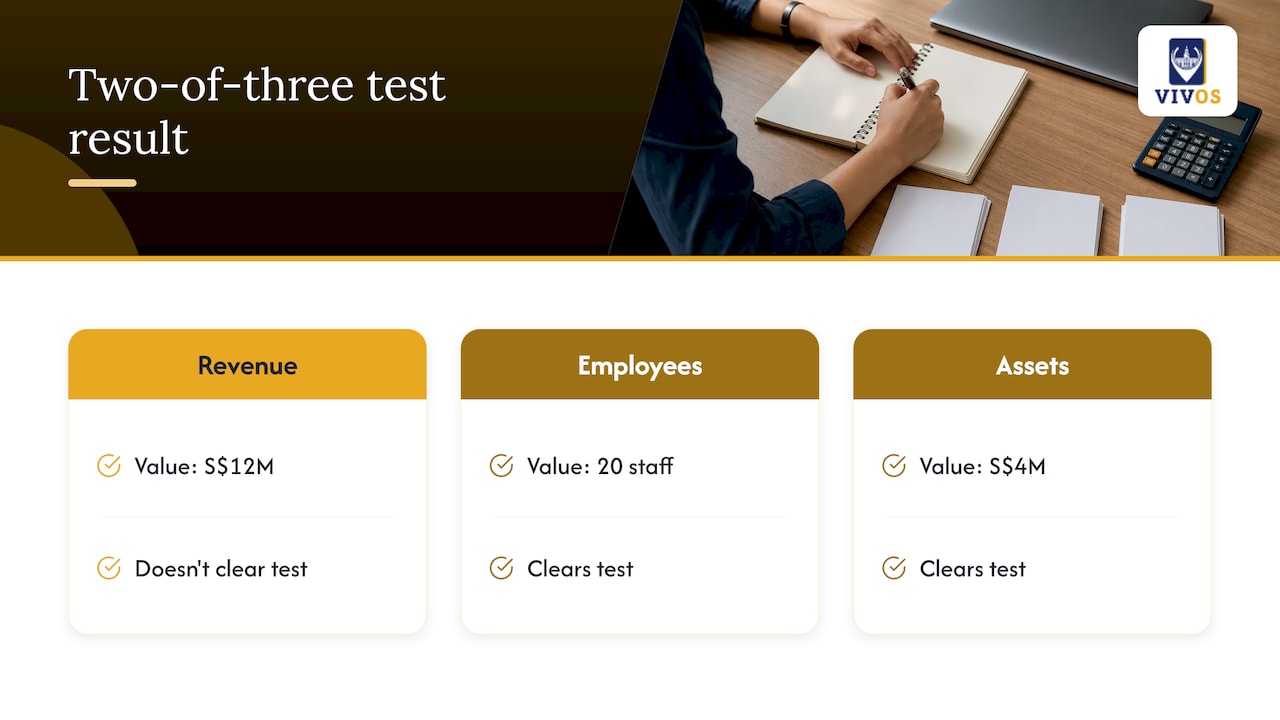
A company needs to satisfy only two of the three. A company with S$12 million in revenue but 20 staff and S$4 million in assets still qualifies, because it clears the asset and employee tests.
Pro Tip: A brand-new company has no prior financial year to compare, so ACRA treats its first financial year on its own merits: qualifying then usually locks in exemption for year two as well, provided the figures hold.
For companies that are part of a group, the test applies on a consolidated basis. Revenue, assets, and employee counts are aggregated across the parent and all subsidiaries, not assessed company by company.
Founders running a Singapore holding structure with overseas operations often miss this rule, assuming each entity is judged on its own. A closer look at how group-wide assessment works helps avoid a late surprise at year-end.
When a company cannot claim the exemption, the appointment clock starts early.
Pro Tip: Ask any auditor for a written scope and fee proposal before engagement: the condition of your books, transaction volume, and whether it’s a first-year audit all move the price, and a clear scope avoids mid-engagement surprises.
Directors juggling incorporation deadlines alongside auditor appointment often find it easier to hand off compliance dates to a corporate secretary who tracks the full compliance calendar for AGM and filing dates.
Under the Companies Act, an auditor’s core duty is to report on whether the financial statements comply with Accounting Standards and give a true and fair view of the company’s position. Auditors also hold statutory rights of access to company records and a duty to report certain breaches to the Registrar.
Auditor rights of access and reporting duties have been strengthened under recent amendments to the Companies Act, which means slow cooperation with an auditor now carries a higher risk of a statutory notice or Registrar inquiry.
Companies seeking relief from specific accounting standard or form-and-content requirements can apply to ACRA directly, though relief from the standards themselves is granted only in limited circumstances and carries its own administrative timeline and fee.
A dormant company with no significant accounting transactions during a financial year, and that meets the substantial-assets test, may be exempt from preparing and filing financial statements altogether under ACRA’s XBRL filing guidance.
A corporate service provider can offer Singapore company incorporation for foreign founders, including nominee resident director services, a registered address, corporate secretary support, and accounting and audit liaison, alongside equivalent services in Malaysia, Hong Kong, and UAE. For a founder setting up a first Singapore entity, that combination covers the typical services needed from an accountant, a secretarial firm, and a separate registered office provider.
A lot of founders assume audit exemption means no paperwork at all. It means less paperwork, done correctly, on time.
Ray Tay, Managing Director of VIVOS
Founders often bring in a corporate services firm at first-year setup, when XBRL formats and AGM deadlines are unfamiliar, or once group consolidation across two or more jurisdictions makes the exemption test harder to track alone.
Most guidance on audit exemption in Singapore stops at the two-of-three test and treats the job as done. That undersells the actual risk for a foreign founder’s new company: qualifying for exemption is not a permanent status, it is a rolling check against two years of figures, and a strong second year of revenue can quietly push a company back into audit territory without anyone noticing until the AGM deadline is close.
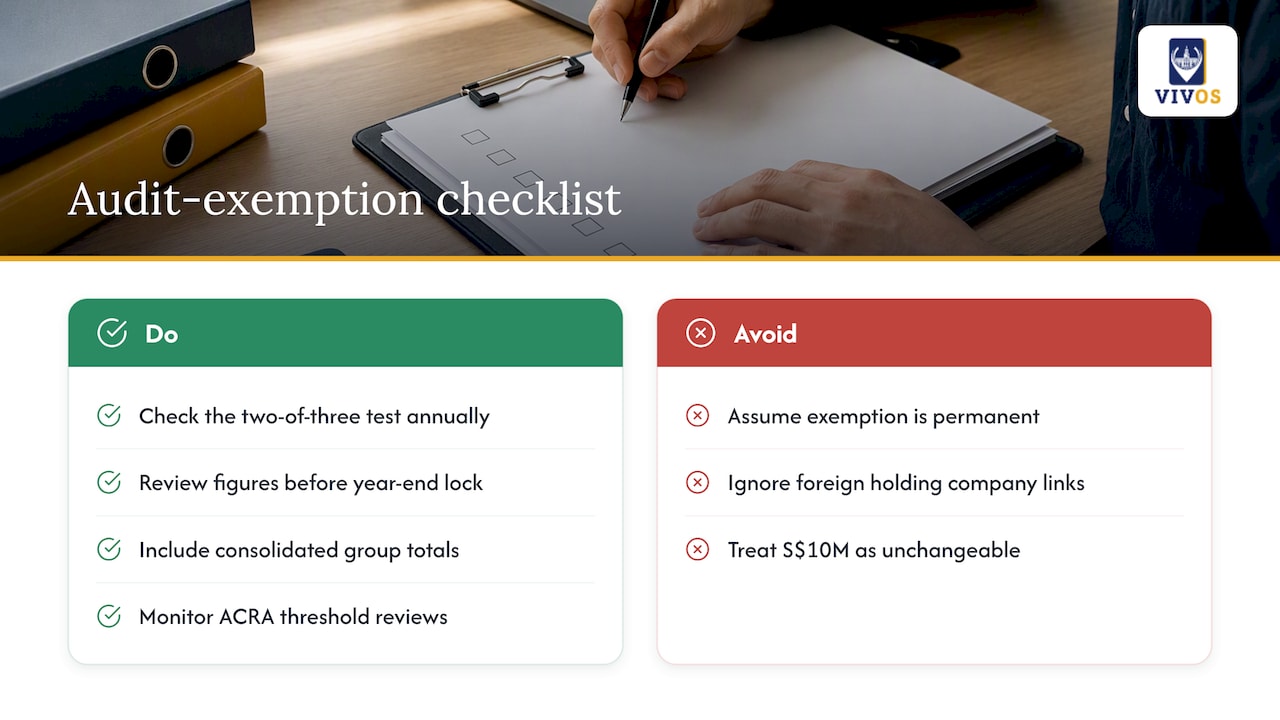
The bigger gap is in group structures. Founders who set up a Singapore holding company alongside an operating entity abroad often assume each entity stands alone, when the consolidated test can erase an otherwise clean exemption. ACRA has also flagged that the thresholds themselves are under review, so treating today’s S$10 million figure as fixed for the life of the company is a mistake.
The practical priority for a new director is not memorizing the test, it is building a habit of checking it every financial year end, before the figures are locked in and options run out.
— Ray
Working out whether your company needs an audit is one part of a longer compliance chain that starts with incorporation and runs through every AGM. VIVOS handles that chain end to end for foreign founders, from company setup and nominee director services to bookkeeping, XBRL preparation, and audit liaison, so directors are not tracking three separate providers for one set of statutory deadlines.
If your company is approaching its first or second financial year end, check current pricing for incorporation and corporate secretarial services and request a compliance readiness review before the deadline arrives.
Auditors in Singapore follow the Singapore Standards on Auditing issued through ISCA, which set the documentation, evidence, and reporting expectations for every statutory audit. Financial statements themselves are prepared under the applicable Accounting Standards framework, typically SFRS(I).
No. A private company that qualifies as a small company under ACRA’s test is exempt from statutory audit, while public companies and groups that breach the thresholds are not. Dormant companies have a separate exemption from preparing financial statements altogether.
An auditor needs access to the company’s ledgers, bank confirmations, statutory registers, and prior-year opening balances, along with a formal appointment made within three months of incorporation under the Companies Act. The audit itself follows planning, fieldwork, and reporting phases before the auditor issues a signed report ahead of the AGM.
A statutory audit is mandatory for any Singapore company that fails the small-company exemption test or is a public company, under the Companies Act’s financial reporting requirements. Companies within a group are judged on a consolidated basis, so a subsidiary that looks small on its own can still require an audit if the wider group exceeds the thresholds.
 2 January, 2025
 2 January, 2025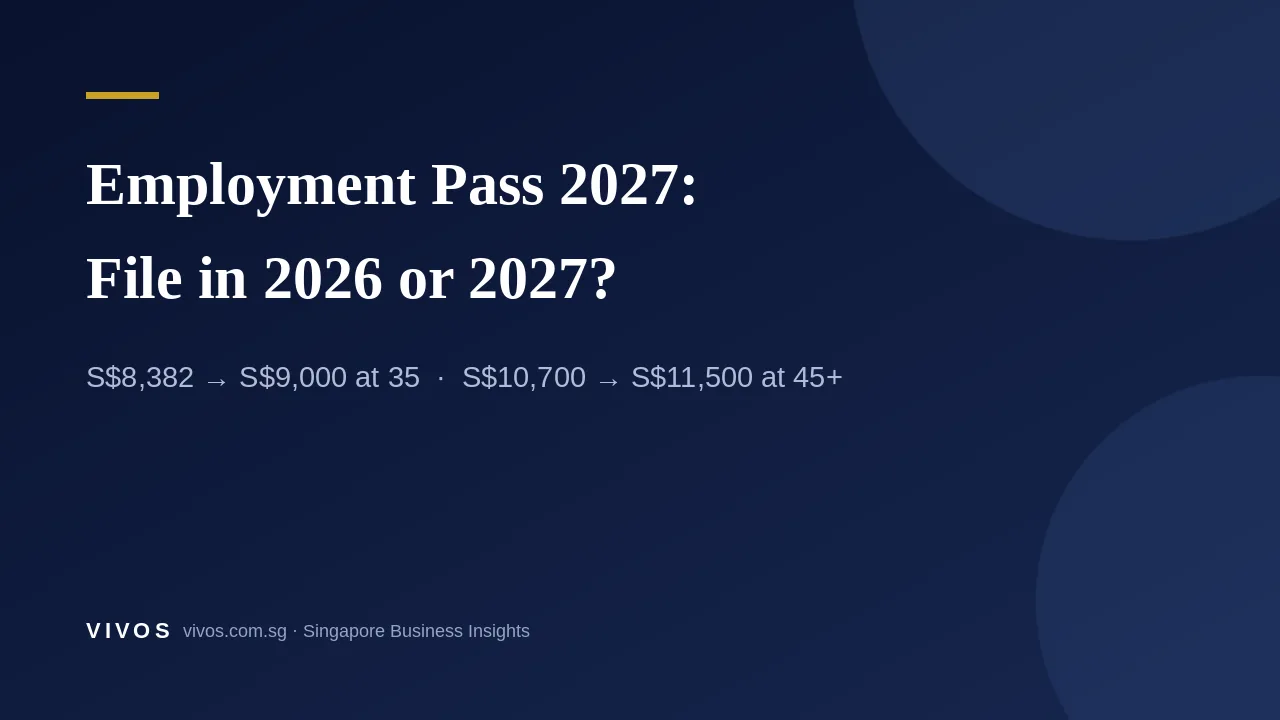
2027年1月1日起EP薪资门槛上调:35岁从8,382新元升至9,000新元,45岁以上从10,700升至11,500新元。按MOM时程推算,2026年规则下最迟何时启动。
EP bar rises 1 Jan 2027: S$8,382→S$9,000 at 35, S$10,700→S$11,500 at 45+. The latest realistic start date to file under 2026 rules, from MOM's own…

Founder guide to Singapore's COMPASS framework: how to hit the 40 point pass, meet S$5,600/S$6,200 salary rules, and fix borderline EP applications.