

新加坡就业准证(EP)2027年门槛上调:创始人应在2026年还是2027年申请?按年龄计算

Ray Tay
2027年1月1日起EP薪资门槛上调:35岁从8,382新元升至9,000新元,45岁以上从10,700升至11,500新元。按MOM时程推算,2026年规则下最迟何时启动。
Published: 29 September 2026 · Reviewed by Ray Tay, Co-Founder & Managing Director, VIVOS PTE. LTD. (ACRA Filing Agent FA20240323 · MOM EA Licence 24S2425)
COMPASS is Singapore’s Complementarity Assessment Framework for Employment Passes. Applicants need 40 points to pass and must first clear the EP qualifying salary, currently S$5,600 general and S$6,200 for financial services, as of 2026. MOM administers the framework, and the Self-Assessment Tool (SAT) and Workforce Insights (WFI) let employers check scores before filing.
TL;DR:
- Candidates earning less than S$5,600 monthly (or S$6,200 for financial services) must meet the sector-specific salary benchmark before scoring in COMPASS.
- A firm’s diversity and local employment scores depend on CPF contribution data and change with each new hire, affecting overall COMPASS points.
- Exemptions apply for salaries of S$22,500 or more, intra-corporate transferees, and short-term roles of less than one month, simplifying application requirements for these groups.
- Achieving a high qualification verification score and adjusting salary offers above the benchmark early can prevent rejection delays for borderline applicants.
- Structuring the company correctly at incorporation, including sector classification and director arrangements, improves COMPASS scores for founder EP applications.
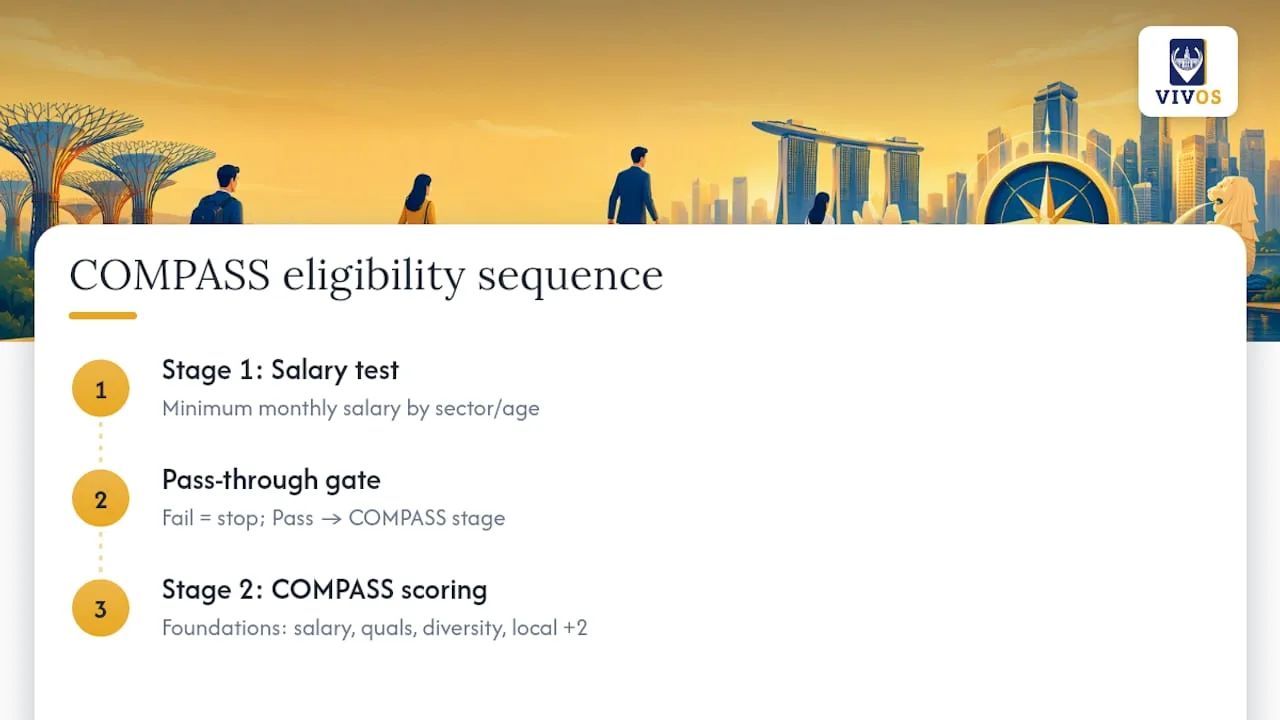
COMPASS operates as the second stage in a two-part eligibility check. Stage 1 is the qualifying salary test. Every Employment Pass candidate must earn at least the minimum monthly salary set for their sector and age band. Stage 2 is COMPASS itself: a points system that scores the candidate and the hiring firm across salary, qualifications, workforce diversity, and support for local employment. Only candidates who clear Stage 1 are assessed against Stage 2.
The framework was built to replace subjective case-by-case judgment with a transparent points structure. According to EDB’s explainer on COMPASS, the goal was to give employers predictability in manpower planning while protecting opportunities for local professionals, managers, executives, and technicians (PMETs). COMPASS assesses four foundational criteria and two bonus criteria, and it lets firms model an outcome before committing to a hire.
COMPASS applies to new Employment Pass applications filed from September 2023 onward, with renewals phased in afterward. It sits alongside, not instead of, the existing qualifying salary rule. That sequencing matters for foreign founders: a candidate who fails the salary test never reaches the COMPASS scoring stage, no matter how strong their qualifications or firm profile look on paper. Getting Stage 1 right is the precondition for everything that follows, and founders can benefit from consultant SEO services to build their online authority and enhance their business presence during relocation.
For founders relocating to Singapore, this two-stage structure changes how a hiring plan should be built. Salary offers, company structure, and even the timing of the first few hires all feed into a score that MOM calculates automatically from CPF and application data.
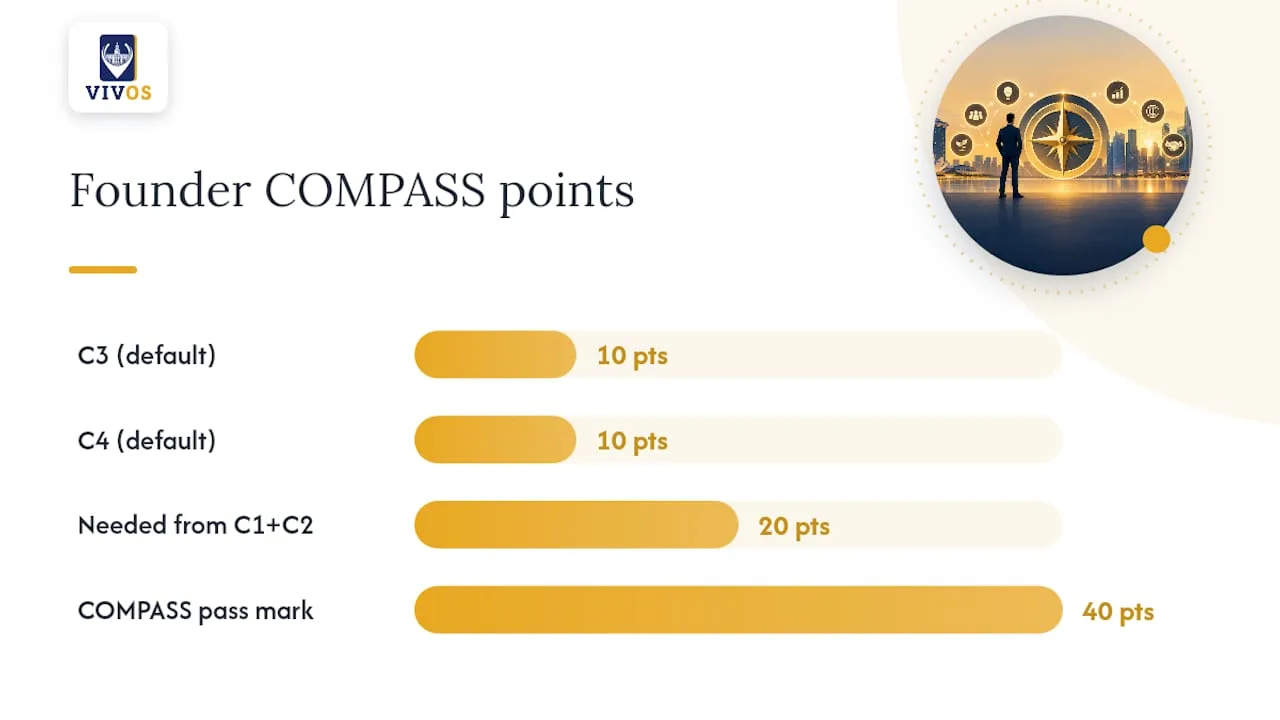
The pass mark is 40 points. Each foundational criterion is banded into 0, 10, or 20 points, so a candidate who scores well across salary, qualifications, firm diversity, and local employment support can clear the bar on foundational criteria alone.
Two conditions exempt applicants from COMPASS entirely. Candidates earning a fixed monthly salary of S$22,500 or more are exempt, as are intra-corporate transferees under trade agreements and applicants filling roles of 1 month or less. Since COMPASS took effect in 2023, about 10% of successful EP applicants have qualified for exemption rather than being scored.
One nuance catches applicants off guard: the Skills Bonus criterion pays up to 20 points for candidates matched to a shortage occupation, but that bonus is halved to 10 points when the candidate’s nationality already makes up a third or more of the firm’s PMET headcount. A firm that has hired heavily from one nationality will find this bonus worth less than it expects.
COMPASS scores four foundational criteria (C1 to C4) and two bonus criteria (C5 and C6). Each foundational criterion is banded 0, 10, or 20 points; bonus criteria add extra points on top when conditions are met.
| Criterion | 0 points | 10 points | 20 points |
|---|---|---|---|
| C1: Salary | Below sector/age benchmark | Meets benchmark | Well above benchmark |
| C2: Qualifications | Unverified or below degree level | Degree from a recognized institution | Degree from top-tier institution |
| C3: Diversity | Nationality dominates PMET pool | Moderate diversity | Broad diversity |
| C4: Local employment support | Low local PMET share | Moderate local PMET share | Strong local PMET share |
| C5: Skills Bonus | Not applicable | 10 points (nationality share at or above one third) | 20 points (nationality share below one third) |
| C6: Strategic Economic Priorities Bonus | Not applicable | Not applicable | 10 points if firm is on MOM’s supported list |
C1 salary points depend on published sector-specific benchmarks that rise with the candidate’s age, so a 35-year-old and a 45-year-old in the same role face different thresholds. C2 qualification points require the degree to be verified through a recognized process; an unverified credential scores zero regardless of the institution’s reputation.
C3 and C4 are calculated at the firm level, not the individual level, using CPF contribution data pulled through Workforce Insights. A firm’s diversity and local employment ratios shift every time it hires, which means these two scores move independently of the specific applicant.
The bonus criteria carry conditions worth checking before relying on them:
Founders launching a new Singapore entity face a structural quirk in C3 and C4. Firms with fewer than 25 PMETs receive a default 10 points on both criteria automatically. This protects a brand-new company with one or two employees from being penalized for a skewed nationality ratio it has not had time to correct. It also means a small firm starts with 20 points banked before touching salary or qualifications, but still needs another 20 points from C1 and C2 alone to clear the 40-point pass mark.
That default is generous, but it is not where founder applications usually fail. The weak points tend to sit elsewhere:
Pro Tip: Set the founder’s own EP salary comfortably above the sector benchmark before incorporating, since correcting a low C1 score later means amending payroll and refiling.
The practical implication for early hiring strategy: a founder who plans the first three or four hires around COMPASS math, rather than around convenience, arrives at the EP stage with a much stronger score.
A borderline score is fixable when addressed before submission rather than after a rejection.
A borderline score, corrected before submission, avoids the delay of a rejected application and a refiled case weeks later, based on MOM’s guidance that qualification failures and adverse records are common, avoidable causes of rejection.
Budget 2 to 3 weeks for qualification verification and salary adjustment, and treat the SAT output as a checklist rather than a formality.
MOM’s Self-Assessment Tool and Workforce Insights are both accessed through EP eService with a Corppass login, and both draw on the firm’s existing CPF records to estimate a score before an application is filed.
Using SAT and WFI together before filing turns COMPASS from a guessing game into a checklist a founder can work through methodically.
Three groups skip COMPASS scoring entirely: candidates earning a fixed monthly salary of S$22,500 or more, intra-corporate transferees moving under trade agreements, and applicants filling short-term roles of one month or less. Each exemption still requires the underlying qualifying salary test to be met first.
Processing times differ sharply by firm history. Established Singapore entities with a filing track record typically see decisions within about 10 business days, while new or overseas-registered firms should expect up to six weeks. A founder incorporating and filing an EP application in the same window should plan around the longer timeline, not the shorter one.
Failing qualification verification or having an adverse compliance record does not just cost points. It can trigger a rejection outright, regardless of how the COMPASS score would otherwise land, since MOM treats verification integrity as a threshold issue rather than a scoring input.
Founder Employment Pass applications tend to fail on structure, not on the individual’s merit. Ray Tay, Managing Director of VIVOS, points to a recurring pattern:
That pattern is fixable at the incorporation stage rather than the filing stage. A company incorporation provider offers Singapore company incorporation for foreign founders, nominee resident director, registered address, corporate secretary, plus EP application support, and also covers Malaysia, Hong Kong and UAE. Getting the entity structure, sector classification, and director arrangement right before the EP application is filed removes several of the common causes of a low COMPASS score before they happen.
— Ray
Founders relocating to Singapore rarely need just an EP filing. They need a company that is structured correctly from day one, so the COMPASS score reflects the business, not an avoidable setup error. A company incorporation provider offers Singapore company incorporation for foreign founders, nominee resident director, registered address, corporate secretary, plus EP application support, and also covers Malaysia, Hong Kong and UAE.
Before filing, prepare:
| Service | What it covers | Starting price |
|---|---|---|
| Foreign-founder incorporation | Full company setup for non-resident founders | S$4,600 one-off |
| Nominee director renewal | Ongoing local director requirement | S$3,000 per year |
| Corporate secretary | Statutory filing and compliance | S$800 per year |
| Employment Pass / visa filing | EP application preparation and submission | S$2,000 one-off |
Full pricing for these packages, including incorporation and secretarial services, is listed on the VIVOS pricing page. Founders who want to see how their planned salary and firm structure would score before incorporating can also review the COMPASS points checker alongside their setup plan.
COMPASS is the points system MOM uses to assess Employment Pass applicants after they clear the qualifying salary test. Applicants and their firms are scored across salary, qualifications, workforce diversity, and support for local employment, and need 40 points to pass.
The EP qualifying salary that candidates must meet before COMPASS scoring applies is S$5,600 a month for most sectors and S$6,200 for financial services, as of 2026, rising with age. Candidates earning S$22,500 or more are exempt from COMPASS scoring entirely.
The COMPASS test scores an Employment Pass applicant and their hiring firm across four foundational criteria, salary, qualifications, workforce diversity, and local employment support, plus two optional bonus criteria for shortage-occupation skills and strategic economic priorities. A score of 40 points or more is required to pass.
COMPASS stands for the Complementarity Assessment Framework, the system MOM uses to evaluate Employment Pass applications against Singapore’s manpower planning goals. It was introduced to make EP outcomes more transparent and predictable for employers and candidates alike.

 2 January, 2025
 2 January, 2025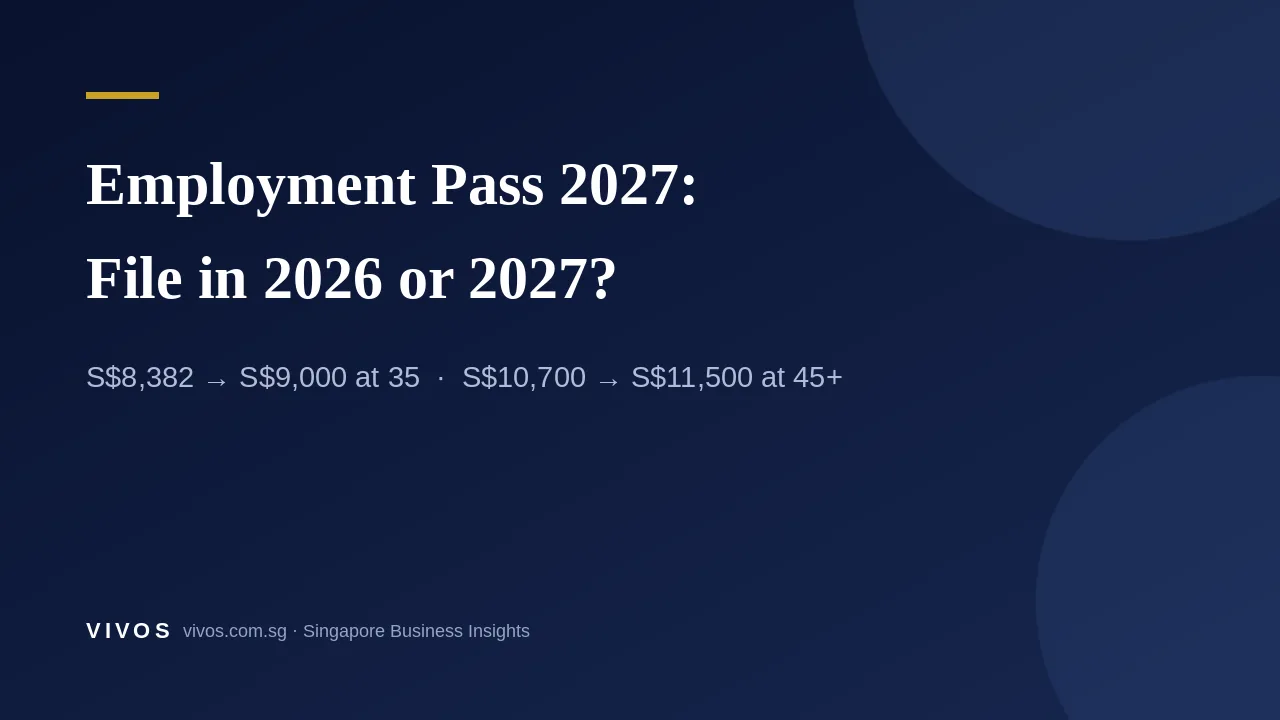
2027年1月1日起EP薪资门槛上调:35岁从8,382新元升至9,000新元,45岁以上从10,700升至11,500新元。按MOM时程推算,2026年规则下最迟何时启动。
EP bar rises 1 Jan 2027: S$8,382→S$9,000 at 35, S$10,700→S$11,500 at 45+. The latest realistic start date to file under 2026 rules, from MOM's own…

Step-by-step BizFile+ checkout, verification and certification tips, the fields banks and embassies inspect, and red-flag checks for Singapore founders.