Secure Singapore PR: 3 Global Investor Programme Routes Compared
Published: 21 September 2026
The Global Investor Programme (GIP) grants Singapore Permanent Residence to qualifying investors who commit substantial capital through one of three defined routes: a new or existing Singapore business, a GIP-select fund, or a Singapore-based single family office. Each route carries its own minimum, which as of 2026 are set by EDB at approximately S$10 million for Option A, approximately S$25 million for Option B, and S$200 million in assets under management for Option C. These thresholds and conditions are revised periodically, so confirm the current figures directly with EDB before committing capital.
TL;DR:
The investment thresholds for GIP options vary from approximately S$10 million for business investment to S$200 million in assets under management for family offices, with ongoing revisions; applicants must confirm current figures with EDB.
Successful GIP applicants typically have a verified business history, active managerial roles, and detailed operational plans with specific hiring, revenue, and investment milestones, not just passive capital.
The application process requires thorough documentation, including financial statements, source-of-funds proof, and business plans, with applicant eligibility closely evaluated based on background and purpose-driven investment strategies.
Investors must maintain their investment commitments after approval, as ongoing proof of deployment, employment, and physical ties is necessary for PR renewal, with lapses risking loss of status.
GIP is ideal for building a regional headquarters or family office with a real Singapore operational footprint, but less suitable for quick PR through smaller or passive investments, which are better served by other visa routes.
Vivos
Plan Your Singapore Business Setup
VIVOS helps international entrepreneurs navigate incorporation, compliance, banking, accounting, taxation, and corporate advisory in Singapore.
The GIP exists to attract capital that creates jobs, deepens Singapore’s business ecosystem, and draws regional headquarters onto the island. It is not a passive investment visa. Every route requires the applicant to play an active role in deploying capital toward outcomes EDB can measure: hires, business spend, and local footprint.
Singapore’s EDB administers the programme through Contact Singapore, screening applications, evaluating business plans, and issuing the Approval in Principle (AIP) that lets an applicant proceed to invest. The Immigration & Checkpoints Authority (ICA) handles the final step, issuing the actual PR status once EDB confirms the investment has been made as promised.
Policy direction has shifted in recent years toward rewarding applicants who root real economic activity in Singapore rather than parking money offshore. EDB’s own guidance makes this explicit:
Economic contribution and regional headquarters attraction sit at the center of the programme’s design.
EDB and Contact Singapore review and approve applications before any capital moves.
ICA finalizes the actual grant of permanent residence after investment is verified.
Recent adjustments emphasize local deployment, quality hiring, and demonstrable business substance over passive capital parking.
For entrepreneurs weighing whether GIP fits their situation, this is the first filter: are you prepared to build or fund something real in Singapore, not just wire money and wait — or do you need to boost your business Mandarin skills for success in Singapore?
How Much Must I Invest for Singapore PR?
The GIP offers three routes, and the right one depends less on how much capital you have and more on how you want to deploy it.
Option A requires roughly S$10 million invested into a new or existing Singapore business. Applicants must show a credible business plan, meaningful local hiring, and satisfaction of Total Business Expenditure (TBE) conditions that prove the money is actually working inside the company, not sitting in a holding account.
Option B requires roughly S$25 million placed into a GIP-select fund. These funds carry their own qualifying bar. Fund managers need a demonstrated track record and must commit a minimum share of capital into Singapore-based investments, which EDB screens before adding a fund to the approved list.
Option C requires setting up a single family office in Singapore with at least S$200 million in assets under management, of which a minimum of S$50 million must be deployed into EDB-specified investment categories.
Route
Minimum Commitment
Vehicle
Core Condition
Option A
≈S$10 million
New or existing Singapore business
Hiring and TBE milestones tied to local operations
Option B
≈S$25 million
GIP-select fund
Fund must meet EDB track record and local deployment rules
Option C
S$200 million AUM
Singapore single family office
At least S$50 million deployed into EDB-specified investments
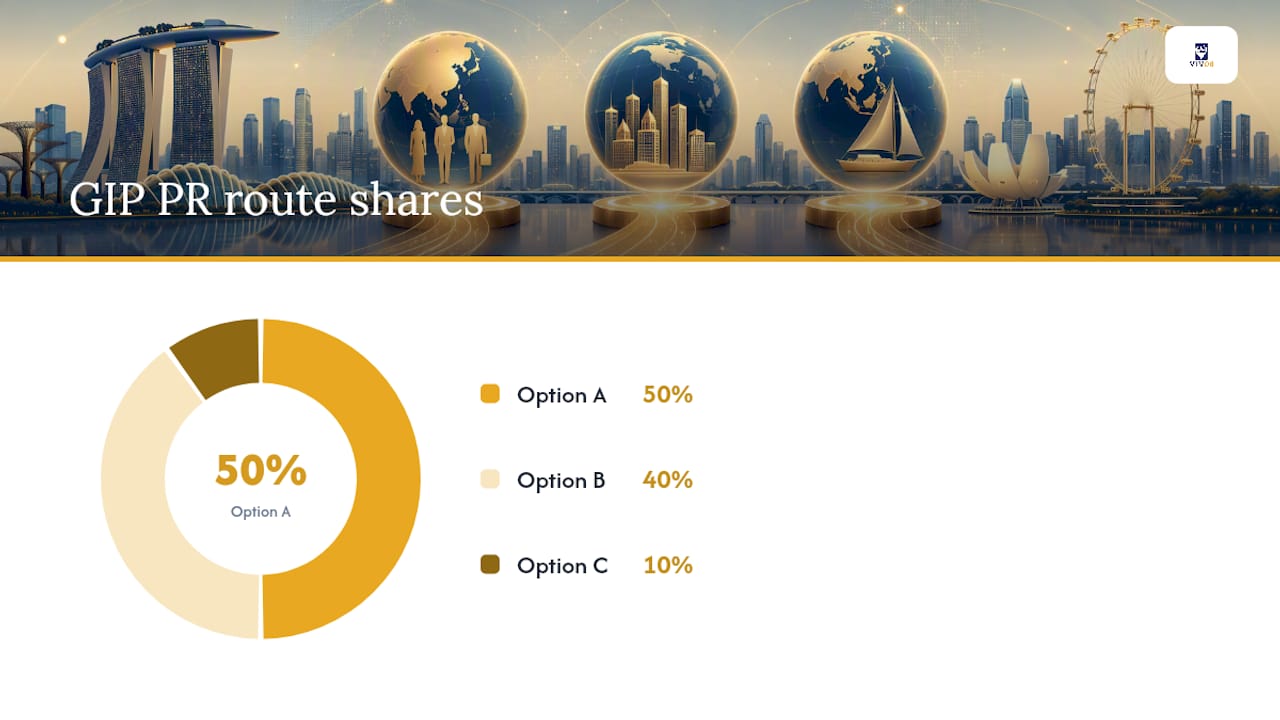
Once EDB issues the AIP, applicants generally have a six-month window to complete the actual investment and submit evidence. Miss that window without an approved extension, and the AIP lapses. Since 2015, about 450 individuals have been granted PR through GIP, with roughly half choosing Option A, 40% Option B, and 10% Option C, a split that tells you Option A remains the most accessible path for active operators.
Which GIP Route Suits My Profile?
EDB does not evaluate applications purely on bank balance. It looks at whether your background, business history, and stated plans actually align with the route you’re pursuing.
Three profiles show up repeatedly among successful applicants:
Established business owners with a multi-year operating history who want to relocate or expand an existing enterprise into Singapore under Option A.
Next-generation owners or founders stepping into a family business or a new venture, who need to demonstrate an independent managerial role rather than a passive shareholding.
Family office principals managing significant multigenerational wealth who are better suited to Option C, where the family office itself becomes the qualifying vehicle.
Beyond capital, EDB weighs a track record it can verify: prior business performance, an active managerial role rather than a nominal one, and a plan that plausibly creates jobs in a sector Singapore wants more of. A generic holding company with no operating history rarely clears the bar.
What separates a strong application from a weak one usually comes down to specificity. A business plan with named hires, a realistic revenue trajectory, and a clear description of your day-to-day role reads very differently to an EDB case officer than a plan built around projections with no operational detail behind them.
Application Process, Fees and Timeline
The GIP path runs through four stages, and each one has its own paperwork and its own clock.
Initial engagement. Contact EDB or Contact Singapore, submit your profile, and prepare supporting evidence: business history, financial statements, and a draft investment plan matched to your chosen route.
Approval in Principle (AIP). EDB reviews the application and, if satisfied, issues an AIP. This is not PR itself. It is permission to proceed and invest.
Investment execution. Within the stated window after AIP, typically six months, the applicant must complete the actual investment and gather documentary proof: transaction records, incorporation papers, fund subscription agreements, or family office deployment records depending on the route.
Final Approval and PR formalization. Once EDB confirms the investment matches what was promised, ICA processes the actual grant of permanent residence.
Budget for a S$20,000 application fee, effective from May 5, 2025, payable to EDB, plus a separate ICA processing fee for the PR application itself. EDB’s factsheet also requires hard-copy supporting documents to be submitted within a specified period after the fee is remitted, so late paperwork can stall an otherwise clean case.
Due diligence runs deep. Expect requests for audited financial statements, source-of-funds documentation, background checks, and detailed family information covering spouses and dependents included in the application. Processing timelines vary by route complexity, and family office structures under Option C, with their five-year business plans and financial projections, tend to take longer to clear than a straightforward Option A business investment.
Post-Approval Obligations and Re-Entry Permit Renewal
Getting PR is not the finish line. GIP investors must maintain their qualifying investment after Final Approval, and EDB expects ongoing proof that the capital stays deployed as promised, not withdrawn once the PR card is issued.
Permanent Residents under GIP receive a Re-Entry Permit (REP), typically valid for five years, which must be renewed to preserve PR status. Renewal is not automatic. ICA and EDB look at whether the underlying economic commitment has held up.
Continued proof of investment: business turnover, fund holding statements, or family office AUM records depending on your route.
Hiring and expenditure milestones originally promised in the business plan, now expected to show real progress.
Physical presence and demonstrable ties to Singapore, since REP renewal weighs actual residence, not just capital on paper.
A pattern of compliance filings, tax submissions, and corporate secretarial upkeep that shows the business is operating, not dormant.
Pro Tip:Treat your five-year REP renewal window as a compliance deadline, not a formality. Start compiling your investment proof and hiring records at least six months before renewal, since gaps in documentation are one of the most common reasons applicants scramble at the last minute.
How VIVOS Supports GIP Applicants
An advisory firm can provide Singapore residency and citizenship-by-investment advisory for global investors pursuing the GIP, paired with the corporate infrastructure that route requires: incorporation, a nominee resident director, a registered address, and ongoing corporate secretarial support. Similar advisory models often extend to Malaysia, Hong Kong, and the UAE, for investors weighing more than one jurisdiction.
An experienced adviser reduces the operational friction that trips up otherwise qualified applicants:
Drafting a business plan that matches EDB’s expectations for hiring and TBE milestones under Option A.
Preparing AIP evidence packages so investment proof arrives complete the first time, not in three separate follow-up requests.
Managing the six-month post-AIP timeline against bank onboarding, incorporation, and fund subscription schedules.
Coordinating directly with banks and EDB case officers to keep documentation moving instead of stalling in email threads.
Singapore residency and citizenship-by-investment advisory often sits alongside incorporation, nominee director, and corporate secretarial services, potentially giving GIP applicants one point of contact rather than three separate vendors.
Practical Checklist: Documents, Pitfalls and Next Steps
Gather these before you approach EDB: audited financial statements, proof of funds and their source, personal and family background details, shareholder records, and a route-specific investment plan.
The most common stumbling points are predictable:
Option B applicants often pick a fund that hasn’t been screened onto EDB’s approved list, or that fails to commit enough capital locally.
Option C applicants submit family office business plans too thin on five-year financial projections and job creation detail.
Option A applicants underdocument hiring and TBE progress, leaving EDB unable to verify the business is actually operating as described.
Pro Tip:Open your Singapore corporate bank account and complete an eligibility review before you remit the S$20,000 application fee. Fixing structural issues after payment costs more time than fixing them before.
Restrictions and Obligations Tied to GIP Investments
GIP capital is not unconditional. EDB attaches real strings to how and where each route’s money must sit, and violating them puts PR status at risk long after approval.
Under Option A, the investment must go into an operating business, not a shell used purely to satisfy the capital threshold. EDB expects the funds to fuel actual hiring, equipment, and expenditure inside Singapore, tracked against the TBE commitments made in the original application. Withdrawing capital shortly after Final Approval, or letting the business go dormant, undermines the basis on which PR was granted.
Option B carries liquidity conditions built into the fund structure itself. GIP-select funds often use staged capital calls or escrow arrangements rather than a single lump sum, and the fund itself must meet EDB’s Singapore deployment obligations to remain qualified. If a fund loses its GIP-select status mid investment, or fails to deploy capital locally as promised, the applicant’s PR eligibility is exposed to that failure even though it sits outside their direct control.
Option C restricts where family office capital can go: the required S$50 million in deployed capital must land in EDB-specified investment categories, not any asset class the family office happens to favor. Sector restrictions also apply broadly across GIP, since EDB prioritizes investments that build Singapore’s economic base over speculative or purely financial plays with no local operating substance.
Tax Implications of Investing Through the GIP
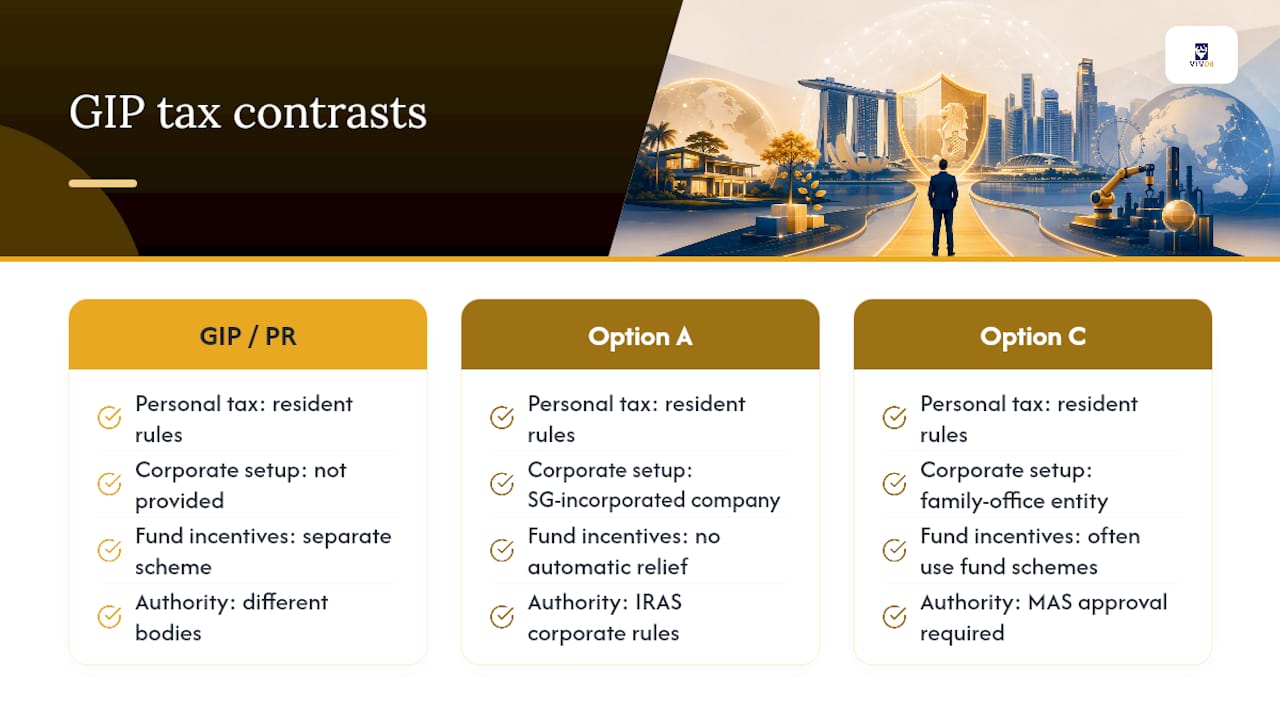
GIP itself is an immigration and investment programme, not a tax incentive scheme, and it does not grant a special tax rate simply for holding PR status. Once you become a Singapore Permanent Resident, your personal income tax treatment follows Singapore’s standard resident rules, which are territorial and progressive, generally more favorable than many home jurisdictions for high earners with Singapore-sourced income.
Where tax planning genuinely matters is at the corporate and structural level. An Option A business investment creates a Singapore-incorporated company subject to Singapore’s corporate tax framework, and how that company is structured, its shareholding, its intercompany arrangements, its treatment of foreign income, has real consequences for the investor’s overall tax position. Option C family offices face their own separate consideration: many structure under Singapore’s fund tax incentive schemes, which carry distinct qualifying conditions unrelated to the GIP investment threshold itself and require separate application to the Monetary Authority of Singapore.
Because GIP and Singapore’s tax incentive schemes are administered by different bodies with different qualifying criteria, an investor should never assume PR approval and favorable tax treatment arrive as a single package. They are two separate applications, evaluated by two separate authorities, and structuring one without regard for the other is a common and costly oversight.
Common Risks and How to Reduce Them
The biggest risk in a GIP application is not rejection outright. It’s a stalled application that drags on for months while capital sits committed and uncertain.
Weak business plans are the most frequent cause. EDB case officers see hundreds of applications and can tell within a few pages whether a plan reflects genuine operating intent or a template built to hit the minimum capital number. Fund and family office structures introduce a different risk: choosing a fund not yet on EDB’s approved list, or a family office structure that doesn’t cleanly demonstrate the required S$50 million deployment, can add months to the review.
Documentary gaps compound both problems. Family background forms, audited accounts, and source-of-funds evidence get reviewed rigorously, and an incomplete submission triggers follow-up requests that reset the clock rather than simply delaying it.
The mitigation is straightforward even if it takes discipline: run an honest eligibility review before applying, choose the route that matches your actual business history rather than the one that merely fits your capital, and build documentary evidence in parallel with the application rather than scrambling after EDB asks for it. Investors who treat the six-month post-AIP window as tight, rather than generous, tend to clear Final Approval with far less friction.
GIP Versus Other Singapore Residency and Investment Routes
The GIP sits at the top of Singapore’s investment migration ladder in terms of capital, and that scale buys a direct route to Permanent Residence that other schemes don’t offer.
Singapore’s Employment Pass route, by contrast, grants a work visa tied to a specific job and employer, not PR, and requires no capital commitment at all, just a qualifying salary and role. It’s faster and cheaper but doesn’t deliver the long-term residency status GIP investors are specifically seeking. Retail investment vehicles like the CPF Investment Scheme are worth mentioning only to rule out: they’re domestic retail products for existing CPF members, not immigration pathways, and should never be confused with GIP capital commitments.
For entrepreneurs who want operational control without the GIP’s capital floor, standard foreign-founder incorporation followed by an Employment Pass or EntrePass is a common, far less capital-intensive starting point, though it doesn’t carry the same immediate PR outcome. The choice really comes down to what you’re optimizing for: GIP suits investors with S$10 million or more who want PR as a direct, defined outcome tied to a specific capital commitment, while lighter-touch routes suit those building a smaller Singapore presence first and considering residency later.
Global Economic Shifts and Their Effect on GIP
EDB has adjusted GIP conditions before, and the March 2023 changes tightened hiring and TBE milestones under Option A and sharpened fund and deployment rules under Options B and C specifically to strengthen local economic impact. That history matters: it shows EDB actively recalibrates the programme in response to how well existing GIP capital is actually working inside Singapore’s economy, not on a fixed schedule.
Global capital flows influence this recalibration directly. When more family offices and funds compete for GIP-select status, EDB has room to raise the bar on deployment and track record requirements. When regional competition for high-net-worth relocation intensifies, from other jurisdictions courting the same investor pool, thresholds and processing efficiency can shift in the other direction to keep Singapore competitive.
For applicants, the practical takeaway is timing discipline. Thresholds, fee structures, and documentary requirements you read about today may not hold by the time you’re ready to apply next year. Treat every figure in this article, and every figure on any advisory firm’s website, as a snapshot to be reconfirmed with EDB before you commit capital, not a fixed rule you can plan five years around without checking again.
Perspective: When GIP Is Strategically the Right Choice
GIP makes sense when you’re building something permanent: a regional headquarters, sustained local hiring, a multigenerational family office. It makes less sense for investors chasing a fast PR outcome on a smaller budget, where other immigration routes cost less and move faster. The programme rewards transparency and genuine economic commitment. Approach it as a shortcut and the due diligence process will find the gap.
— Ray
VIVOS GIP Advisory: Services and Next Steps
Advisory firms run GIP applications end to end: eligibility review, incorporation or fund and family office structuring, ongoing compliance, and coordination with EDB throughout the AIP and Final Approval stages. Some provide Singapore residency and citizenship-by-investment advisory alongside foreign-founder incorporation, nominee resident director services, registered address, and corporate secretarial support, extending advisory models to Malaysia, Hong Kong, and the UAE for investors comparing jurisdictions.
If you’re weighing Option A against setting up a fund structure for Option B, or wondering whether your business plan is strong enough to clear EDB’s Option C bar, the fastest way to find out is a direct eligibility review rather than another round of research. VIVOS’s GIP and family office advisory starts from S$1,000, and foreign-founder incorporation packages, priced from S$4,600, cover the entity you’ll likely need alongside your investment. Full pricing for both sits on the VIVOS pricing page, and broader business management support, including banking coordination and immigration filing, is outlined on the business management services page. Book an initial assessment with VIVOS to map your capital and business history against the right GIP route before you spend a dollar on the application fee.
Sources
Verify current thresholds and procedures directly through the EDB GIP programme page and the EDB GIP Factsheet. EDB sets and revises all figures cited above.
This article is general information, not a substitute for advice from a qualified lawyer. Consult a qualified legal professional about your own circumstances before acting on anything here.
How Much Do I Need to Invest to Get PR in Singapore?
Through the GIP, you need roughly S$10 million for Option A, roughly S$25 million for Option B, or a family office with S$200 million in AUM and S$50 million deployed for Option C. These figures are set by EDB and revised periodically, so confirm the current minimum before applying.
What Is the Safest Investment With the Highest Return in Singapore?
There’s no single “safest, highest return” investment, and GIP itself isn’t designed as a yield-maximizing vehicle. It’s an investment migration route where returns depend entirely on how your Option A business, Option B fund, or Option C family office performs, so due diligence on the specific vehicle matters more than the route label.
Who Qualifies for an Investor Visa Like the GIP?
Established business owners with a verifiable track record, next-generation founders stepping into active management roles, and family office principals managing significant multigenerational wealth typically qualify. EDB assesses managerial role, business history, and the credibility of your hiring and investment plan, not capital alone.
Who Is the Largest Investor in Singapore Under the GIP?
EDB does not publish individual applicant rankings, so there’s no public “largest investor” figure. What is public is programme-wide uptake: from 2015 to 2025, about 450 people received PR through GIP, split roughly 50% Option A, 40% Option B, and 10% Option C.
Singapore’s Corporate Service Providers Act 2024 (CSP Act) took effect on 9 June 2025, and the grace period for previously-unregistered providers ended 9 December 2025…
14 point Singapore due diligence checklist for foreign founders and investors. Includes ACRA, IRAS and SLA checks plus contracts, tax, CPF, work pass and...
Master the cap versus discount crossover. Calculate the $12.5M breakpoint from a $10M cap and 20% discount, model conversions, and avoid Singapore filing...