Hong Kong Incorporation in Hours: 2026 Checklist + HK vs SG Snapshot
Published: 17 September 2026
Incorporating in Hong Kong means registering with the Companies Registry, which requires only one director and one shareholder, who can be the same person, with no residency requirement for either. The one condition that trips up most foreign founders: the company secretary must be a Hong Kong resident or a licensed local firm. The fastest path forward is a name check followed by appointing that secretary.
TL;DR:
Most foreign founders do not need a Hong Kong resident director but must appoint a locally resident company secretary and provide a physical Hong Kong address.
Electronic filing reduces incorporation costs to HK$1,545 and speeds approval, often within hours, compared to several days for paper submissions.
The typical startup costs include government fees, a registered address, a company secretary, and bank KYC, with additional ongoing secretarial and address fees.
Proper documentation, especially certified IDs and proof of address, is crucial to avoid delays or rejections during the registration process.
Choosing the correct entity type impacts future banking, tax, and investor relations, with private limited companies being the most common and flexible option.
Vivos
Set Up Your Hong Kong Company
Vivos helps international entrepreneurs navigate Hong Kong incorporation, compliance, banking support, accounting, taxation, and corporate advisory.
How Do I Start My Hong Kong Incorporation? A Quick Checklist
Before filing anything, gather what the Companies Registry and Inland Revenue Department will actually ask for. Missing a single document is the most common reason applications stall.
Run a name search and reserve your preferred company name.
Collect identification and residential address proof for every director and shareholder.
Decide your share structure and company type (private limited is standard for most founders).
Prepare Form NNC1 (or NNC1G for companies limited by guarantee), the articles of association, and the IRBR1 Notice to Business Registration Office.
Line up a Hong Kong registered office address and a qualified company secretary.
Note the KYC documents your bank will want later, plus certified translations if any paperwork isn’t in English or Chinese.
Founders juggling this from abroad, especially those setting up a business in Hong Kong for the first time, tend to underestimate item five. A registered address and secretary need to be locked in before you file, not after.
How Do I Incorporate a Company in Hong Kong?
The process itself is mechanical once your documents are ready. Here’s the sequence the Companies Registry expects, step by step.
Choose your company type and search the name. Run an electronic name search through the Companies Registry to confirm your preferred name isn’t taken or too similar to an existing entity. Most founders default to a private company limited by shares.
Prepare the incorporation package. This means Form NNC1 or NNC1G, your articles of association, and the IRBR1 business registration notice. Non-Hong Kong residents face no special barrier here. The Companies Registry accepts applications from overseas founders on the same terms as local ones.
Appoint your company secretary and confirm a registered office. The secretary must be a Hong Kong resident individual or a corporate body with a local office. Your registered address has to be a physical Hong Kong address. Many founders use a virtual office or a corporate secretarial provider’s address rather than lease commercial space they don’t need yet.
File through e-Services or submit hard copy, and pay the fee. Electronic filing through the Companies Registry’s e-Services Portal is the route almost every founder should take. It’s faster, cheaper, and less prone to clerical rejection than a paper submission.
Receive your Certificate of Incorporation and Business Registration Certificate. Under Hong Kong’s one-stop registration service, both documents get issued together once your application clears. Filings submitted electronically are often approved within hours for straightforward private companies, while hard-copy submissions can take several working days according to Companies Registry processing guidance. After that, your next moves are opening a bank account, which will involve its own KYC review, and setting up your statutory registers.
Pro Tip:Prepare certified copies of every director’s and shareholder’s passport and proof of address before you start the online form. Rejections at the e-Services stage almost always trace back to a document that was missing, expired, or improperly certified, and each rejection resets your timeline.
Which Entity Type Should I Pick for Hong Kong Incorporation?
Most founders never seriously weigh alternatives to a private limited company, but the choice affects your accounting, banking approval, and investor readiness down the line.
Private limited company: Limited liability, separate legal personality, and the structure banks and investors expect. This is the default for anyone planning to trade, hire, or raise capital in Hong Kong.
Branch office: Registration triggers automatically when a foreign company establishes a place of business in Hong Kong. The branch isn’t a separate legal entity, so the parent company carries full liability for its activities.
Representative office: Informational and liaison functions only. It cannot invoice, sign contracts, or generate revenue locally, which makes it a poor fit for anyone actually planning to operate a business in Hong Kong.
Your structure choice ripples into everything that follows. A branch office files differently with the Inland Revenue Department than a private limited company does, and banks scrutinize branch accounts more closely during KYC than they do standalone local entities.
Do Directors Need to Be Hong Kong Residents?
No. The Companies Ordinance sets no residency requirement for directors of a Hong Kong company, which is one of the jurisdiction’s biggest draws for international founders. The company secretary is a different story entirely.
Directors: Any nationality, any country of residence. No local presence required.
Company secretary: Must be a natural person ordinarily resident in Hong Kong, or a body corporate whose registered or principal office sits in Hong Kong.
Common solution: Most foreign-owned companies appoint a licensed Trust or Company Service Provider (TCSP) to fill the secretary role rather than searching for an individual resident willing to take it on.
Compliance reminders: Get written consent from anyone appointed as director or secretary before filing, and remember that removing or replacing a secretary triggers a Form NNC3 filing with the Registry.
Pro Tip:Verify any corporate secretarial firm against the TCSP public license search before signing an engagement. An unlicensed provider handling your statutory secretary function is a compliance risk you don’t want discovered during a bank audit.
What Is the Business Registration Certificate?
The Business Registration Certificate (BRC) is proof that your company is registered for tax purposes with the Inland Revenue Department. It’s not a separate application, and that surprises a lot of first-time founders.
Under Hong Kong’s one-stop registration service, an incorporation application doubles as a business registration application. The Companies Registry issues your Certificate of Incorporation and your BRC together the moment your filing clears.
Banks ask for the BRC as standard proof of legitimacy during account opening, and certain trade licenses require it too.
Keep the certificate accessible digitally and notify the IRD promptly once your business actually commences trading, since that date matters for your first tax filing cycle.
What Does Hong Kong Incorporation Cost, and How Long Does It Take?
Budgeting for Hong Kong company registration means accounting for more than just the Registry’s headline fee. Here’s what the official numbers actually look like.
Cost Item
Electronic Filing
Hard Copy Filing
Companies Registry incorporation fee
HK$1,545
HK$1,720
Business registration fee/levy
Per IRD’s published table
Per IRD’s published table
Typical issuance time
Often within hours
Several working days
The Companies Registry’s fee schedule confirms electronic filing runs cheaper and faster on both counts. Beyond the government fees, plan for a company secretary’s annual fee, a registered address fee if you’re not leasing your own office, and your bank’s KYC and minimum deposit requirements, which vary by institution and can add real friction for founders without a Hong Kong track record.
What Compliance Comes After Incorporation?
Incorporation is the easy part. Staying compliant in year one is where founders who skip professional support tend to run into trouble.
File your annual return on time under the disclosure rules set by the Companies Ordinance.
Prepare audited accounts and file profits tax returns with the Inland Revenue Department within the prescribed deadlines tied to your financial year end.
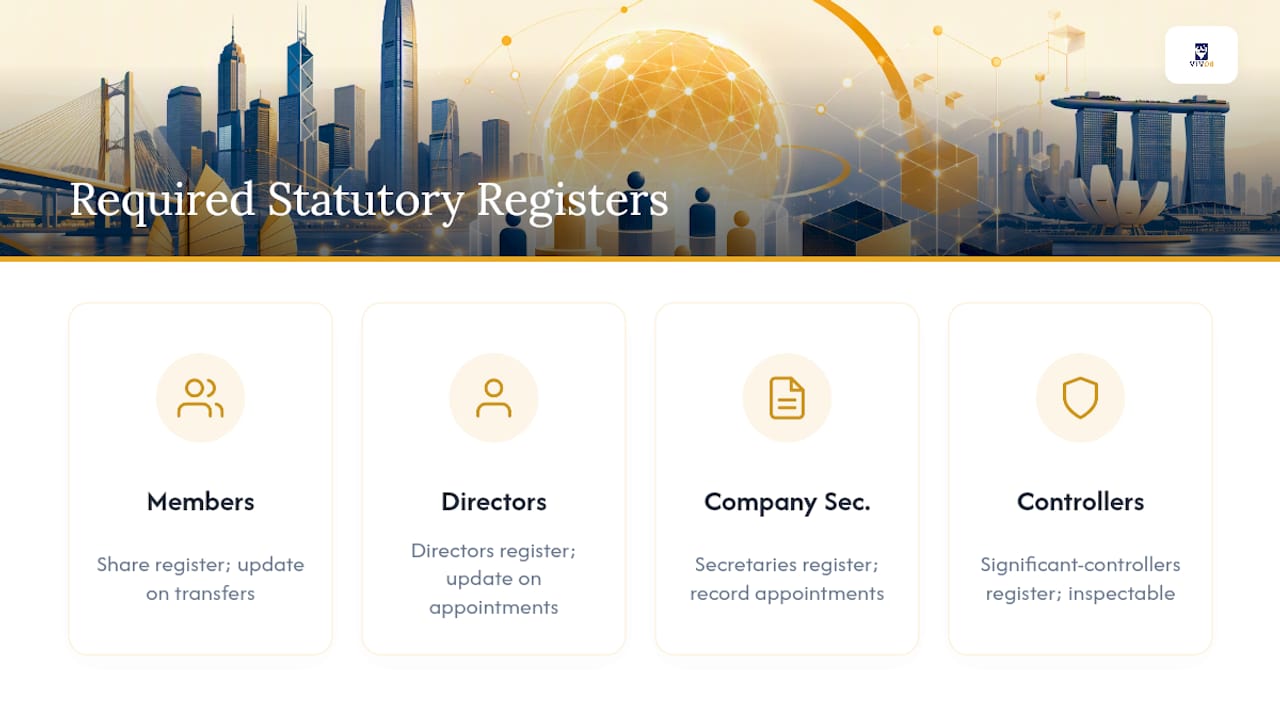
Maintain statutory registers, including the register of members, directors, and significant controllers, and keep board minutes on file.
Notify the Companies Registry promptly of any change in officers, registered address, or company secretary.
Bring in corporate secretarial and accounting support as soon as your filings extend beyond basic annual returns; the deadlines compound quickly once you add payroll, GST-equivalent obligations, or shareholder changes.
Pro Tip:Set calendar reminders for your annual return anniversary the day your Certificate of Incorporation arrives. Hong Kong’s late filing penalties escalate the longer a return sits outstanding, and by the time most founders notice, they’ve already missed the cheapest correction window.
Hong Kong vs. Singapore: Which Jurisdiction Fits Your Business?
Founders weighing both hubs usually narrow the decision to four practical factors.
Factor
Hong Kong
Singapore
Director residency
Not required
At least one resident director required
Headline profits/corporate tax
Territorial, two-tiered rates
Flat corporate rate with partial exemptions
Typical e-filing setup time
Often within hours
Typically one to two business days
Company secretary requirement
Hong Kong-resident secretary mandatory
Locally resident secretary mandatory
Neither jurisdiction is objectively “better.” Hong Kong’s no-residency rule for directors makes it attractive for founders who don’t have a local partner ready to serve on the board, while Singapore’s resident director rule pushes many international founders toward nominee arrangements from day one.
Capital Requirements and Share Structure
Hong Kong sets no statutory minimum paid-up capital for a private company limited by shares. You can technically incorporate with HK$1 of issued capital, and plenty of small trading companies do exactly that.
What matters more than the number is how you structure it. Your authorized and issued share capital determines ownership percentages, dividend entitlements, and how easily you can bring in investors later. Most founders issue a round number, HK$10,000 or HK$100,000 divided into ordinary shares, mainly because banks and future investors expect a structure that looks deliberate rather than arbitrary.
Multiple share classes are permitted if you want to separate voting rights from economic rights, a common move when founders bring in early investors who want economic upside without board control. Bearer shares are not permitted under the Companies Ordinance, and every share must be fully or partly paid and recorded in the register of members.
If you’re planning a future fundraising round, get your share structure right at incorporation rather than restructuring later. Amending share capital after the fact means additional filings with the Companies Registry, updated statutory registers, and, in some cases, stamp duty on share transfers. A ten-minute conversation with a corporate secretary before you file usually costs less than fixing a structure that doesn’t accommodate your first investor.
Common Pitfalls That Delay Hong Kong Incorporation
Most incorporation delays trace back to the same handful of avoidable mistakes.
The registered office address is the single biggest culprit. Founders sometimes list a residential address or an address they don’t actually control, then discover months later that mail from the Companies Registry or Inland Revenue Department never reached them. A registered office needs to be a real, monitored Hong Kong address for the life of the company.
Incomplete director and shareholder identification is the second common snag. Passport copies that aren’t properly certified, or address proof that’s outdated, both trigger rejection at the e-Services stage. Since experts note, minor documentation errors are a leading cause of processing delays for foreign-owned applications, it pays to over-prepare rather than submit and hope.
Name similarity issues also stall filings more often than founders expect. A name search that looks clear can still get rejected if the Registry judges it too close to an existing company, so building in time for a second attempt is wise rather than assuming approval on the first pass.
Finally, founders sometimes delay appointing their company secretary until after they’ve already tried to file, not realizing it’s a prerequisite rather than a follow-up task. Lock in your secretary and registered address before you touch the incorporation form, not after.
Can I Use Nominee Directors or Shareholders in Hong Kong?
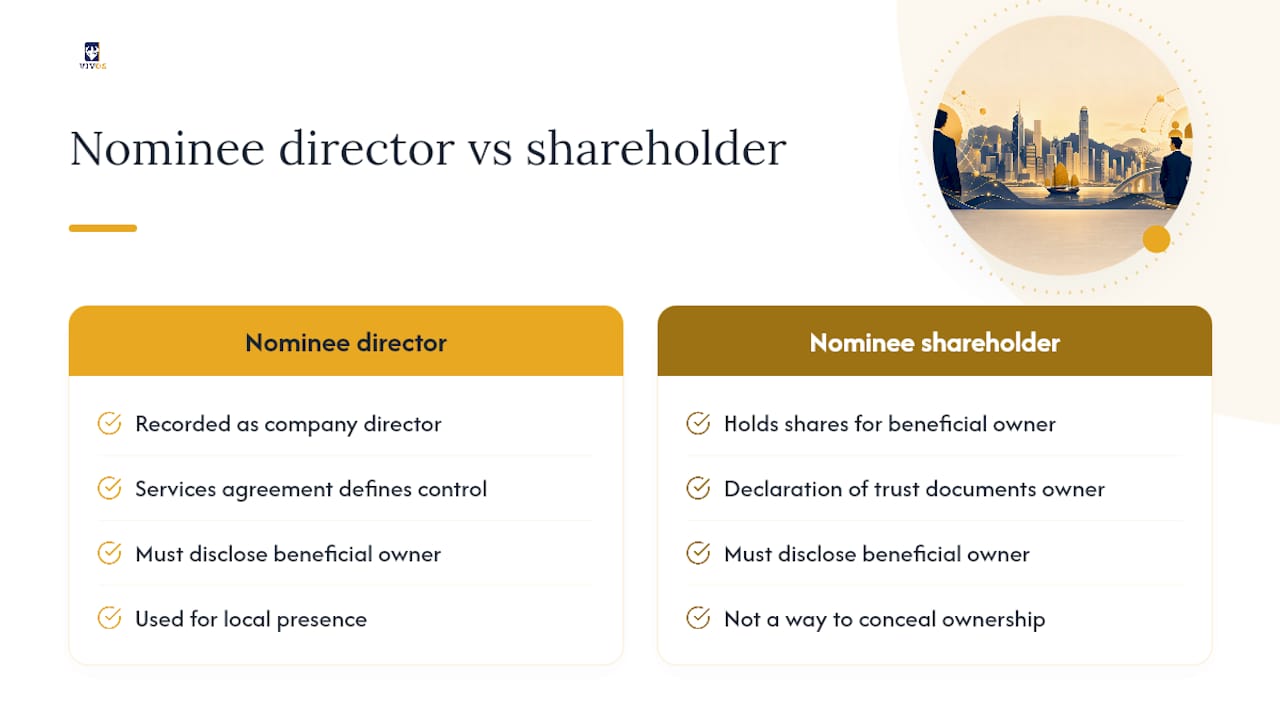
Nominee arrangements are legal in Hong Kong and commonly used by foreign founders who want a local presence without immediately relocating a director. A nominee director holds the title on the company’s official records while a services agreement typically defines who actually controls decision-making behind the scenes.
The distinction that matters legally is between a nominee shareholder and a nominee director. A nominee shareholder holds shares on behalf of a beneficial owner, usually documented through a declaration of trust that identifies the real owner. Hong Kong’s Companies Registry also requires companies to maintain a register of significant controllers, so using nominees doesn’t remove your obligation to disclose who actually controls the company for regulatory purposes.
Where founders get into trouble is treating nominee arrangements as a way to obscure ownership entirely. That’s not what the structure is for, and regulators and banks increasingly scrutinize beneficial ownership regardless of who sits on paper as director or shareholder. A properly documented nominee arrangement, with clear service agreements and disclosed beneficial ownership where required, is a standard and legitimate tool. An undocumented one is a liability waiting to surface during a bank compliance review or a Companies Registry inquiry.
If you’re considering a nominee director because you don’t have a Hong Kong-based person ready to serve, working with a licensed provider who understands the disclosure obligations is far safer than an informal arrangement with an acquaintance.
What Statutory Records Must My Hong Kong Company Keep?
Incorporation isn’t a one-time filing. It creates an ongoing record-keeping obligation that lasts for the life of the company.
Every Hong Kong company must maintain a register of members, a register of directors, a register of company secretaries, and a register of significant controllers. These registers need to stay current, meaning you update them promptly whenever shares transfer, a director resigns, or beneficial ownership changes. The register of significant controllers, in particular, has to be accessible for inspection by law enforcement on request.
Beyond the statutory registers, companies must keep minutes of directors’ and shareholders’ meetings, accounting records sufficient to explain the company’s transactions, and copies of all resolutions passed. The Companies Ordinance requires these accounting records to be kept for at least seven years.
Many founders assume a corporate secretary only handles the annual return filing. In practice, keeping these registers accurate day to day is where a good secretarial provider earns its fee, since a register that’s out of date at the moment a bank or regulator asks to see it creates far more friction than the modest cost of ongoing upkeep.
How Are Hong Kong Companies Taxed?
Hong Kong runs a territorial tax system, meaning profits tax applies only to income sourced within Hong Kong. Profits earned entirely offshore can, in some circumstances, be exempt, though the offshore claim process requires documentation and Inland Revenue Department review rather than automatic exemption.
The territory uses a two-tiered profits tax structure. Corporations pay a lower rate on the first slice of assessable profits, with the standard rate applying above that threshold. Unincorporated businesses face a slightly different two-tier structure. There is no capital gains tax, no VAT or GST, and no withholding tax on dividends, which is part of why Hong Kong remains a preferred base for regional holding structures.
Hong Kong has signed comprehensive double taxation avoidance agreements with a wide network of trading partners, reducing the risk of the same profit being taxed twice when a company has cross-border operations. Whether a specific treaty applies to your situation depends on where your customers, suppliers, and management functions actually sit, which is a determination worth making with a tax advisor rather than assuming automatic coverage.
None of this replaces a real conversation with a qualified tax professional about your specific structure. Territorial taxation sounds simple until you’re actually trying to document that income was sourced offshore to the Inland Revenue Department’s satisfaction.
Why Getting the Setup Right on Day One Matters
“Founders often treat incorporation as paperwork to get through quickly,” says Ray Tay, Managing Director of VIVOS. “The mistake shows up months later, when a nominee arrangement, a registered address, or a secretarial gap wasn’t set up to survive a bank’s compliance review.”
VIVOS handles company incorporation for foreign founders across Singapore, Hong Kong, Malaysia, and the UAE, including nominee resident directors, registered addresses, corporate secretary appointments, and bank account opening support, with bilingual English-Mandarin service throughout. Founders typically reach out once they’ve settled on a structure and need help executing it correctly the first time.
— Ray
Get Your Hong Kong Company Set Up Without the Guesswork
Handling your own Hong Kong incorporation from abroad means coordinating a registered address, a resident company secretary, certified identity documents, and bank KYC, often across three time zones at once. This process directly supports foreign founders, covering nominee resident directors, registered office addresses, corporate secretarial appointments, and bank account opening, often with bilingual English-Mandarin support from a single point of contact.
VIVOS Pte. Ltd. is an ACRA Registered Filing Agent (Licence FA20240323) and MOM-licensed Employment Agency (Licence 24S2425), advising foreign founders on Hong Kong and Singapore incorporation side by side.
That means you’re not chasing four separate vendors to get one company off the ground. VIVOS’s team prepares your Form NNC1 and articles of association, lines up your registered address and secretary before you file, and stays on as your ongoing corporate secretarial provider once the Certificate of Incorporation and Business Registration Certificate arrive. If you’re also comparing Hong Kong against a Singapore setup, the same team can walk you through Singapore company incorporation side by side. Reach out with your target company name and structure, and VIVOS will tell you exactly which documents to gather first.
Sources
For anything specific to your filing, go straight to the primary sources: the Companies Registry’s incorporation FAQ, the IRD’s business registration fee table, GovHK’s business registration guidance, and the TCSP public license search for verifying secretarial providers. For a sense of how registration mechanics compare elsewhere, Ready Accounting’s CIPC registration guide covers the equivalent process in a different jurisdiction.
How Much Does It Cost to Incorporate a Company in Hong Kong?
The Companies Registry charges HK$1,545 for electronic incorporation of a company limited by shares, or HK$1,720 for hard copy, plus the separate business registration fee and levy set by the Inland Revenue Department. Budget additionally for a registered address and company secretary if you engage a provider like VIVOS rather than handling those roles yourself.
How Can I Check If a Company Is Registered in Hong Kong?
You can search company records through the Companies Registry’s public search services, which confirm a company’s registration status, incorporation date, and filing history. The same portal lets you verify licensed TCSP providers before engaging one for secretarial services.
How Do I Register a Company in Hong Kong?
Run a name search, prepare Form NNC1 or NNC1G with your articles of association and IRBR1 notice, appoint a Hong Kong-resident company secretary, and file through the Companies Registry’s e-Services Portal along with the application fee. Approval for straightforward private companies filed electronically often arrives within hours.
What Is the Difference Between a Certificate of Incorporation and a Business Registration Certificate?
The Certificate of Incorporation confirms your company legally exists as a registered entity, while the Business Registration Certificate confirms you’re registered for tax purposes with the Inland Revenue Department. Under Hong Kong’s one-stop service, both are issued together the moment your incorporation application is approved.
A quick-reference glossary of Singapore immigration, corporate structuring and family office terms — GIP, EP, COMPASS, Section 13O/13U, VCC, PTC and more — each linked…
Singapore has no estate duty, no inheritance tax and no capital gains tax. Here's how HNW families use Private Trust Companies, reserved-powers trusts and the…
There's no special family-office visa. SFO principals and key staff go through an ordinary Employment Pass under MOM's COMPASS framework — here's the salary benchmark,…