
Avoid Renewal Risks: EntrePass Requirements for Foreign Founders
Published: 5 September 2026 · Last reviewed: 30 September 2026 · Reviewed by Ray Tay, Co-Founder & Managing Director, VIVOS PTE. LTD. (ACRA Filing Agent FA20240323 · MOM EA Licence 24S2425)
The EntrePass is Singapore’s work pass for foreign founders running an innovative, venture-backed startup. Unlike the Employment Pass, Ministry of Manpower (MOM) sets no minimum salary at application, but renewal depends on hitting business spending and hiring milestones. Some providers support founders through incorporation and immigration filing at every stage.
TL;DR:
- Most entrepreneurs fail renewal because they do not maintain proper records of local spending and hiring, not because of eligibility issues.
- The renewal process becomes stricter over time, requiring increasing local expenditure and hiring thresholds that must be well-documented.
- Applying through the correct route based on funding, IP, or track record evidence can save months and prevent mismatched documentation.
- The EntrePass is generally more suitable for pre-revenue startups backed by incubators or investors, while Employment Passes suit those with steady salaries.
- Building a compliant corporate and accounting infrastructure early is essential to avoid rejection at renewal, as most issues arise from recordkeeping rather than initial eligibility.
Table of Contents
- Who Qualifies for an EntrePass?
- What Are the Three EntrePass Eligibility Routes?
- How to Apply: Process, Fees, and Timelines
- How Is the EntrePass Renewed?
- EntrePass vs Employment Pass: Which Should I Choose?
- Practical Tips to Avoid Delays and Rejections
- How VIVOS Supports EntrePass Applicants
- Our Take: Where the Real Bottleneck Sits
- Get Your EntrePass Application Right the First Time
- Where to Verify EntrePass Rules Directly
- Sources
Who Qualifies for an EntrePass?
MOM built the EntrePass for serial entrepreneurs, high-caliber innovators, and experienced investors prepared to run a private limited company registered in Singapore. It’s not a general startup visa. The applicant must personally hold operational control of the business, and the underlying entity must be registered with the Accounting and Corporate Regulatory Authority (ACRA).
Three conditions decide whether you’re even in the right lane:
- The company must be a private limited entity registered with ACRA, not a sole proprietorship or partnership.
- If the company already exists, the applicant must hold at least 30% of shareholding personally.
- Companies older than 12 months at the time of application get assessed against renewal criteria rather than initial eligibility, which is a stricter bar.
Beyond those baseline conditions, MOM sorts applicants into one of three qualifying routes: Entrepreneur, Innovator, or Investor. Each has its own evidentiary bar, and picking the wrong lane wastes months. The next section breaks down exactly what proof each route demands.
What Are the Three EntrePass Eligibility Routes?
Every EntrePass application gets built around one of three qualifying routes, and the paperwork differs sharply between them. Matching your profile to the correct route before you start assembling documents saves real time.
| Route | Who it fits | Core evidence MOM expects |
|---|---|---|
| Entrepreneur | Founders with early funding or incubator backing | Signed investor letters, term sheet, bank receipts showing funding of roughly S$100,000 from a single round or backing from a recognized incubator or accelerator |
| Innovator | Founders with registered IP or research ties | IP registration certificates (WIPO or national IP office), or a Research Collaboration Agreement with a Singapore-based institution |
| Investor | Founders with a track record of founding and exiting businesses | Sale and purchase agreements, ACRA incorporation records, valuation history, prior funding rounds |
Beyond route-specific evidence, MOM expects a standard document set from every applicant:
- Passport bio page and a current CV showing entrepreneurial or technical background.
- A business plan of 10 pages or fewer covering product, market, and financials.
- Bizfile or ACRA extract confirming company registration and shareholding.
- Financial statements or bank statements demonstrating funds or revenue.
- Notarized translations for any document not originally in English.
Recognized incubator letters and signed term sheets carry disproportionate weight in Entrepreneur-route applications. Vague or unsigned investor correspondence is one of the fastest ways to stall a file, so pair every letter with bank or escrow confirmation where you can.
How to Apply: Process, Fees, and Timelines
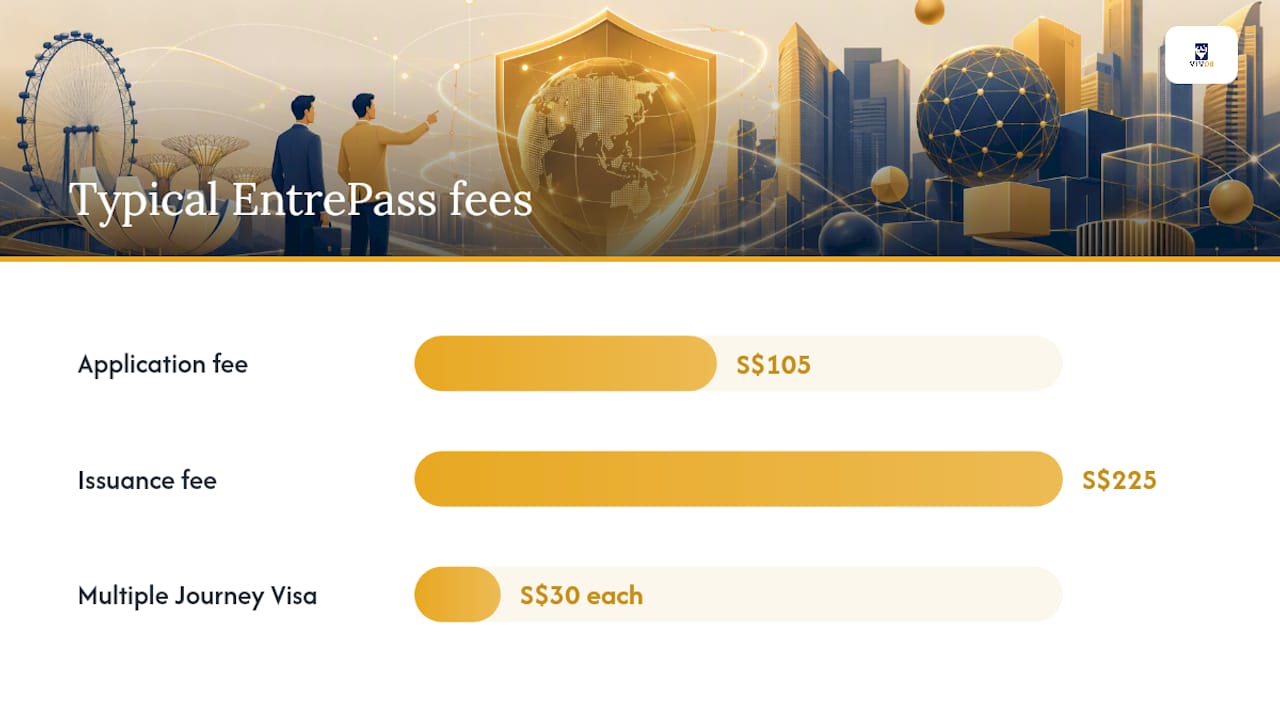
Applications go through MOM’s online eService, and only the applicant or an appointed employment agent can submit. Fees are modest compared to the paperwork burden: S$105 for the application and S$225 upon issuance, plus S$30 for each Multiple Journey Visa if your travel pattern needs one.
The process runs in a fairly fixed sequence:
- Submit the application with the full document set through the MOM eService.
- Receive an In-Principle Approval (IPA), which functions as a single-entry visa valid for six months to enter Singapore.
- Enter Singapore within the IPA window and complete pass issuance, including fingerprint and photo registration where required.
- Set up SGWorkPass and Singpass access, then wait for the physical card, typically delivered within about five working days of registration.
Most applications process within roughly six weeks. A few habits speed things up:
- Submit a fully bundled application rather than filing documents piecemeal.
- Attach notarized translations directly alongside the original documents, not as a separate follow-up.
- Plan your travel to land comfortably inside the six-month IPA window rather than at the deadline.
How Is the EntrePass Renewed?
Renewal is where most EntrePass holders get caught off guard. The pass runs one year initially, the first renewal is also capped at one year, and subsequent renewals extend to two years. Each renewal cycle tightens the bar.
MOM measures renewal against two figures: Total Business Spending (TBS), meaning your company’s local operating expenditure, and local hiring, meaning Singaporean or PR employees on payroll. Both thresholds rise as the company matures.
| Renewal stage | Typical spending expectation | Typical local hiring expectation |
|---|---|---|
| First renewal | Modest, company still ramping up | At least one local hire common |
| Second renewal | Meaningfully higher spending | Two or more local hires often expected |
| Third renewal and beyond | Sustained higher spending | Growing local team expected |
These figures move over time, so confirm exact current thresholds directly with MOM before filing. What doesn’t change is the recordkeeping burden behind them.
- Keep clean payroll records showing CPF contributions for local hires.
- Retain signed employment contracts and invoices tied to local spending.
- Reconcile bank statements against your TBS claims before submission.
Falling short of thresholds without a credible explanation is the single most common reason renewals get rejected outright. Providers may handle the corporate secretarial and bookkeeping side of this so ACRA filings and financial records stay renewal-ready year over year, and the EntrePass renewal criteria deserve a closer read if you’re already a few months from your renewal window.
EntrePass vs Employment Pass: Which Should I Choose?
The two passes run on entirely different logic. The Employment Pass is salary and COMPASS-points based, meaning your qualifying salary and points score against fixed benchmarks. The EntrePass runs on innovation and funding evidence instead, with no salary floor at all.
If you can comfortably pay yourself a market-rate salary and clear COMPASS benchmarks, the Employment Pass is usually the more predictable route. It skips the funding-proof and renewal-milestone complexity entirely.
EntrePass tends to fit better when:
- You’re pre-revenue but backed by a recognized incubator or investor round.
- Your company’s value sits in registered IP or a formal research collaboration.
- You plan to bootstrap salary low in year one and can’t yet meet EP salary thresholds.
Founders who qualify for an EP today but expect to scale fast sometimes start there and pivot to EntrePass later once the business needs a structure built around funding milestones rather than payroll. Our Employment Pass eligibility breakdown walks through current salary and COMPASS benchmarks in detail.
Practical Tips to Avoid Delays and Rejections
Write the business plan MOM actually wants: product, target market shaped by halal consciousness, founding team, funding use, revenue model, and 12 month milestones, kept to 10 pages or fewer. Package every letter and bank document signed and dated, with certified translations attached, not separate.
Pro Tip: Route confusion is the quietest rejection cause. Applicants blend Entrepreneur-route funding evidence with Innovator-route IP claims and end up with a file that satisfies neither route fully.
Before travel, confirm your IPA validity window, book your issuance appointment, and bring:
- Original passport and IPA letter.
- Any documents MOM flagged as pending during review.
- Proof of a Singapore address for card delivery.
How VIVOS Supports EntrePass Applicants
Some service providers handle incorporation, nominee resident director appointment, registered address, and corporate secretarial filing that MOM’s document checklist demands, alongside immigration filing support.
“Founders lose weeks chasing the wrong documents for their route. We build the corporate structure and the evidence file in parallel, so the EntrePass application and the company itself are ready at the same time,” says Ray Tay, Managing Director of VIVOS.
Our Take: Where the Real Bottleneck Sits
Most guidance on EntrePass requirements treats eligibility as the hard part. It isn’t. The three routes are clearly defined, and MOM’s documents page spells out exactly what counts as evidence for each. The real bottleneck sits at renewal, months after approval, when spending and hiring records have to hold up under scrutiny.
Founders who treat incorporation, payroll, and bookkeeping as an afterthought during the first year almost always struggle at first renewal. The pass doesn’t fail because the business idea was weak. It fails because nobody kept a clean paper trail of local spending and hires from day one.
If there’s one thing worth prioritizing before you even file the initial application, it’s setting up proper corporate secretarial and accounting infrastructure immediately, not after the pass is issued. Founders who can genuinely meet Employment Pass salary thresholds should also weigh that route seriously rather than defaulting to EntrePass out of assumption. It’s often the simpler path, not the lesser one.
— Ray
Get Your EntrePass Application Right the First Time
Some firms offer an integrated alternative to piecing together incorporation, immigration filing, and compliance across separate providers. One team may handle Singapore company incorporation for foreign founders, nominee resident director, registered address, and corporate secretarial filing, plus the immigration paperwork your EntrePass file needs, without coordinating three separate vendors. Similar support may be available for founders setting up in Malaysia, Hong Kong, and the UAE.
Your next step is a document checklist review: send over your funding, IP, or track record evidence, and get a straight answer on which route fits before you file anything. Start with a company incorporation consultation and get your corporate structure built to match your EntrePass route from day one.
Where to Verify EntrePass Rules Directly
- MOM: eligibility, documents, apply.
- EDB on work pass comparisons; ACRA for company registration; StartupSG partners for incubator lists.
Sources
- Eligibility for EntrePass
- Documents required for EntrePass
- Everything you need to know about work passes in Singapore | EDB
Recommended
- Singapore EntrePass 2026: Eligibility & Renewal Guide
- EntrePass Singapore: Eligibility, Business Plan & Compliance Tips
- EP vs EntrePass vs ONE Pass: Which Singapore Pass? (2026)
- The Foreign Founder’s Guide to Incorporating a Company in Singapore (2026)
Related guides
Most Popular

 2 January, 2025
Why Singapore Comes Into Action For Chinese Companies
 2 January, 2025
Malaysia’s Budget 2025: What The Dividend Tax Means For You
Recents Blogs


Nominee Director Services in Singapore: 7 Providers Ranked on 6 Checks (2026)

Since 9 June 2025, a nominee director acting by way of business in Singapore must be arranged by an ACRA-registered corporate service provider.
Does Singapore Offer Citizenship by Investment? (2026)
Singapore has no citizenship by investment programme. Investors can get PR through the Global Investor Programme, then apply to ICA for citizenship after at least…