Angel Investors Singapore: Your 2026 Funding Guide
Published: 20 July 2026
Angel investors in Singapore are high-net-worth individuals who invest their own capital directly into early-stage startups, typically through organized networks or syndicates. They fill the critical gap between personal savings and institutional venture capital, providing pre-seed and seed funding when a startup is too early for most VC firms. Singapore’s position as Southeast Asia’s financial hub makes it one of the most active angel investment markets in the region. Networks like Epic Angels and She1K have formalized this activity, giving founders structured access to pools of experienced investors.
How do angel investor networks and syndicates operate in Singapore?
Angel networks in Singapore operate differently from traditional venture capital funds. Groups like Epic Angels and She1K pool their deal flow but invest through individual members’ capital, not a blind-pool fund. There are no general partners, no management fees, and no centralized investment committee making decisions on behalf of the group. Each member decides independently whether to write a check.
This syndicate model has a direct implication for founders. Getting accepted by a network is not the finish line. It is the starting line. After a network screens and approves your startup, you must still pitch individual members and secure commitment from each one separately. Syndicate decisions are made per member, which means your fundraising effort multiplies once you enter a network.
Networks also operate under specific thesis mandates. Epic Angels, for example, requires female founder presence on the founding team. Failing to meet a network’s thesis results in immediate rejection, regardless of how strong the business is. Researching each network’s mandate before applying is not optional. It is the minimum preparation required.
Thesis alignment: Confirm the network’s investment focus matches your sector, stage, and founding team profile.
Individual outreach: After network approval, treat each member as a separate investor requiring a tailored conversation.
No management fees: Angel networks do not charge founders fees. Any group requesting upfront fees is not a legitimate angel network.
Collective deal flow: Networks share deal sourcing but keep capital decisions individual, which preserves member autonomy.
Pro Tip:Before applying to any Singapore angel network, read its public mandate carefully. A single misalignment on gender diversity, sector focus, or stage can disqualify your application before anyone reads your deck.
What criteria do Singapore startups need to attract angel investment?
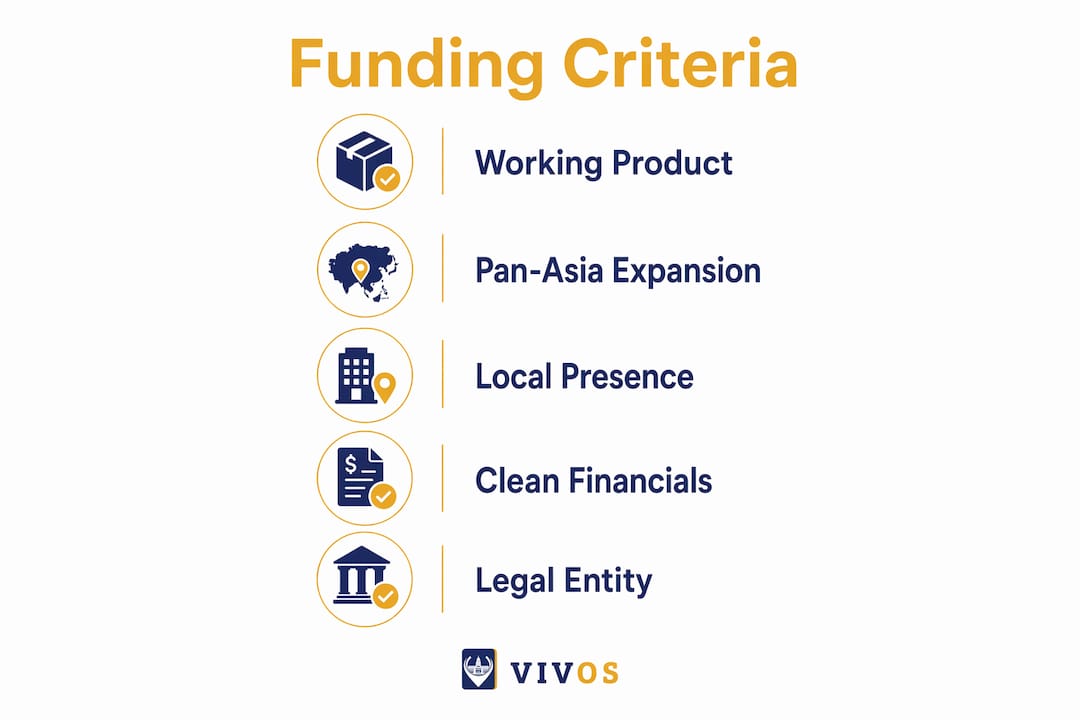
Singapore angel investors set a clear baseline before they engage with any startup. A working product and a pan-Asia expansion plan are the two non-negotiable requirements at the seed stage. Investors here do not fund ideas. They fund traction.
The regional expansion requirement reflects Singapore’s role in the broader ecosystem. Singapore functions as a capital allocation hub for Southeast Asia, and investors expect founders to treat it as a launchpad, not a destination. A startup pitching Singapore-only revenue with no regional plan will struggle to generate serious interest from most angel networks.
Local presence matters too. Investors prefer a Singapore or regional HQ because it signals market commitment and qualifies the startup for government grants like those from Enterprise Singapore. Founders without a local entity often find themselves excluded from conversations before they begin. Establishing a Singapore company early removes this barrier and builds credibility. Vivos helps international founders with company formation in Singapore to meet exactly this requirement.
Beyond structure, investors increasingly weigh founder-investor alignment. Shared ethics and values influence funding decisions, particularly in niche networks focused on areas like halal ventures. This is not a soft consideration. It directly affects whether a member writes a check.
Here is a practical preparation checklist for founders targeting angel investment in Singapore:
Build a working product. Prototypes and MVPs are acceptable. Pure concepts are not.
Map your regional expansion plan. Identify two or three Southeast Asian markets with clear entry timelines.
Establish a Singapore legal entity. This qualifies you for grants and signals commitment to local investors.
Secure warm introductions. Accelerators like Antler and Founders Factory Asia are primary deal sourcing channels for warm introductions that increase success rates significantly.
Research investor theses. Match your sector, stage, and team profile to the right networks before applying.
Pro Tip:If you are pre-revenue, get your financial records in order before approaching investors. Clean, organized accounts signal operational discipline. A guide on accounting for pre-revenue startups covers exactly what investors expect to see at this stage.
What are typical funding ranges from angel investors in Singapore?
Singapore angel investors operate across two primary stages, each with defined check sizes. Pre-seed rounds typically range from $250,000 to $1,000,000. Seed rounds scale up to $5,000,000. These figures reflect the broader Singapore VC market, where check sizes by stage follow a consistent pattern from pre-seed through Series A and beyond.
Angel investors operate primarily at pre-seed and seed. Venture capital firms take over at Series A, where checks can reach $25,000,000. Sovereign capital, such as funds linked to Temasek or GIC, operates at the upper end of the market, approaching $1,000,000,000 in deployment capacity. Understanding where angels sit in this stack prevents founders from approaching the wrong capital source at the wrong stage.
Funding Stage
Typical Check Size
Primary Source
Pre-seed
$250K–$1M
Angel investors, angel networks
Seed
$1M–$5M
Angel syndicates, early-stage VCs
Series A
Up to $25M
Venture capital firms
Sovereign/Growth
Approaching $1B
Sovereign wealth funds, large VCs
Equity expectations vary by investor and deal structure, but founders should expect to give up a meaningful stake at each round. Valuation benchmarks at pre-seed in Singapore are not publicly standardized, so comparable deals from accelerator cohorts like Antler’s Singapore program serve as useful reference points.
How to pitch and build relationships with Singapore angel investors
The most effective path to angel funding in Singapore runs through warm introductions. Cold outreach to angel networks produces low conversion rates. Accelerators like Antler and Founders Factory Asia are the primary channels that connect founders with active investors. Graduating from or being associated with a recognized accelerator signals credibility before you say a word.
Pitch preparation requires more than a polished deck. You need to tune your materials to the specific stage and sector focus of each network. A deck built for a generalist network will not land with a niche network focused on halal ventures or female-founded businesses. Customization is not optional.
Syndicate momentum is a real force in angel funding. First investor validation is critical to attracting further investment from other syndicate members. Securing one committed member early creates social proof that makes subsequent conversations easier. Founders who close their first check quickly tend to close their round faster.
Pitching do’s and don’ts for Singapore angel networks:
Do research each network’s thesis before submitting any materials.
Do lead with regional market signals, not Singapore-only metrics.
Do treat each syndicate member as an individual investor after network approval.
Do prepare clean financials and a clear cap table before your first meeting.
Don’t send cold emails to individual angel investors without a mutual introduction.
Don’t pitch a Singapore-only business model to investors expecting pan-Asia scale.
Don’t assume network approval equals funding. It opens the door. You still have to close each member.
Pro Tip:When one syndicate member commits, ask them directly if they will introduce you to two or three other members. This is standard practice in Singapore angel networks and accelerates the closing process significantly.
Key Takeaways
Angel investment in Singapore requires a working product, a regional expansion plan, and a Singapore legal entity before most networks will engage with your startup.
Point
Details
Syndicate model
Networks like Epic Angels invest via individual members, not a central fund. Each member decides independently.
Thesis alignment
Networks have specific mandates. Misalignment on gender diversity or sector leads to immediate rejection.
Funding ranges
Pre-seed rounds run $250K–$1M; seed rounds reach $5M. Angels operate below Series A.
Warm introductions
Accelerators like Antler and Founders Factory Asia are the primary channels for reaching active investors.
Local presence
A Singapore legal entity signals market commitment and qualifies startups for government grants.
Singapore angel funding: what founders get wrong
Founders consistently underestimate how much preparation happens before the first pitch meeting. The most common mistake I see is treating network approval as the hard part. It is not. The hard part is closing individual syndicate members one by one after you have been approved. Each member has their own thesis, their own risk tolerance, and their own timeline. You are not closing one investor. You are closing five to fifteen.
The second mistake is ignoring local presence. Founders who pitch from overseas without a Singapore entity are signaling that they have not committed to the market. Investors notice this immediately. Setting up a local company before you start fundraising is not bureaucratic overhead. It is a credibility signal that costs relatively little and removes a major objection.
The third thing I would push back on is the idea that Singapore angel networks are interchangeable. They are not. She1K focuses on women-led ventures. Epic Angels has its own gender diversity requirements. Niche networks focused on halal investing prioritize founder values alignment above almost everything else. Applying to every network with the same deck is a waste of time. Targeted preparation with a customized pitch for each network’s mandate produces better results every time.
Singapore is genuinely one of the best places in the world to raise early-stage capital for a Southeast Asia play. The infrastructure, the networks, and the government support are all in place. Founders who do the preparation work get funded. Founders who skip it do not.
— Ray
How Vivos helps founders prepare for angel investment in Singapore
Raising angel funding in Singapore requires more than a strong pitch. Investors expect a properly incorporated local entity, clean corporate records, and governance structures that hold up to due diligence.
Vivos provides corporate secretarial services that keep your company compliant throughout the fundraising process, from statutory filings to shareholder resolutions. The team also supports founders with corporate advisory to align your business structure with investor expectations before you enter any room. For international founders establishing a Singapore presence, Vivos handles the full incorporation process, giving you the local entity that angel networks and grant programs require. Clean structure from day one removes friction at every stage of the funding conversation.
FAQ
What is an angel investor in Singapore?
An angel investor in Singapore is a high-net-worth individual who invests personal capital into early-stage startups, typically at pre-seed or seed stage, often through organized networks or syndicates.
How much do angel investors in Singapore typically invest?
Pre-seed rounds typically range from $250,000 to $1,000,000. Seed rounds scale from $1,000,000 to $5,000,000, depending on the startup’s traction and regional expansion plan.
Do I need a Singapore company to raise angel funding?
Investors strongly prefer a Singapore or regional HQ because it signals market commitment and qualifies the startup for government grants. Founders without a local entity face a significant disadvantage in most funding conversations.
How do I find angel investors in Singapore?
Warm introductions through accelerators like Antler and Founders Factory Asia are the most effective channel. Direct applications to networks like Epic Angels and She1K are also viable, provided your startup meets their specific thesis requirements.
What do Singapore angel networks look for in a startup?
Networks require a working product, a clear pan-Asia expansion plan, and a founding team that aligns with the network’s mandate. Some networks, like Epic Angels, also require female founder representation on the team.
Master the cap versus discount crossover. Calculate the $12.5M breakpoint from a $10M cap and 20% discount, model conversions, and avoid Singapore filing...
Which consulting niches need a licence in Singapore, PDPA obligations every consulting firm carries, and the SS 680:2021 standard that replaced TR 43:2015 for Enterprise…