
Does Singapore Offer Citizenship by Investment? (2026)

Ray Tay
Singapore has no citizenship by investment programme. Investors can get PR through the Global Investor Programme, then apply to ICA for citizenship after at least…
Published: 1 September 2026 · Last reviewed: 30 September 2026 · Reviewed by Ray Tay, Co-Founder & Managing Director, VIVOS PTE. LTD. (ACRA Filing Agent FA20240323 · MOM EA Licence 24S2425)
Singapore-incorporated companies limited by shares, unless specifically exempted, must file financial statements in XBRL format with ACRA, uploaded through BizFinx and submitted alongside the Annual Return. Solvent exempt private companies may file voluntarily instead of mandatorily. This has been ACRA’s standing requirement as of 2026, with no major structural change to the filing route.
TL;DR:
- Early mapping and reconciliation of financial statements to the correct XBRL template significantly reduces filing errors and rejection risks.
- Small private companies without public accountability mainly file Simplified XBRL with around 120 data elements, compared to 210 for full reporting.
- Solvent exempt private companies can file a certificate of solvency instead of financial statements, but insolvent EPCs must file full XBRL documents.
- MAS-regulated entities usually submit a PDF of their statements along with XBRL Highlights rather than the full data set.
- Outsourcing XBRL preparation and filing to a specialist provider can prevent common mistakes and ensure compliance before the deadline.
Every Singapore-incorporated company limited by shares, and most unlimited companies, must file financial statements with ACRA unless a specific exemption applies. Solvent exempt private companies (EPCs) sit outside the mandatory rule. An EPC has no corporate shareholders and no more than 20 individual shareholders, and stays solvent throughout the financial year.
The distinction matters because solvency status can flip a company’s obligation entirely.
Foreign founders running a Singapore entity from overseas almost never file this themselves. Their corporate secretary or corporate service provider holds CorpPass authorization and handles the lodgment on the company’s behalf, which is precisely the workflow VIVOS runs for its incorporation clients.
Template choice depends on company type, size, and whether the company answers to a public accountability regime. ACRA recognizes three main formats plus the exemption path, and picking the wrong one is a common reason first submissions bounce back.
A small private company with no public accountability generally qualifies for Simplified XBRL, which covers roughly 120 data elements against the approximately 210 elements in Full XBRL. A listed company, or one with public accountability, must use Full XBRL because regulators and investors need the fuller data set. A bank or insurer regulated by MAS instead files a PDF of its statements together with Financial Statements Highlights, a lighter template of about 80 elements built for that sector.
| Filing type | Applies to | Data elements | Format |
|---|---|---|---|
| Full XBRL | Public accountability companies, listed entities | ~210 | Full XBRL instance |
| Simplified XBRL | Private companies without public accountability | ~120 | Simplified XBRL instance |
| FSH + PDF | MAS-regulated banks, insurers, finance companies | ~80 | XBRL Highlights + PDF statements |
| Exempt (voluntary) | Solvent exempt private companies | None mandatory | Certificate of solvency or optional XBRL |
If you are unsure which bucket your company falls into, that judgment call is exactly where a corporate secretary or accountant earns their fee. Getting it wrong late in the filing window means redoing the mapping under time pressure.
Filing XBRL is not a single upload. It is a sequence of preparation, mapping, validation, and submission, each stage capable of throwing an error if rushed.
Non-listed companies generally work to a 7-month deadline after financial year end for the Annual Return, with the XBRL upload completed beforehand as a prerequisite step. An authorized lodger, whether an officer or an appointed corporate secretary with CorpPass access, must complete the BizFile portion. Firms managing several client entities typically use the Multi-upload Tool to batch this work rather than processing one company at a time.
Pro Tip: Reconcile your XBRL text block against the AGM PDF line by line before uploading. A single mismatched figure between the two is one of the most common reasons ACRA rejects an otherwise correct filing.
Mapping is where most filing delays start. The BizFinx Preparer’s Guide sets out best-fit mapping principles against the Minimum Requirement List, and for Full XBRL, the complete set of financial statements must go in as one text block that mirrors the AGM PDF exactly. Minor formatting drift between the two documents is a frequent rejection reason.
Beyond mapping, a small cluster of recurring errors accounts for a disproportionate share of validation failures:
Reconcile the XBRL against your AGM PDF before every submission, and re-run validation any time you import comparative figures from a prior year. Taxonomy updates can silently break mappings that worked fine the year before, so treat automated imports as a starting draft rather than a finished product.
Exemption eligibility is narrow. Solvent EPCs qualify voluntarily, and MAS-regulated entities file FSH plus PDF instead of Full or Simplified XBRL. An EPC that becomes insolvent during the financial year loses its exemption and must file financial statements like any other company.
Genuine errors are not a backdoor exemption. ACRA expects the XBRL to match your AGM financial statements exactly, and any discrepancy needs documentation and justification, not a shrug.
Most foreign founders never touch BizFinx directly. They rely on a corporate secretary who already holds the CorpPass authorization needed to lodge with ACRA, which is the model VIVOS runs for its Singapore incorporation clients.
VIVOS provides Singapore company incorporation for foreign founders, including nominee resident director, registered address, corporate secretary, and XBRL conversion and filing, and also incorporates companies in Malaysia, Hong Kong, and UAE. The typical workflow: VIVOS’s team maps your finalized AGM financial statements to the correct ACRA taxonomy, validates the instance in BizFinx, uploads it, and lodges the Annual Return through CorpPass, all before your filing window closes.
For foreign founders, VIVOS provides Singapore company incorporation alongside the compliance work that keeps the entity in good standing after setup.
The XBRL regime gets blamed for being complicated when the actual failure point is usually timing, not the taxonomy itself. Companies that treat XBRL preparation as a task squeezed in during the final week before the Annual Return deadline are the ones hitting rounding mismatches, currency errors, and rejected uploads. Companies that map early, ahead of the AGM, rarely see these problems.
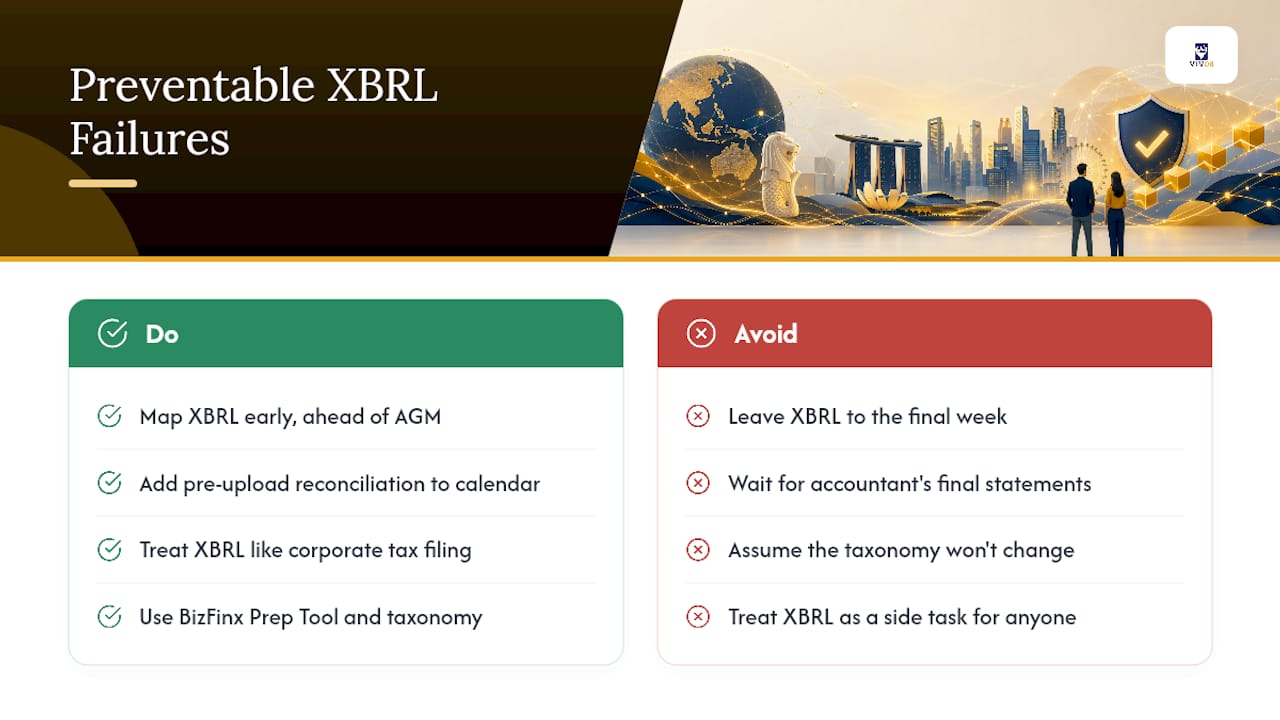
The conventional advice, “use the BizFinx Prep Tool and follow the taxonomy,” is technically correct and practically incomplete. It skips the part where taxonomy updates quietly break comparative-year mappings that worked fine twelve months earlier. That is not a software failure. It is a process failure, and it is entirely avoidable with a pre-upload reconciliation step.
If you take one thing from this: build the reconciliation check into your calendar before your financial year even closes, not after your accountant hands you the final statements. Foreign founders in particular should not treat XBRL as a side task for whoever is free that week. It deserves the same rigor as your corporate tax filing, because a rejected XBRL submission can stall your entire Annual Return, and that has real downstream consequences for good standing.
— Ray
Preparing XBRL in-house means learning ACRA’s taxonomy, running validation cycles, and hoping your mapping survives the next taxonomy update. VIVOS removes that entire burden for foreign founders and Singapore directors who would rather run their business than their compliance calendar.
VIVOS’s team prepares your XBRL instance, maps it to the correct template, validates it in BizFinx, and lodges your Annual Return through CorpPass, all coordinated with your existing accounting records. This sits alongside full Singapore company incorporation support, including nominee resident director and registered address services for founders who are not physically based here.
If your financial year end is approaching and you want your XBRL filing handled correctly the first time, reach out to VIVOS to scope your company’s specific filing requirements and get a clear timeline before your deadline arrives.

 2 January, 2025
 2 January, 2025
Singapore has no citizenship by investment programme. Investors can get PR through the Global Investor Programme, then apply to ICA for citizenship after at least…

2026年新加坡私人公司股份转让完整流程:章程核查、转让文书、IRAS印花税计算、ACRA申报与控制人名册更新,并附各环节时限总表。