
Accounting Year End Singapore: FYE Rules and Deadlines
Published: 27 August 2026 · Last reviewed: 30 September 2026 · Reviewed by Ray Tay, Co-Founder & Managing Director, VIVOS PTE. LTD. (ACRA Filing Agent FA20240323 · MOM EA Licence 24S2425)
Your accounting year end, or financial year end (FYE), is the last day of your company’s accounting period. It determines when your Annual General Meeting (AGM) is due (six months later), when your annual return (AR) must be lodged with the Accounting and Corporate Regulatory Authority (ACRA) (seven months later), and which tax basis period the Inland Revenue Authority of Singapore (IRAS) uses to assess you.
- Sets your AGM and AR deadlines
- Fixes your tax basis period and Year of Assessment
- Requires notification through BizFile+ if changed
- Governed by ACRA and the Companies Act
Key Takeaways
Your FYE fixes every downstream compliance date, so picking and managing it deliberately saves both cash and administrative strain.
| Point | Details |
|---|---|
| FYE drives your deadlines | AGM falls six months after FYE, AR seven months after, per ACRA. |
| Tax runs on preceding year basis | ECI is due within three months of FYE; Form C/C-S by November 30 of the YA. |
| Changes are restricted | ACRA blocks FYE changes once AGM, AR, or statement deadlines are missed. |
| Audit exemption has thresholds | Applies if you meet two of three: S$10M revenue, S$10M assets, 50 employees. |
| Pte Ltd usually wins above S$100k profit | Corporate 17% rate with startup exemption often beats personal tax rates. |
| VIVOS supports the full cycle | From FYE selection through incorporation, accounting, and annual filings. |
This article is general information, not a substitute for advice from a qualified financial advisor. Consult a qualified financial professional about your own circumstances before acting on anything here.
Table of Contents
- What Is a Financial Year End (FYE) in Singapore?
- How Does FYE Affect AGM, AR, and Tax Deadlines?
- How Do I Choose the Right FYE for My Business?
- How Do I Change My Company’s Financial Year End?
- What Are Directors’ Reporting Duties Under Audit Exemption?
- Should I Register a Company or Sole Proprietorship?
- How Much Tax Would I Save With a Pte Ltd?
- Practical Year-End Checklist for Singapore Companies
- Why Most Owners Get FYE Planning Backwards
- Get Help Setting Up Your FYE and Year-End Filings
- Sources
What Is a Financial Year End (FYE) in Singapore?
An FYE marks the close of your accounting period, the stretch of trading activity your financial statements cover. Singapore permits two formats: a fixed 12-month period or a 52-week period, which some retailers and franchises prefer because it keeps closing dates on the same weekday every year.
Most private companies pick common quarter-end dates such as 31 March, 30 June, 30 September, or 31 December, according to ACRA’s guidance on choosing an FYE. These dates align with calendar quarters, making bookkeeping and tax planning simpler for accountants juggling multiple clients.
- A new company can set its first FYE anywhere up to 18 months from incorporation.
- Example: incorporate in January 2026, and your first FYE could fall as late as June 2027 without breaching the cap.
- Every FYE after the first must run 12 months (or 52 weeks) unless you formally change it.
How Does FYE Affect AGM, AR, and Tax Deadlines?
Your FYE date triggers a chain of statutory dates you cannot negotiate away. The AGM falls due six months after FYE, and the AR is due seven months after FYE for most private companies, per ACRA’s Step 4.2 guidance. Companies with a branch register outside Singapore have a longer AR filing window.
On the tax side, IRAS assesses companies on a preceding year basis: profits earned in your financial year get taxed in the following Year of Assessment (YA). The Estimated Chargeable Income (ECI) is due within a few months of FYE unless your company qualifies for a waiver, and Form C or Form C-S is due by November 30 of the YA, according to IRAS’s basic guide to corporate income tax.
| FYE Date | ECI Due | AGM Due | AR Due | Form C/C-S Due |
|---|---|---|---|---|
| 31 December | 31 March | 30 June | 31 July | 30 November |
| 30 June | 30 September | 31 December | 31 January | 30 November (following year) |
| 31 March | 30 June | 30 September | 31 October | 30 November |
Corporate tax rate in Singapore is currently set at 17%, though many companies benefit from exemptions that reduce their effective tax rates on initial portions of chargeable income.
How Do I Choose the Right FYE for My Business?
Picking a date is not a formality. It shapes cash flow, audit scheduling, and how cleanly your tax filings land relative to your busiest trading months.
- Match seasonality. A retailer with a December sales peak often avoids a 31 December FYE, since closing the books during the busiest month strains staff and accuracy.
- Check the inventory cycle. Year end during a stock count lull makes physical inventory verification far less disruptive.
- Align with group reporting. If you sit inside a multinational structure, matching the parent company’s calendar cuts down on consolidation adjustments.
- Weigh tax timing. Because IRAS taxes on a preceding year basis, an FYE that spreads profit recognition across two calendar years can smooth taxable income and cash outflows.
- Consider audit-season crowding. FYEs of 31 December are common, meaning auditors and accountants are stretched thinnest between January and April.
Pro Tip: If you expect to raise institutional funding, ask your prospective investors what FYE their portfolio companies typically use. Matching it early avoids a costly, disruptive change later.
How Do I Change My Company’s Financial Year End?
Singapore lets you change your FYE, but only within limits set by the Companies Act and enforced through BizFile+. You cannot change it if you have already missed your AGM, AR, or financial statement filing deadlines under the current FYE, according to ACRA’s guidance on updating FYE. Directors sometimes try to use a change as a workaround for late filings; ACRA blocks exactly that maneuver.
You need ACRA’s prior approval if the new financial year would run longer than 18 months, or if you changed FYE on or after 31 August 2018 and want to change again within five years.
- Log in to BizFile+ and select the “Change Financial Year End” transaction.
- Enter the proposed new FYE and the affected financial year.
- Attach a brief explanation if approval is required (for example, aligning with a new parent company).
- Submit; straightforward cases process without a manual review, while approval cases can take up to 14 working days.
- Confirm the updated FYE reflects correctly on your company profile before relying on the new deadlines.
What Are Directors’ Reporting Duties Under Audit Exemption?
Audit exemption removes the requirement for external verification. It does not touch your legal duty to prepare accurate books.
Directors remain responsible for presenting financial statements that give a “true and fair” view of the company’s affairs, a duty that survives regardless of audit-exemption status, under Section 201 of the Companies Act.
Your company qualifies as a “small company” and can skip statutory audit if it meets certain thresholds on annual revenue, total assets, and number of employees, according to ACRA’s audit exemption criteria.
- Keep bank reconciliations, invoices, and board resolutions organized year round, not scrambled together at FYE.
- Have the board formally approve financial statements before AGM, even without an auditor’s sign-off.
- Reassess your exemption status regularly as business growth can affect eligibility.
For deeper guidance, see VIVOS’s audit exemption guide and the companion resource on unaudited financial statements.
Should I Register a Company or Sole Proprietorship?
A sole proprietorship suits a solo freelancer testing a low-risk idea with minimal paperwork. A private limited company (Pte Ltd) suits anyone earning meaningful profit, carrying business risk, hiring staff, or planning to raise capital, since it caps personal liability and unlocks a lower effective tax rate.
How Much Tax Would I Save With a Pte Ltd?
At S$100,000 in annual profit, a sole proprietor pays personal income tax on the full amount, landing in a band that can reach an effective rate in the mid-teens once reliefs are applied. A Pte Ltd earning the same S$100,000 pays corporate tax after the startup exemption shields a large portion of that income, typically leaving an effective rate closer to single digits before any dividend considerations. Assumptions: no other personal income, standard reliefs only, first three YAs for the startup exemption.
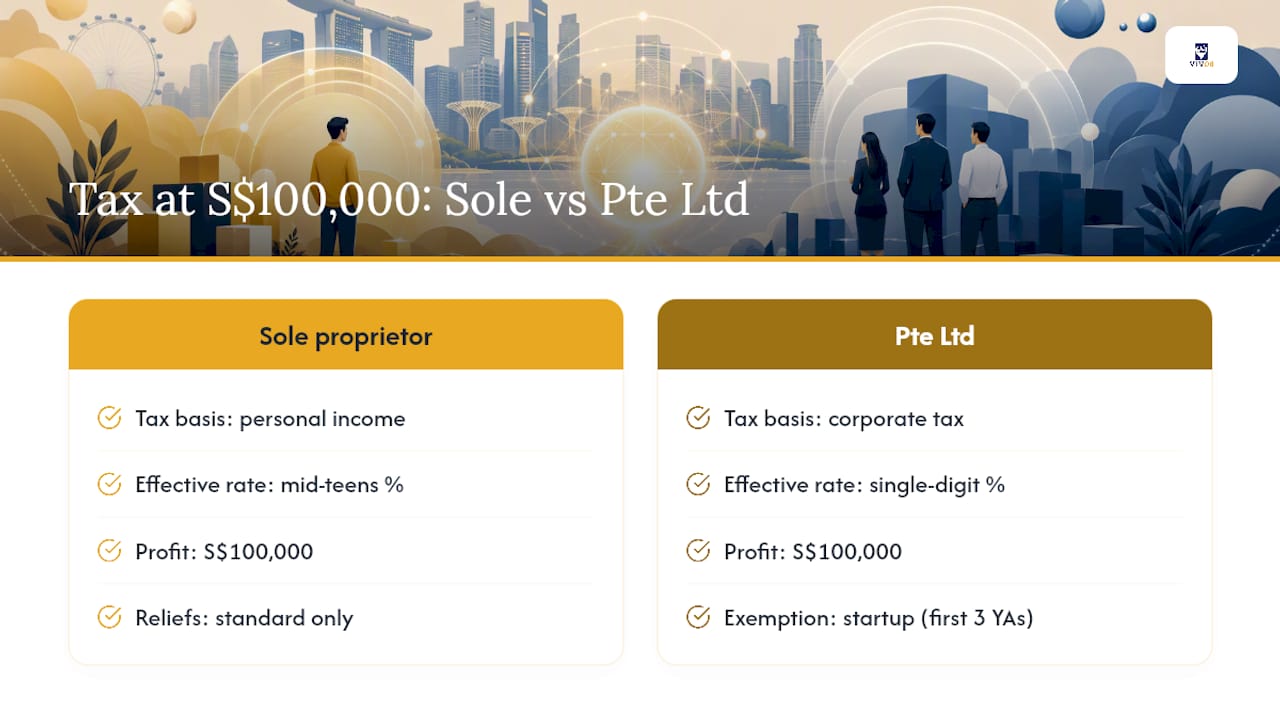
At S$300,000 in annual profit, the gap widens.
Steps to convert a sole proprietorship into a Pte Ltd
- Reserve your new company name through BizFile+.
- Incorporate the Pte Ltd, appointing at least one Singapore-resident director.
- Transfer business assets, contracts, and goodwill from the sole proprietorship to the new entity, with proper valuation documentation.
- Update business licenses and permits to reflect the new corporate entity.
- Cancel the sole proprietorship registration once the transition completes.
Verdicts by profile:
- Freelancer earning under S$50,000 with low risk: sole proprietorship is fine for now.
- Growing SME clearing S$100,000 or more in profit, hiring staff, or facing client liability exposure: a Pte Ltd pays for itself through tax savings and credibility.
- Foreign founder: a Pte Ltd is the only realistic route, and you will need a Singapore-resident director from day one, a step Singapore company incorporation support can arrange quickly.
Practical Year-End Checklist for Singapore Companies
- Three months before FYE: finalize bookkeeping, reconcile bank accounts, and confirm outstanding accruals and invoices.
- At FYE: post final journal entries, freeze the books, and prepare a management pack for your accountant.
- After FYE: file ECI within three months, prepare Form C/Form C-S, hold your AGM, and lodge the AR.
Pro Tip: Engage a corporate service provider before FYE, not after. Fixing missed entries retroactively costs more than a quarterly bookkeeping check-in.
Why Most Owners Get FYE Planning Backwards
Most guidance treats FYE selection as a formality you set once at incorporation and forget. That is backwards. The date interacts with your tax basis period every single year, and a poorly chosen FYE quietly costs you cash flow timing advantages you never notice you are missing.
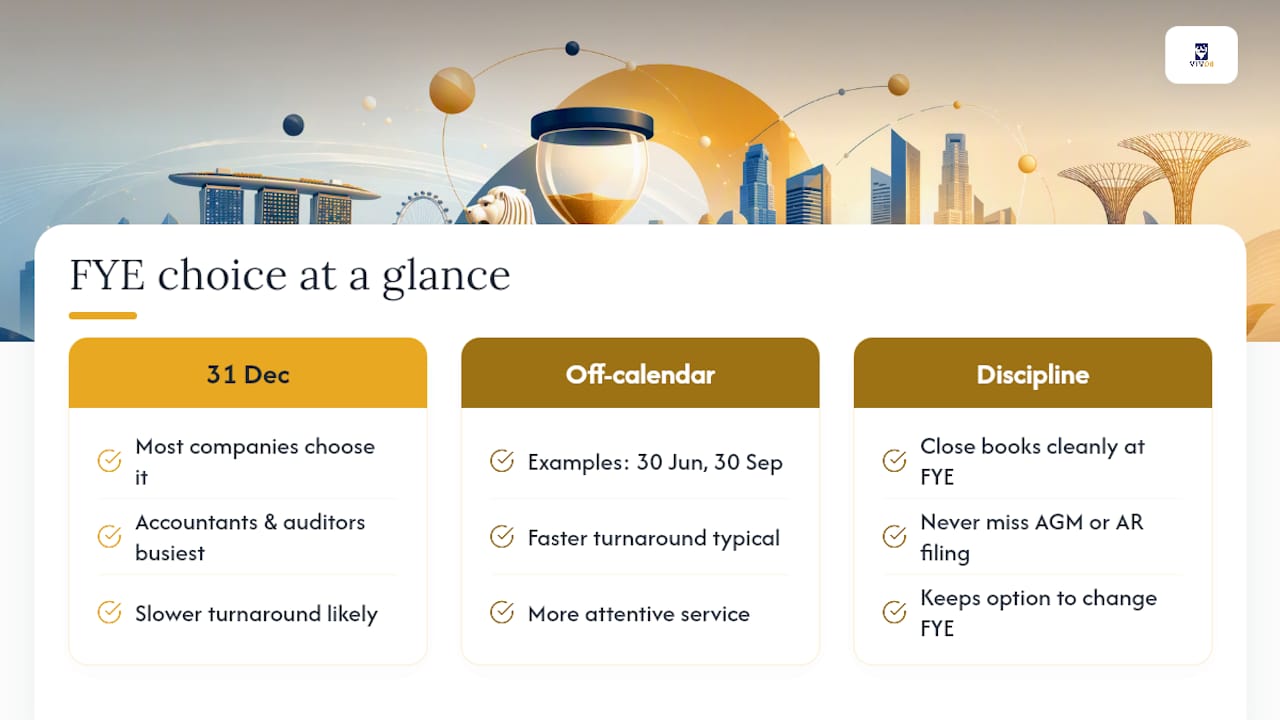
The conventional advice, “pick 31 December because everyone does,” ignores that this is precisely when your accountant and auditor are busiest with every other client doing the same thing. A slightly off-calendar date, like 30 June or 30 September, often gets you faster turnaround and more attentive service.
What matters more than the date itself is discipline: closing the books cleanly at FYE and never letting a missed AGM or AR filing lock you out of changing it later. That trap catches more companies than any tax miscalculation ever does. If there is one thing worth prioritizing above the decision table for Pte Ltd versus sole proprietorship, it is building a recordkeeping habit that survives contact with a real deadline.
— Ray
Get Help Setting Up Your FYE and Year-End Filings
VIVOS manages the full cycle: choosing or changing your FYE, keeping your books audit-ready, and filing ECI, Form C/C-S, AGM minutes, and AR submissions on time. For foreign founders, VIVOS also provides the resident director your Pte Ltd needs from day one.

If you are still weighing sole proprietorship against a Pte Ltd, or converting an existing sole proprietorship, Singapore company incorporation support from VIVOS handles the paperwork, the BizFile+ filings, and the ongoing corporate secretarial duties that follow. Reach out for a tailored compliance checklist or an incorporation quote before your next FYE deadline creeps up on you.
Sources
- Step 4.2: Choosing a company’s financial year end (FYE) | Accounting and Corporate Regulatory Authority
- Basic guide to corporate income tax for companies | IRAS
Recommended
- Annual Return Filing in Singapore: 2026 Guide
- Unaudited Financial Statements Singapore: 2026 Guide
- How to Manage Dormant Company Accounting and Stay Compliant?
- How Do I File Annual Tax in Singapore? | VIVOS
Related guides
Most Popular
 2 January, 2025
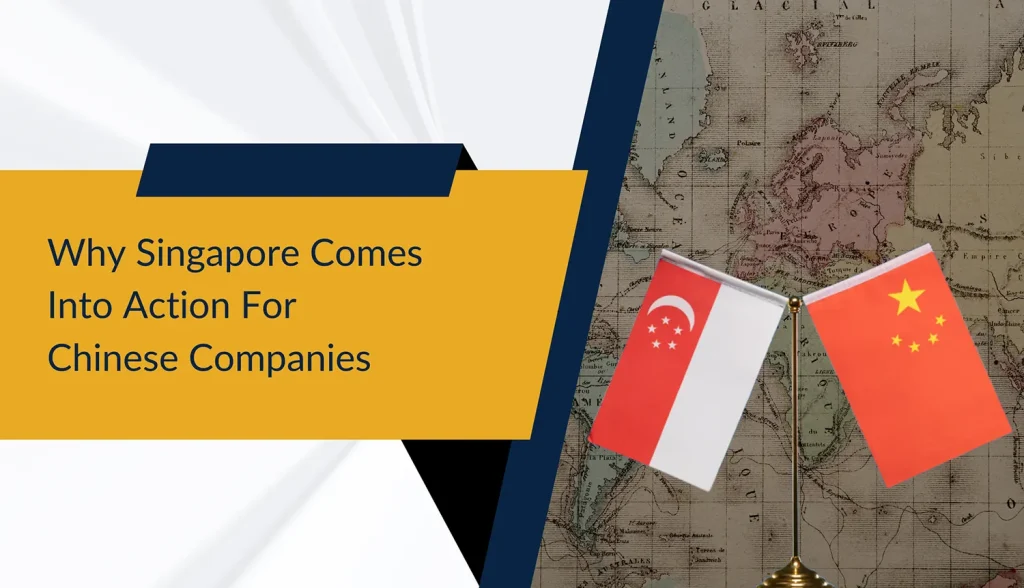
Why Singapore Comes Into Action For Chinese Companies
 2 January, 2025
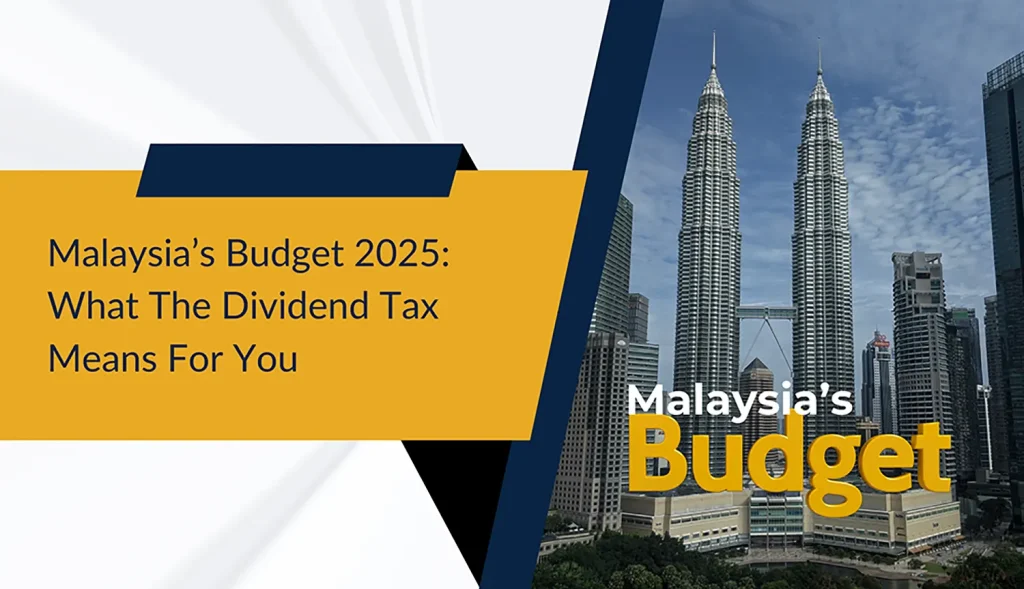
Malaysia’s Budget 2025: What The Dividend Tax Means For You
Recents Blogs


Nominee Director Services in Singapore: 7 Providers Ranked on 6 Checks (2026)

Since 9 June 2025, a nominee director acting by way of business in Singapore must be arranged by an ACRA-registered corporate service provider.
Does Singapore Offer Citizenship by Investment? (2026)
Singapore has no citizenship by investment programme. Investors can get PR through the Global Investor Programme, then apply to ICA for citizenship after at least…