
8 Steps to File a Share Allotment in Singapore

8 steps to file share allotments in Singapore: board resolution, section 161 checks, BizFile+ filing and register updates.
Published: 13 September 2026
A Singapore company may buy back its own shares if its constitution permits it and the directors must sign the required solvency statement. Under an approved general mandate, buybacks are normally capped at 20% of issued shares, and repurchased shares held as treasury cannot exceed 10%, per ACRA guidance and the Companies Act, as of 2026.
TL;DR:
- Companies can buy back shares only if their constitution explicitly allows it and if the directors sign a solvency statement confirming affordability.
- The 20% buyback cap applies based on issued shares as of the resolution date, excluding treasury shares already held, with exceptions for certain share classes.
- After repurchase, shares can be canceled permanently or held as treasury shares, which must stay below 10% of the class, or face disposal within six months.
- Private companies often use off-market buybacks approved by ordinary resolution, while listed companies usually execute market purchases through SGX.
- Accurate, timely filings with ACRA and proper record-keeping are essential to avoid legal liabilities and registry errors during buyback procedures.
Yes, but only if the company’s constitution expressly allows it. That’s the first checkpoint, and it trips up more foreign founders than any other step in the process. Sections 76B through 76G of the Companies Act set the framework: the constitution must permit the purchase, the directors must sign a solvency statement, and shareholders must approve the transaction through the correct resolution.
Listed issuers typically use market purchases, executed through SGX and governed by the SGX rulebook’s provisions on treasury shares and buyback mandates. Private companies more often use off-market purchases, approved by ordinary resolution under a general mandate, or selective off-market purchases, which require special resolution and exclude the selling shareholder and associates from voting.
Private companies must still notify ACRA and update the Electronic Register of Members (EROM). Public companies face a firm 30-day filing window after the acquisition date, discussed further below.
Under a general mandate, a company can typically repurchase shares of its class up to a set percentage within the mandate period, calculated against the number of issued shares as of the date the shareholders pass the resolution, not the date of the purchase itself.
Treasury shares are excluded from that calculation. If a company already holds shares in treasury from an earlier buyback, those shares don’t count toward the issued share base used to compute the ceiling percentage. This detail matters for founders running repeat buyback rounds during a cap table restructuring, since it changes the math each time.
Exceptions exist. Redeemable preference shares follow their own redemption terms rather than the general buyback limit, and the Minister can prescribe different percentages or conditions by order. Always check the current mandate resolution rather than assuming 20% applies universally to every share class.
Once shares are repurchased, the company chooses one of two paths: cancel them outright, or hold them as treasury shares.
Cancellation extinguishes the shares entirely. They stop existing, the issued share count drops permanently, and there’s nothing left to reissue later. Treasury shares, by contrast, sit in limbo. They carry no voting rights, earn no dividends, and hold no claim in a liquidation, but the company retains the option to sell them, cancel them, or use them for other permitted purposes.
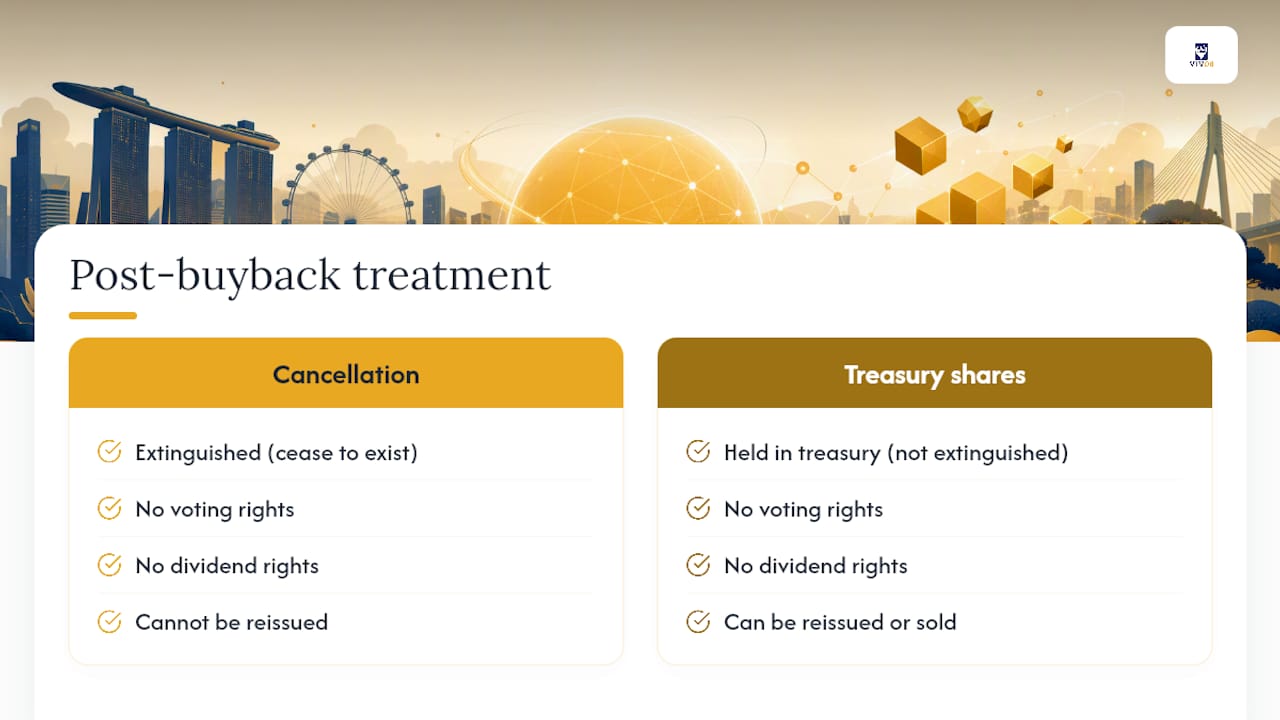
That flexibility comes with a hard limit. Treasury holdings cannot exceed 10% of the issued shares of that class at any point, under section 76I of the Companies Act. Breach that cap, and the company has six months to dispose of or cancel the excess, though the Registrar may grant a further period on application.
Common uses for treasury shares include funding employee share schemes, serving as consideration in an acquisition, or transfers subject to ministerial approval. For founders restructuring ownership ahead of a funding round, treasury shares often provide more optionality than outright cancellation.
Selective purchases carry the highest procedural risk because the exclusion of interested voters is where disputes most often surface. Get the voting mechanics wrong, and the resolution can be challenged after the fact.
Filing mistakes here aren’t always reversible through a simple correction.
Every buyback generates paperwork that outlives the transaction itself. Companies must lodge a notice of purchase or acquisition, and later, a notice of cancellation or disposal if treasury shares are eventually sold off or extinguished. Both go through BizFile, using ACRA’s prescribed forms.
Public companies face a strict 30-day filing deadline from the date of acquisition. Private companies don’t face the same statutory clock, but they still need to lodge notices promptly so the EROM reflects the correct share count. Delayed updates create real problems if the company later tries to raise capital or transfer shares, since the register other parties rely on is out of date.
Keep signed resolutions, solvency statements, and payment receipts on file indefinitely. If a filing error surfaces later and can’t be fixed through a Notice of Error, the company may need a Court Order to correct the registry, a slow and costly outcome that a corporate secretary is specifically trained to prevent.
Directors carry personal exposure here. Signing a solvency statement that later proves inaccurate, or authorizing a buyback that pushes the company toward insolvency within 12 months, can expose directors to liability under the Companies Act.
Practical solvency modeling should account for projected cash flows, known contingent liabilities, existing financing covenants, and a buffer for adverse scenarios before directors conclude the company can meet its obligations for the coming year.
The recurring pitfalls: miscounting share classes when calculating the 20% cap, failing to exclude disqualified voters in selective purchases, and letting excess treasury shares sit past the six-month disposal window.
Pro Tip: Build your 12-month solvency model before drafting the resolution, not after. Directors who reverse-engineer the paperwork to fit a buyback they’ve already agreed to verbally are the ones who end up signing statements they can’t defend later.
Most foreign founders restructuring a cap table don’t have the bandwidth to track solvency modeling, resolution drafting, and BizFile deadlines simultaneously. Some corporate secretarial firms prepare solvency statements, draft and file shareholder resolutions, lodge ACRA notices, and update EROM on behalf of clients, reducing the risk of filing errors.
Some firms also provide resident director and registered address services for foreign founders incorporating in Singapore, with multilingual support across various jurisdictions.
As Ray Tay, Managing Director of Vivos, puts it: “Many buyback disputes can be traced back to rushed resolutions or insufficiently reviewed solvency statements. Accurate paperwork from the outset helps avoid costly corrections later.”
Restructuring a cap table through a share buyback touches company law, corporate secretarial filings, and solvency accounting all at once, which is exactly where most in-house teams run out of depth. Specialized corporate secretarial teams often assist foreign founders operating in Singapore with these intersecting compliance requirements.
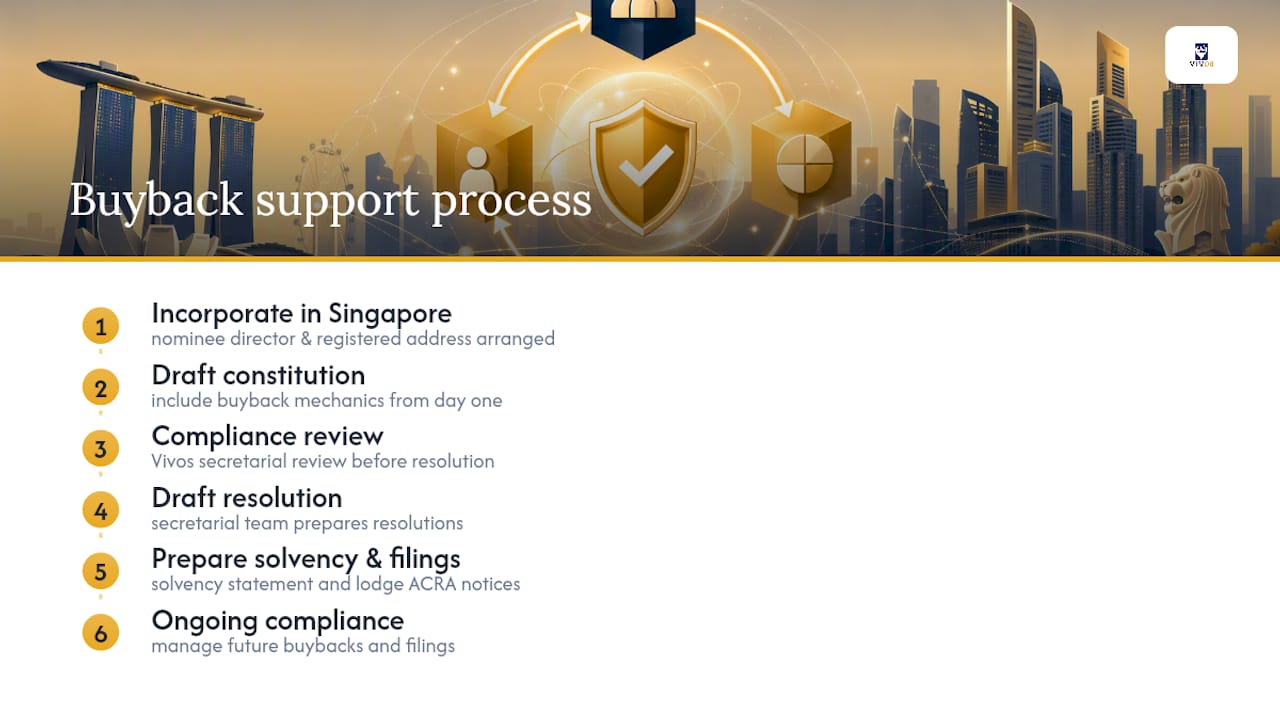
Corporate secretarial teams can draft resolutions, prepare solvency statement documentation, and lodge ACRA notices to ensure filing deadlines are met. For founders who haven’t yet incorporated, some firms arrange nominee resident directors and registered addresses needed to set up a Singapore company from overseas, and may also manage ongoing compliance including future buybacks.
If you’re restructuring ownership ahead of a funding round or buying out a departing shareholder, get a compliance review from Vivos’s corporate secretarial services before you draft the resolution. For founders still setting up their entity, start with Singapore company incorporation for foreign investors and build the buyback mechanics into your constitution from day one.
This article is general information, not a substitute for advice from a qualified financial advisor. Consult a qualified financial professional about your own circumstances before acting on anything here.
A company needs constitutional authority, a signed solvency statement, and the correct shareholder resolution.
No, unless the buyback is structured as a compulsory scheme under specific court-sanctioned arrangements. Ordinary market and off-market purchases are voluntary. Shareholders choose whether to tender their shares.
Yes, in most standard off-market and market purchase structures, participation is optional. Selective off-market purchases require special resolution approval, and the selling shareholder is excluded from voting on that specific resolution.
The company must dispose of or cancel the excess shares within six months, though the Registrar may grant additional time on application. Failing to act risks regulatory penalties and registry complications.
 2 January, 2025
 2 January, 2025
8 steps to file share allotments in Singapore: board resolution, section 161 checks, BizFile+ filing and register updates.

ECI at 3 months, AGM at 6, Annual Return at 7, tax return by 30 November, plus CPF, GST, IR8A and ACRA change notices: the…
VIVOS holds both an ACRA filing-agent licence (FA20240323) and a MOM employment-agency licence (24S2425), so incorporation and the Employment Pass are handled by one team…