
Singapore Statutory Registers: Filing Deadlines for Directors & Founders
Published: 9 September 2026 · Last reviewed: 30 September 2026 · Reviewed by Ray Tay, Co-Founder & Managing Director, VIVOS PTE. LTD. (ACRA Filing Agent FA20240323 · MOM EA Licence 24S2425)
Every Singapore company must maintain four core statutory registers: the Register of Members, the Register of Directors, Secretaries and CEOs, the Register of Charges, and the private Register of Registrable Controllers. Under the Companies Act 1967, as confirmed by ACRA guidance, these must be kept at the registered office or another notified location in Singapore.
TL;DR:
- Private registers such as the RORC and ROND/RONS must be updated first before submitting the central registers within two business days to stay compliant.
- Directors, secretaries, and shareholders’ details must be updated promptly whenever changes occur, with no delay in recording new appointments or share transfers.
- The Registers of Members and Charges are publicly accessible, while the RORC, ROND, and RONS are kept confidential, only visible to authorities.
- Failure to maintain accurate registers or missed deadlines results in fines, potential legal complications, and can harm investor relations.
- Corporate secretaries and incorporation service providers typically handle ongoing register updates, especially for foreign founders relying on nominee officers and multilingual support.
Table of Contents
- What statutory registers must a Singapore company keep?
- Where must they be held and in what format?
- What are the update deadlines and the correct filing sequence?
- Who may inspect registers and what penalties apply for non-compliance?
- Who handles this: company secretary vs corporate service provider
- Practitioner notes on statutory register compliance
- An editorial take on register compliance for foreign founders
- Get Your Statutory Registers Handled From Day One
- Sources
What statutory registers must a Singapore company keep?
Foreign founders often assume statutory registers are a formality handled somewhere in the paperwork of incorporation. They are not. Each register captures a different legal fact about the company, and ACRA treats gaps or stale entries as a compliance failure, not an oversight.
The Register of Members records every shareholder’s name, address, number of shares held, and the dates they became or ceased to be a member. Any allotment or share transfer triggers an update obligation immediately, not at the next annual filing.
The Register of Directors, Secretaries and CEOs holds full particulars for each officer, including appointment and cessation dates. The Companies Act sets out exactly which particulars must appear and gives Registrar certificates evidential weight in disputes.
The Register of Charges logs security interests created over company assets, such as bank debentures or mortgages, and is triggered whenever a new charge is registered.
The Register of Registrable Controllers (RORC) captures individuals or entities with significant control or influence over the company. It stays private, never open to public search, and must be updated within seven days of any change in controller information.
Some companies also carry a Register of Nominee Directors (ROND) and a Register of Nominators (RONS), required where nominee director or shareholder arrangements exist.
| Register | What it records | Update deadline |
|---|---|---|
| Register of Members | Shareholder names, addresses, shareholdings, dates | Promptly on allotment or transfer |
| Directors/Secretaries/CEOs | Officer particulars, appointment/cessation dates | Promptly on appointment or resignation |
| Register of Charges | Security interests over company assets | Promptly on creation of a charge |
| RORC (Registrable Controllers) | Individuals/entities with significant control | Update promptly after change in private register |
| ROND / RONS | Nominee director and nominator particulars | Update promptly in private register, then file centrally within two business days |
Where must they be held and in what format?
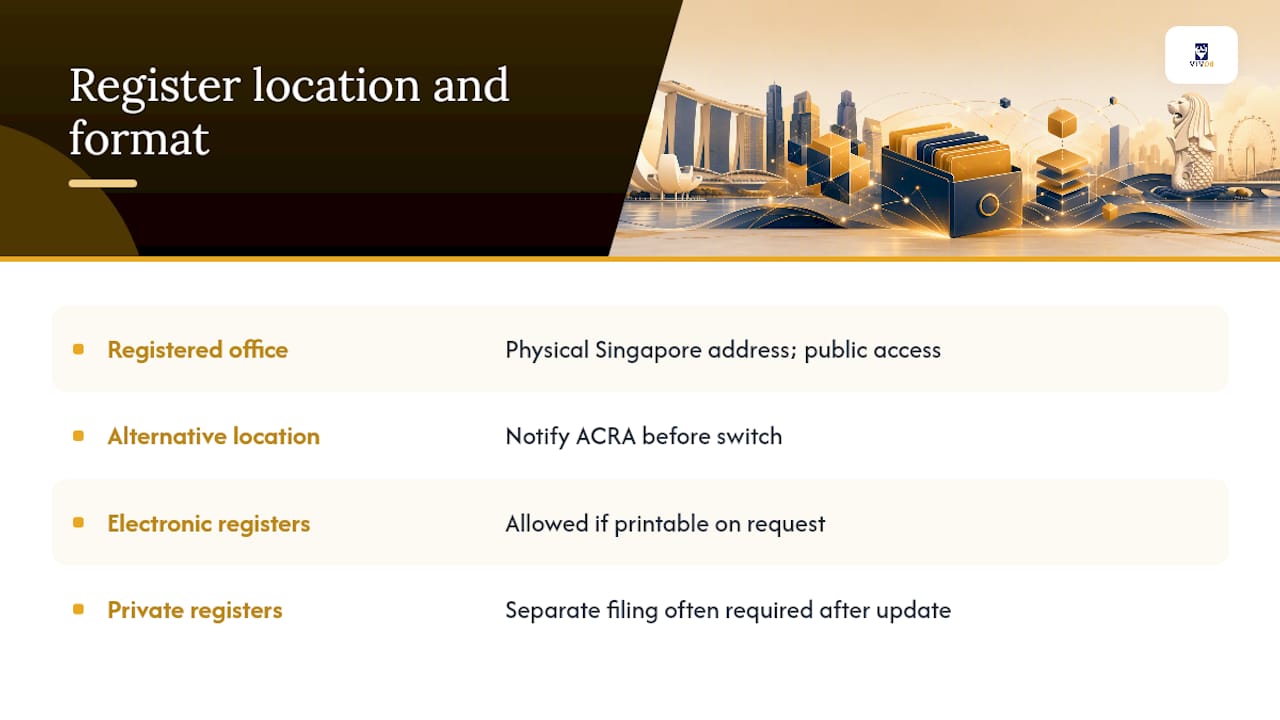
The registered office must sit at a physical Singapore address, accessible to the public during ordinary business hours on business days. Companies wanting to keep registers at an alternative Singapore location must notify ACRA within the statutory deadline before making the switch.
Electronic registers are acceptable, but only if the system can convert entries into readable hard copy on request. Some registers sync automatically once you file through BizFile, the ACRA portal used to create initial registers at incorporation. Others, particularly private RORC and ROND/RONS entries, still require a separate filing step even after the internal record is updated.
What are the update deadlines and the correct filing sequence?
Sequence trips up more companies than ignorance of the rule itself. ACRA expects the private register updated first, with the central filing following inside a fixed window, never the reverse.
- Update the private register first. RORC changes must be entered promptly into the internal register after the triggering event.
- Send controller verification notices at least annually to confirm the information on file remains accurate.
- File the central register second. For ROND and RONS, the Central register must be filed within two business days after the private register update, not from the date of the original change.
- Update officer and share registers via BizFile promptly whenever a director, secretary, or shareholder changes.
- Set up all applicable registers from the date of incorporation, since ACRA treats the obligation as starting immediately, not after the first annual return.
Missing step one before attempting step two is the single most common timing trap directors run into.
Who may inspect registers and what penalties apply for non-compliance?
The Register of Members and the Register of Charges are generally open to inspection by members and, in some cases, the public. The RORC, ROND, and RONS stay private and confidential, visible only to ACRA and authorized law enforcement, never to competitors or the general public.
Failing to maintain accurate registers or missing lodgement deadlines is a breach under the Companies Act 1967, and ACRA enforces this with fines against the company and its officers. Beyond the financial penalty, a compliance lapse on the public record can complicate bank account renewals, due diligence during fundraising, and investor confidence generally. For a closer look at how the fines apply specifically to controller registers, see this breakdown of RORC penalties directors should avoid.
Who handles this: company secretary vs corporate service provider
Legal responsibility for statutory registers sits with the company and its officers, but the day-to-day work of preparing, updating, and filing them almost always falls to the company secretary. That is not a technicality. It is standard practice, especially for founders based outside Singapore who cannot personally track seven-day and two-business-day deadlines from another time zone.
Some corporate service providers offer Singapore company incorporation for foreign founders, often including nominee resident directors, registered addresses, and corporate secretaries who maintain statutory registers. That combination matters because incorporation for foreign founders and ongoing register maintenance are really one continuous obligation, not two separate services.
- Corporate service providers typically handle incorporation from the first BizFile submission through the appointment of officers.
- Nominee resident directors and registered addresses help satisfy Singapore’s local presence requirements.
- Corporate secretaries maintain RORC, ROND/RONS, and share registers with proper filing sequences.
- Incorporation services are often available in Malaysia, Hong Kong, and the UAE, with support in English and other languages.
Founders engaging a corporate secretary should have shareholder identification documents, director particulars, and any charge or nominee agreements ready. Turnaround for setting up initial registers typically follows shortly after incorporation is confirmed, once the secretary has full particulars in hand. Explore incorporation support built for international founders if you’re setting up from abroad.
Practitioner notes on statutory register compliance
Directors sometimes assume ACRA’s public register search shows the full compliance picture. It does not. RORC and ROND/RONS entries stay private, so a clean public search can mask a late private-register update sitting unfiled behind the scenes.
Pro Tip: Keep a dated log, a short change request note plus authorizer signature, for every register update and each annual controller verification notice. It becomes your evidence trail if ACRA ever queries a filing date.
An editorial take on register compliance for foreign founders
Most guidance on this topic treats statutory registers as a filing chore, something to tick off once and forget. That framing undersells the real risk. The registers that cause trouble are almost never the public ones; they’re the private RORC and ROND/RONS entries nobody outside the company ever sees until an auditor, bank, or ACRA officer asks for them.

The conventional advice, “just update your registers when something changes,” skips the part that actually trips founders up: sequence. Update the private register first, file centrally second, inside two business days. Reverse that order and you’re technically non-compliant even if both filings eventually land.
If you take one thing from this article, prioritize the handoff, not the paperwork. Foreign founders rarely fail because they didn’t know a register existed. They fail because nobody owned the seven-day clock while they were asleep in a different time zone. That’s a staffing problem, not a knowledge problem, and it’s solved by delegation, not by memorizing deadlines.
— Ray
Get Your Statutory Registers Handled From Day One
Some providers offer incorporation packages with corporate secretarial services to help maintain statutory registers and manage filing deadlines, reducing the compliance burden for founders operating across time zones.

Certain corporate service providers cater to foreign founders seeking nominee resident directors, registered Singapore addresses, and corporate secretarial assistance with statutory register filings. Similar services may be offered for incorporation in Malaysia, Hong Kong, and the UAE, sometimes with multilingual support.
If you’re setting up a Singapore entity as a foreign founder, start with corporate secretarial services built for ongoing register maintenance and get your registers compliant before your first deadline arrives.
Sources
- Company registers: Requirements & deadlines | Accounting and Corporate Regulatory Authority
- Companies Act 1967 – Singapore Statutes Online
Recommended
- Singapore Directors: Avoid a $5,000 Fine on Register of Controllers
- Appointing a Director in Singapore
- Annual Return Filing in Singapore: 2026 Guide
- Director Responsibilities in Singapore | Guide to Duties & Liabilities
Related guides
Most Popular


 2 January, 2025
Why Singapore Comes Into Action For Chinese Companies
 2 January, 2025
Malaysia’s Budget 2025: What The Dividend Tax Means For You
Recents Blogs



新加坡海外收入汇回:2026年公司与个人的纳税规则与免税条件

海外收入汇回新加坡何时需纳税?本文解析第10(25)条“汇入”定义、第13(8)条三项免税条件、外国税收抵免、第10L条及文件留存要求。
Long-Term Visit Pass for Parents in Singapore: Who Qualifies? (2026)
Employment Pass holders can bring their parents to Singapore on a Long-Term Visit Pass only if they earn a fixed monthly salary of at least…