
$50 on US$10k: Singapore Multi Currency Accounts for Foreign Founders
Published: 2 September 2026 · Last reviewed: 30 September 2026 · Reviewed by Ray Tay, Co-Founder & Managing Director, VIVOS PTE. LTD. (ACRA Filing Agent FA20240323 · MOM EA Licence 24S2425)
Singapore business owners billing overseas clients have two practical routes: traditional banks like DBS, OCBC, and UOB, or fintechs like Wise, Aspire, and Airwallex. Banks suit companies that need deposit protection, credit lines, and payroll infrastructure. Fintechs suit founders who need cheap FX conversion, local receiving accounts, and fast onboarding. Most foreign founders end up using both.
TL;DR:
- Bank accounts are best for large SGD balances, deposit protection, and comprehensive corporate services, while fintech accounts prioritize low FX costs and fast onboarding.
- Fintechs typically offer more cost-effective USD invoicing with local receiving accounts, ideal for irregular or small-volume US client billing.
- Large, predictable currency conversions benefit from bank tools like forward contracts, whereas fintechs suit smaller or irregular currency exchange needs.
- Foreign founders face longer approval times at banks, often requiring in-branch verification, while fintechs can provide near-instant digital onboarding.
- Combining both account types is common to optimize statutory protections with cost-efficient overseas collections and currency conversions.
Table of Contents
- Comparing Multi-Currency Accounts Available in Singapore
- What Is the Best Multi-Currency Account in Singapore?
- Bank or Fintech for USD Invoicing?
- How to Choose a Multi-Currency Account for Business or Personal Use
- What Banks Offer in Singapore
- What Fintechs Offer in Singapore
- Worked FX Cost Example: Converting US$10,000 to SGD
- How to Open a Multi-Currency Business Account in Singapore
- Who Handles This: VIVOS for Foreign Founders
- Tax and Reporting Requirements for Multi-Currency Accounts
- A Founder’s Honest Take on Multi-Currency Setups
- Get Banking Ready Faster With VIVOS
- Sources
Comparing Multi-Currency Accounts Available in Singapore
Every provider structures fees, currency coverage, and eligibility differently, and the gaps matter more than the marketing suggests. A bank might waive monthly fees but charge a wider FX margin. A fintech might undercut on conversion cost but cap how much you can hold in reserve.
The table below reflects published 2026 terms for the accounts most commonly used by Singapore businesses and foreign founders. Rates and minimums change, so verify current terms directly with each provider before opening an account.
What Is the Best Multi-Currency Account in Singapore?
There is no single best account. There is a best account for your transaction pattern, and the answer splits cleanly between two use cases.
If you hold large SGD balances, need payroll infrastructure, or want deposit protection under the SDIC scheme, a bank account wins. DBS, OCBC, and UOB all offer that structure, with DBS’s Business Multi-Currency Account supporting 13 currencies alongside corporate FX tools like SecureFX for locking in forward rates. If your priority is receiving USD, EUR, or GBP invoices cheaply and converting them without a wide markup, a fintech account wins on cost almost every time.
Banks emphasize deposit protection and comprehensive corporate services; fintechs emphasize transparent, near mid-market FX and local receiving accounts that simplify overseas collections. Neither claim cancels the other out. Many Singapore businesses run both: a bank account for statutory functions and a fintech account for the currency conversion work that banks handle less efficiently.
Bank or Fintech for USD Invoicing?
If you invoice US clients regularly, the math usually favors a fintech.
- Bank FX margins on card-rate conversions commonly run wider than fintech percentage fees, particularly on amounts under $50,000.
- Fintechs like Wise and Aspire publish local USD receiving details, so your client pays like a domestic US transfer instead of an international wire.
- Banks offer structured tools such as forward contracts and SecureFX that suit predictable, high-volume conversions better than one-off invoices.
- SWIFT transfers routed through banks often pick up intermediary agent bank fees that fintech local transfers avoid entirely.
For a founder billing a handful of US clients monthly, fintech FX margins usually beat bank markups on a like-for-like conversion. For a company converting six figures a month on a predictable schedule, a bank’s forward contract can lock in a rate and remove uncertainty that a spot fintech conversion cannot.
Pro Tip: Collect through a fintech’s local USD or EUR receiving account, then sweep the balance into your Singapore bank account weekly or monthly for payroll and liquidity. You get fintech pricing on the conversion and bank-grade protection on the balance you hold.
How to Choose a Multi-Currency Account for Business or Personal Use
Work through these questions before comparing rate sheets:
- Which currencies do you actually need? Match the account to your real invoicing and payment mix, not a hypothetical future one.
- What’s your monthly transaction volume? High-volume, predictable flows favor bank FX tools; irregular, smaller flows favor fintech percentage fees.
- Do you need local receiving details? A US client paying via a Singapore-issued local USD account avoids international wire fees on their end too.
- What do SWIFT transfers actually cost? Ask about intermediary agent bank fees, not just the headline transfer fee, since these often get added by a correspondent bank mid-route.
- Does the linked card debit the currency wallet or convert at checkout? This determines whether you avoid FX fees on card spend or absorb them silently.
- Do you need deposit protection? SDIC coverage applies to SGD deposits at member banks, not fintech e-money balances.
Red flags worth walking away from: unclear or undisclosed FX margins, no local receiving account option despite marketing claims of “multi-currency,” and fall-below fees that erase a small business’s monthly savings.
What Banks Offer in Singapore
Bank multi-currency accounts remain the default for companies that need full corporate banking, not just currency holding.
- DBS, OCBC, and UOB accounts typically support 10 to 13 major currencies, with fall-below fees or currency-specific minimum deposits attached.
- UOB’s Global Currency Account lists per-currency minimum deposits that directly affect the effective monthly cost if balances dip below the threshold.
- Bank FX products like forward contracts and DBS’s SecureFX suit businesses with predictable, large-volume conversion needs rather than occasional invoices.
- Linked debit cards draw from the matching currency wallet fee-free when balance is available, converting only when that specific currency runs dry.
The eligibility catch matters most for foreign founders. Instant online account opening is often restricted to Singapore-registered companies with local ownership, while foreign-owned entities frequently require in-branch verification before the account activates. That single requirement adds weeks to a timeline that otherwise looks straightforward on a bank’s website.
What Fintechs Offer in Singapore
Fintechs built their entire proposition around solving what banks handle clumsily: transparent conversion pricing and fast digital onboarding.
- Wise and Aspire both provide local receiving account details across several currencies, letting clients pay as if sending a domestic transfer.
- Airwallex and Aspire lean into business workflows, offering APIs, invoicing tools, and payout integrations that connect to accounting software.
- YouTrip and Revolut target individual and small-business spending rather than high-volume receivables, making them better suited to travel and card-based use than invoicing.
- Trade-offs exist: fintech balances generally don’t carry the same deposit protection structure as SGD held at a bank, and very large payment volumes may hit account limits that require an upgraded tier or manual review.
For a foreign founder collecting USD or EUR payments from overseas clients, the fintech route usually shortens the path from invoice sent to funds usable.
Worked FX Cost Example: Converting US$10,000 to SGD
Assume a mid-market USD/SGD rate as the baseline.
The gap: roughly $50 on a single $10,000 conversion. Run that monthly and the annual difference becomes a real line item. These figures are illustrative; live rates and published fee schedules shift, so check current terms before converting.
How to Open a Multi-Currency Business Account in Singapore
The documents overlap across providers, but the timeline diverges sharply.
- Gather your ACRA business profile, company constitution, and director/shareholder identification documents.
- Prepare proof of business address and supporting evidence of business activity, such as invoices or signed contracts, since KYC teams want to see real operations.
- Apply online for fintech accounts (Wise, Aspire, Airwallex) — approval typically takes days when documents are complete.
- Apply for bank accounts (DBS, OCBC, UOB) expecting one to four weeks, with in-branch verification often required for foreign directors.
- Bring certified copies of foreign documents when a bank requests them, since uncertified scans frequently trigger delays.
Pro Tip: Write your business activity description in plain, specific language on every application. Vague descriptions like “consulting services” trigger more compliance questions than “provides marketing strategy consulting to US and EU retail clients.”
Who Handles This: VIVOS for Foreign Founders
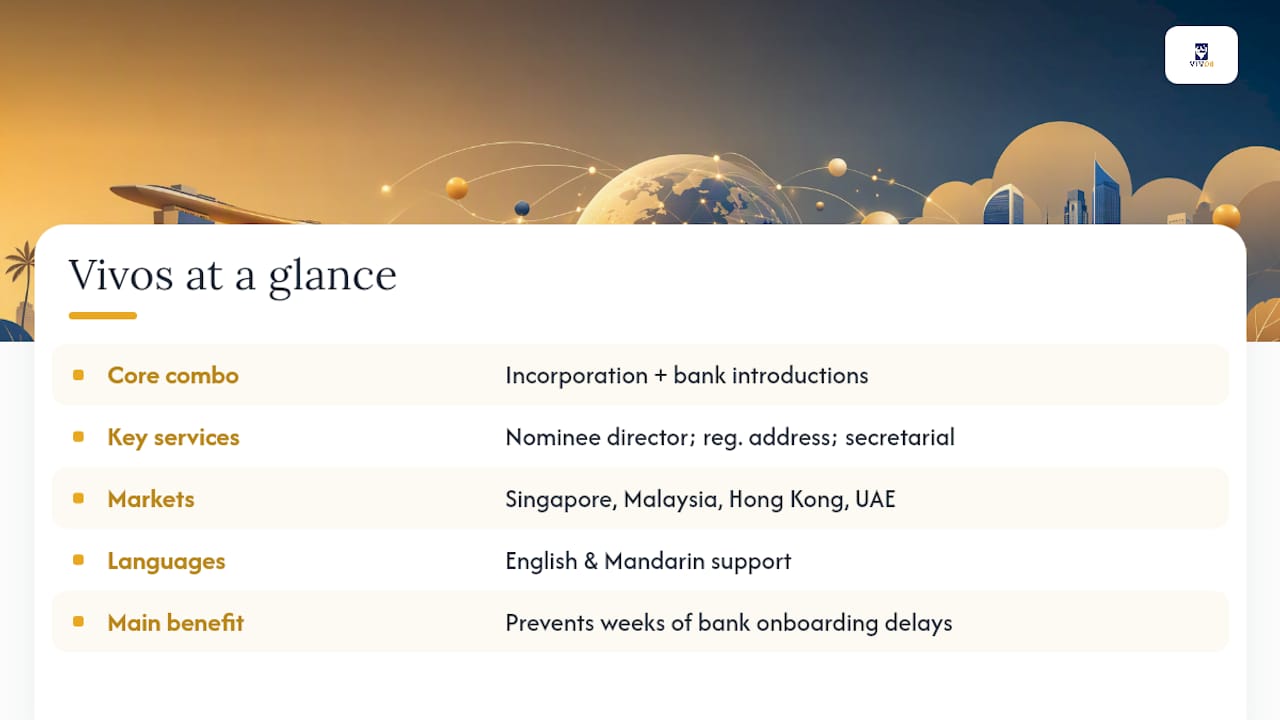
Foreign founders face the sharpest friction in this entire process at the bank onboarding stage, not the incorporation stage. VIVOS provides Singapore company incorporation for foreign founders, including a nominee resident director, registered address, and corporate secretarial services required under the Companies Act, plus direct bank account introductions once the entity is formed.
That combination, incorporation paired with bank introductions, is what actually moves a foreign-owned company from “registered” to “banking-ready.” VIVOS also incorporates companies in Malaysia, Hong Kong, and the UAE, with support delivered in English and Mandarin for founders operating across those markets.
“Most delays we see aren’t about the business itself. They’re about a foreign director missing one document a bank needed on day one,” says Ray Tay, Managing Director of VIVOS.
Because eligibility and documentation requirements shift constantly between providers, VIVOS’s incorporation and bank introduction service exists specifically to keep foreign founders from losing weeks to avoidable compliance gaps.
Tax and Reporting Requirements for Multi-Currency Accounts
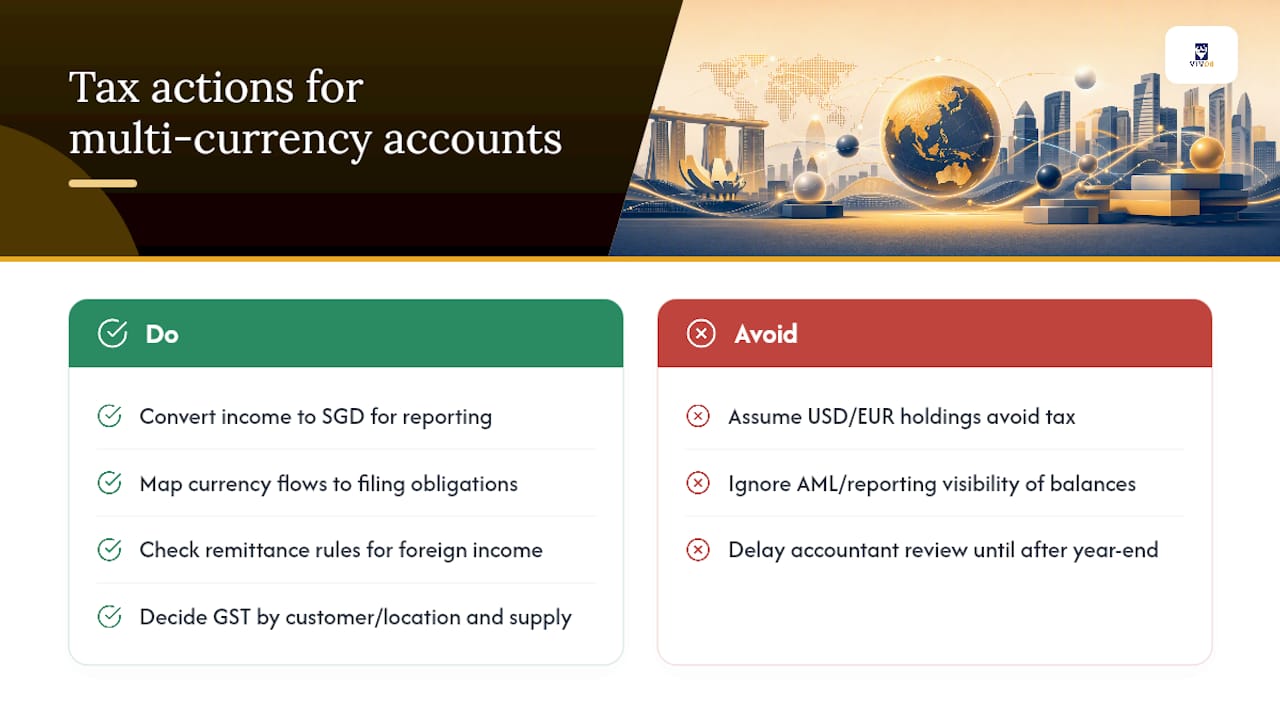
Holding a multi-currency account doesn’t create a separate tax category. Income is still assessed under standard Singapore corporate tax rules regardless of which currency it arrives in, and it gets converted to SGD for reporting purposes at the applicable exchange rate on the transaction date or another consistent method your accountant applies.
Foreign-sourced income can trigger different treatment depending on whether it’s remitted into Singapore and whether specific exemption conditions under the Income Tax Act apply. This is where many foreign founders get caught out. Holding USD or EUR in a fintech or bank multi-currency account doesn’t exempt that income from Singapore tax obligations. It simply delays the currency conversion decision.
GST treatment also depends on where your customer is located and how the service is classified, not on which currency account received the payment. A company invoicing US clients in USD still needs to determine GST treatment based on the nature of the supply and the customer’s location, not the currency itself.
Banks and fintechs both report account information as required under Singapore’s regulatory framework, and MAS enforces anti-money-laundering and counter-terrorism financing rules that require providers to screen transactions and maintain records. None of this changes your filing obligations, but it does mean multi-currency balances show up clearly during any audit or annual filing review.
Get this wrong and you’re not just risking a penalty. You’re risking a foreign tax authority and IRAS both asking questions about the same income at the same time. A qualified accountant should map your currency flows against your filing obligations before your first full financial year closes, not after.
A Founder’s Honest Take on Multi-Currency Setups
Working with foreign founders across Singapore, Malaysia, Hong Kong, and the UAE, the pattern is consistent: businesses that split functions between a bank and a fintech avoid the most common friction points. One account for payroll and statutory protection, one account for fast, cheap receipts and conversions.
The one caution worth repeating: don’t treat fintech onboarding speed as a signal that KYC and MAS compliance requirements are lighter. They aren’t. Speed comes from better digital infrastructure, not looser standards.
— Ray
Get Banking Ready Faster With VIVOS
Comparing bank and fintech accounts only gets you halfway. The harder part, for most foreign founders, is getting a Singapore bank to actually approve the account once the company exists. VIVOS handles that gap directly: Singapore company incorporation, a nominee resident director, a registered address, ongoing corporate secretarial services, and bank account introductions once your entity is formed and compliant.
That combination matters because banks weigh company structure and documentation heavily before opening an account for a foreign-owned entity, and a corporate services provider that has already run this process commonly shortens onboarding timelines and improves approval likelihood. VIVOS also supports founders expanding into Malaysia, Hong Kong, and the UAE, with English and Mandarin service available throughout.
If you’re a foreign founder trying to move from “company registered” to “bank account active,” start with VIVOS’s corporate secretarial services and request a bank introduction as part of your setup.
Sources
Verify current rates and eligibility directly: MAS regulatory portal, DBS Business Multi-Currency Account, UOB Global Currency Account, OCBC Global Savings Account, and Wise’s Singapore account guide. Fees and terms shift, so treat this 2026 comparison as a starting point, not a final rate sheet.
- MAS lists of designated individuals and entities
- DBS Business Multi-Currency Account
- UOB Global Currency Account | UOB Business
- OCBC Global Savings Account | Multi Currency Account
- Best multi-currency accounts in Singapore
- Multi-currency account | send & receive in SGD, USD, EUR, GBP, MYR, PHP, IDR and VND – Aspire
Recommended
- The Foreign Founder’s Guide to Incorporating a Company in Singapore (2026)
- How to Open a Singapore Company Bank Account (2026 Guide)
- Can a Foreigner Own 100% of a Singapore Company?
- Singapore Corporate Bank Accounts 2026: Application to Approval
Related guides
Most Popular

 2 January, 2025
Why Singapore Comes Into Action For Chinese Companies
 2 January, 2025
Malaysia’s Budget 2025: What The Dividend Tax Means For You
Recents Blogs


Nominee Director Services in Singapore: 7 Providers Ranked on 6 Checks (2026)

Since 9 June 2025, a nominee director acting by way of business in Singapore must be arranged by an ACRA-registered corporate service provider.
Does Singapore Offer Citizenship by Investment? (2026)
Singapore has no citizenship by investment programme. Investors can get PR through the Global Investor Programme, then apply to ICA for citizenship after at least…