
Foreign Founders, Avoid Bank Delays When Renaming in Singapore
Published: 29 August 2026 · Last reviewed: 30 September 2026 · Reviewed by Ray Tay, Co-Founder & Managing Director, VIVOS PTE. LTD. (ACRA Filing Agent FA20240323 · MOM EA Licence 24S2425)
To change a company name in Singapore, you reserve the new name through BizFile+, wait for approval, then file the official change of name (with a special resolution for companies) using the transaction ID ACRA issues. Directors or the company secretary usually handle the filing, though an authorized corporate service provider can act on your behalf. Directors stay legally responsible, and local companies must notify ACRA within 14 days of the resolution date.
TL;DR:
- The name reservation through BizFile+ costs S$15 and is valid for 120 days, requiring completion within that timeframe to avoid starting over.
- A company usually needs a special resolution approved by shareholders and proper documentation before filing the change with ACRA, with strict filename and attachment guidelines.
- The statutory deadline for notifying ACRA of the name change is 14 days for local companies and 30 days for foreign firms, with failure risking non-compliance.
- After approval, the name change updates IRAS automatically within about a week, but bank, licensing, and contract updates require proactive notification to avoid delays.
- Filing delays or rejections often stem from name overlaps, undesirable terms, or unapproved restricted words, so conducting thorough pre-checks and preparing supporting documents speeds approval.
Table of Contents
- How Do You Change a Company Name in Singapore?
- Passing the Special Resolution and Filing With ACRA
- What Are the Timelines and Costs for a Name Change?
- What Should You Update After the Name Change Takes Effect?
- Why Do Companies Get Their Proposed Name Rejected?
- Is Xero or Zoho Books Better for a Newly Renamed Singapore Company?
- How Does VIVOS Support Foreign Founders Through Incorporation and Renaming?
- What Happens to Your Existing Contracts When the Company Name Changes?
- How Do You Handle the Company Seal and Statutory Registers After Renaming?
- Does a Name Change Affect Your CDP Account?
- Will Changing Your Company Name Affect Tax Filings or GST Registration?
- A Practical Note From Company Secretarial Practice
- Managed Support for Your Name Change and What Comes After
- Where to Verify These Rules Yourself
- Sources
How Do You Change a Company Name in Singapore?
The process runs through BizFile+, the online portal operated by the Accounting and Corporate Regulatory Authority (ACRA), and it happens in two distinct stages. First, you reserve the proposed name. Second, once that name is approved, you file the actual change of name using the transaction ID generated at reservation. Skip either step or let the reservation lapse, and you start over.
Here’s the sequence in practice:
- Log in via CorpPass as a Business User (a director, secretary, or authorized filer).
- Select the “Apply for new business entity name” eService on BizFile+.
- Choose the purpose as a change to an existing name, enter your proposed name with the correct suffix (Pte. Ltd., LLP, and so on), and pay the S$15 reservation fee.
- Save the transaction ID and note the expiry date. A reserved name is valid for 120 days, and you must complete the change within that window or the name goes back into the public pool.
- Use that transaction ID to file the formal change of name once your internal approvals (special resolution, if required) are in place.
Most applications clear instantly or within a few hours. Others take longer. ACRA typically reviews standard applications within three working days, but if your proposed name touches a regulated term or overlaps with another entity, it gets referred to a specialist authority. Referred cases can take up to 15 working days. If that happens, you’ll see a “referred” status on your BizFile+ dashboard rather than an outright rejection, so hold off on printing new letterheads until the referral clears.
Before you even reach BizFile+, run a quick check using a free name availability search to rule out obvious conflicts. It won’t guarantee approval, but it filters out the names that would get rejected on sight.
Pro Tip: Reserve the name before you draft the special resolution, not after. If the name gets rejected or referred, you’ll want to know before your shareholders vote on wording tied to a name that never clears.
Passing the Special Resolution and Filing With ACRA
Once ACRA approves your reserved name, a private company typically needs a special resolution to formally adopt it, usually requiring a substantial majority vote unless your company’s constitution sets a different threshold. This isn’t a rubber stamp. Get the paperwork wrong and BizFile+ will bounce it back.
A few things trip up first-time filers:
- Save resolution documents as PDFs with simple, ASCII-only filenames. ACRA’s system frequently rejects uploads with spaces or special characters in the file name.
- Combine multiple supporting attachments into a single PDF where possible rather than uploading a dozen separate files.
- File the notice of resolution within the statutory window and be ready to attach supporting documents if ACRA asks for them.
- Double-check your SSIC activity codes are current. Mismatches here can trigger a second round of queries.
Many directors hand this stage to a corporate secretary or a licensed corporate service provider, particularly when timelines are tight or the company has multiple shareholders spread across jurisdictions.
What Are the Timelines and Costs for a Name Change?
Budget S$15 for the ACRA name reservation fee, payable by card or supported digital wallets through BizFile+. That fee is non-refundable, even if the name is later rejected or you withdraw the application.
Key figures to track: Reserved names expire after 120 days. Routine reviews clear within 3 working days; referred cases take up to 15 working days. Local companies must notify ACRA of the change within 14 days of the resolution date, while foreign companies get 30 days.
Miss the 14-day window and you risk falling out of compliance on a statutory deadline, not just a procedural one. Build your internal timeline backward from that date rather than forward from your reservation.
What Should You Update After the Name Change Takes Effect?
The Registrar’s approval is only the legal trigger. Under Section 28 of the Companies Act, the name change becomes effective once the Registrar issues a notice of incorporation under the new name, and everything downstream flows from that notice.
IRAS is usually the first concern for directors. IRAS pulls updated company particulars from ACRA on a weekly cycle, so most companies see the change reflected automatically within a week. If you’re expecting a refund or urgent correspondence, don’t wait. Send a copy of your updated BizProfile to IRAS through myTax Mail to request an immediate update.
Beyond tax, the real friction usually comes from everywhere else:
- Corporate bank accounts at DBS, OCBC, UOB, or wherever you bank. Notify them promptly. Banks are often the slowest to process the change.
- Payment gateways, payroll providers, GST registration details, and InvoiceNow e-invoicing profiles.
- Business licenses and permits tied to the old registered name.
- Clients, suppliers, contracts, your website, invoice templates, and letterhead.
Directors typically own the bank and licensing notifications, while a company secretary or CSP handles the ACRA-facing filings and BizProfile updates.
Pro Tip: Draft your stakeholder notification list before the Registrar issues its notice, not after. Banks and licensing bodies routinely cause the longest post-change delays, and getting ahead of them shortens the disruption window considerably.
Why Do Companies Get Their Proposed Name Rejected?
ACRA rejects or refers proposed names for a handful of predictable reasons. Understanding them upfront saves a filing cycle:
- Identical or near-identical names to an existing registered entity.
- Undesirable names, including anything offensive, misleading about the company’s activities, or likely to cause confusion with a government body.
- Restricted words (bank, university, chamber of commerce, and similar terms) that require ministerial or regulatory approval before use.
- Referral triggers, where the name touches a regulated sector and gets kicked to another authority for sign-off, extending your timeline.
If your name overlaps with an existing trademark or a similarly named business, prepare a letter of consent from the affected party, evidence of trademark clearance, or a certified translation if the name uses non-English characters. A concise, well-documented justification attached to the application shortens the back-and-forth considerably.
Is Xero or Zoho Books Better for a Newly Renamed Singapore Company?
Xero tends to suit foreign founders who want a globally recognized platform with a mature app ecosystem, while Zoho Books appeals to cost-conscious startups already using other Zoho tools for CRM or inventory. Both handle GST filing and local bank feeds reasonably well, but the fit depends on your growth plans and existing software stack.
| Feature | Xero | Zoho Books |
|---|---|---|
| — | Plans typically run from roughly $15 per month or more | Plans typically run from a free tier for very small entities to modest monthly fees |
| GST F5 filing | Supported via GST reporting features | Supported via GST reporting features |
| InvoiceNow readiness | Growing support through connected apps | Native InvoiceNow support in the regional edition |
| Bank feeds (DBS/OCBC/UOB) | Available for major local banks | Available for major local banks |
| Multi-currency | Strong, built for multi-entity founders | Included, solid for standard cross-border invoicing |
| Payroll add-ons | Third-party payroll integrations | Zoho Payroll integrates directly within the ecosystem |
Best for startups: Zoho Books, given the lower entry cost and bundled ecosystem. Best value: Zoho Books again, for solo founders watching every dollar in year one. Best for e-commerce: Xero, thanks to its deeper multi-currency handling and wider app marketplace for inventory and sales channel integrations.
Who handles this?
Choosing accounting software is only useful once the company itself exists and the bank account is open. VIVOS provides Singapore company incorporation for foreign founders, including a nominee resident director, registered address, corporate secretary, accounting setup, and bank account opening, so the software decision comes after the legal groundwork is solid. As Ray Tay, Managing Director of VIVOS, puts it, “Foreign founders often pick accounting software before they’ve even opened a bank account. Get the incorporation and banking sequence right first, and the software choice becomes a lot easier.”
How Does VIVOS Support Foreign Founders Through Incorporation and Renaming?
VIVOS runs a free name-availability search before any BizFile+ filing, then handles the special resolution, ACRA submission, and updated BizProfile delivery end to end. For foreign founders, that pairs with a nominee resident director, registered address, bank account introductions, and accounting setup. VIVOS also incorporates entities in Malaysia, Hong Kong, and the UAE, with English and Mandarin support throughout. Directors can delegate filings to a corporate service provider like VIVOS, but statutory responsibility for accuracy stays with them regardless of who submits the form.
What Happens to Your Existing Contracts When the Company Name Changes?
A name change does not create a new legal entity, and that distinction matters practically. Your Unique Entity Number (UEN) stays the same, contracts remain valid, and obligations under them continue exactly as before. Courts and counterparties generally treat this as a continuation, not a novation.
That said, contracts often name the company explicitly, and leaving the old name unaddressed creates avoidable friction. Landlords, key suppliers, and major clients should receive formal notice of the name change, ideally with a copy of the updated BizProfile or the ACRA notice of incorporation attached. Some counterparties will ask for a deed of variation or an addendum referencing both the old and new names, particularly for long-term leases or financing agreements. This isn’t usually a legal requirement, but it prevents disputes later if a bank or auditor questions why a signed contract carries a name that no longer matches your BizProfile.
Employment contracts, insurance policies, and intellectual property registrations deserve particular attention. Trademarks and patents registered under the old company name may need an ownership update with the Intellectual Property Office of Singapore, and insurers should be notified so claims aren’t delayed on a technicality. None of this blocks day-to-day operations, but leaving it undone for months tends to surface at the worst possible moment, usually during due diligence for financing or an audit.

How Do You Handle the Company Seal and Statutory Registers After Renaming?
Singapore abolished the mandatory common seal requirement for most companies years ago, so many private companies today operate without one entirely. If your company still uses a seal for specific documents (some banks or overseas counterparties still request sealed documents for certain transactions), you’ll need a new seal engraved with the updated company name. Keep the old seal secured and clearly marked as void rather than discarding it, in case historical documents ever need verification against it.

Your statutory registers are a separate and more urgent matter. Under the Companies Act, every company must maintain registers of members, directors, secretaries, and, where applicable, registrable controllers. These registers must reflect the current legal name of the company as the record-keeping entity, even though the underlying membership and directorship data doesn’t change because of a rename.
Update the header and any entity references across these registers promptly once the Registrar issues the notice of incorporation under the new name. If your company uses a physical minute book or register binder, insert a note recording the date and resolution reference for the name change, so future directors or auditors have a clear paper trail. Companies using electronic register software or a corporate secretarial platform typically see this reflected automatically once the CSP updates the entity’s core profile, which is one advantage of outsourcing this function rather than tracking it manually across spreadsheets.
Does a Name Change Affect Your CDP Account?
If your company has securities lodged with the Central Depository (CDP), whether shares in another listed entity held as a corporate investment, or your own listed shares if you’re a public company, the CDP account needs a separate update once the ACRA name change is finalized.
CDP does not automatically sync with ACRA’s BizFile+ system the way IRAS does. You’ll need to submit a formal request to CDP, typically through your appointed broker or directly if you hold a corporate CDP account, along with a certified copy of the ACRA notice of incorporation reflecting the new name. Expect to provide supporting board resolution documents confirming the name change was properly authorized.
This step gets overlooked more often than it should, mainly because most private companies going through a rename don’t hold CDP accounts at all. It becomes relevant primarily for companies that hold shares in other Singapore-listed entities as investments, or for private companies preparing for a future listing where CDP infrastructure is already partially in place. If this doesn’t apply to your company, skip it. If it does, treat it as a priority item alongside your banking updates, since delays here can affect dividend processing or corporate action notices tied to your holdings.
Will Changing Your Company Name Affect Tax Filings or GST Registration?
No. A name change does not alter your UEN, your tax reference number, or your GST registration status. IRAS treats this as an administrative update to an existing taxpayer record, not a new registration event, and your GST number, filing frequency, and F5 filing obligations continue uninterrupted.
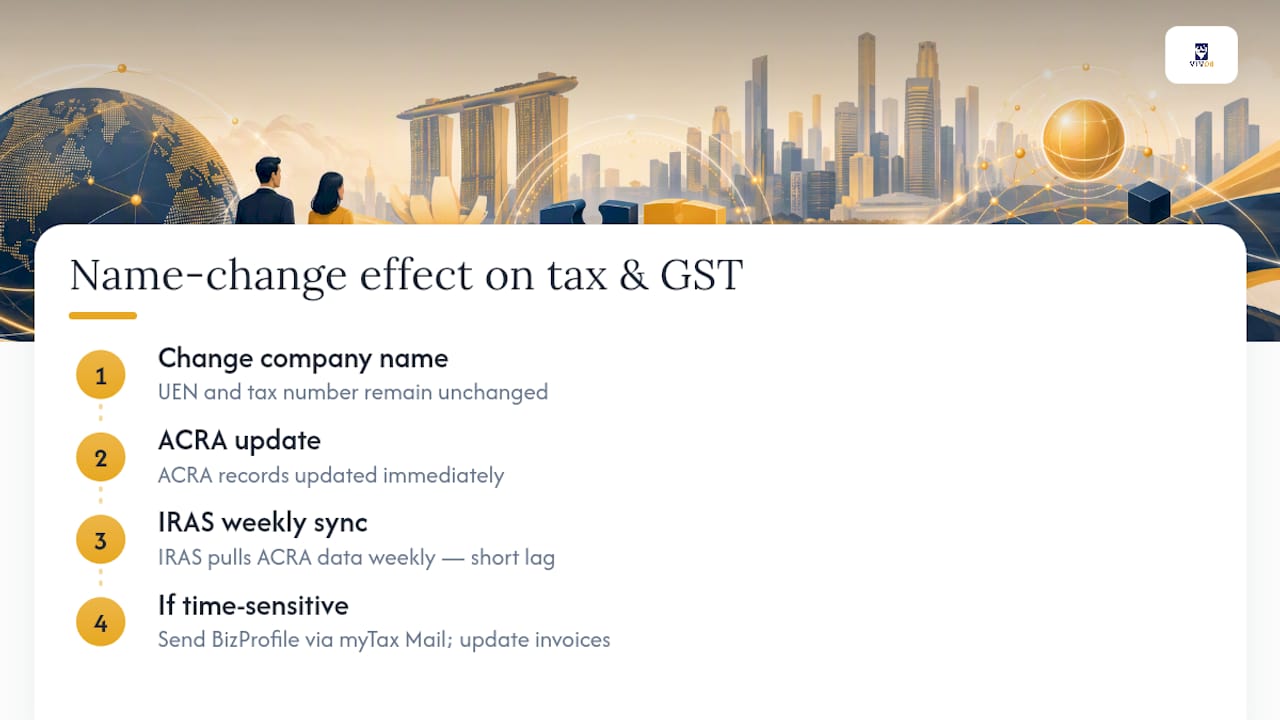
The practical risk isn’t a broken registration. It’s a timing mismatch. Because IRAS syncs company particulars from ACRA on a weekly basis, there’s a short window where your official tax correspondence and any GST F5 acknowledgments might still reference the old name. This rarely causes a substantive problem, but it can create confusion if your accountant or auditor cross-checks filings against your current BizProfile during that lag.
If you’re mid-way through a GST refund claim, awaiting a tax assessment, or expecting time-sensitive correspondence from IRAS, don’t rely on the automatic weekly sync. Send your updated BizProfile to IRAS directly through myTax Mail to trigger an immediate update on their end. This is a five-minute task that avoids weeks of confused back-and-forth over a document referencing a name your company no longer legally holds.
Update your invoicing templates and InvoiceNow e-invoicing profile at the same time. GST-registered invoices issued under the old name after your change takes effect are technically still valid tax documents, but they invite unnecessary questions from clients and, eventually, from IRAS itself during an audit.
A Practical Note From Company Secretarial Practice
Two habits separate a clean name change from a messy one. First, get your filename and document formatting right before you upload anything to BizFile+. Rejected uploads over a stray space in a filename are entirely avoidable and cost days. Second, on the day the Registrar’s notice lands, send your updated BizProfile to your bank and payroll provider immediately. Everything else can wait a week. Those two cannot.
— Ray
Managed Support for Your Name Change and What Comes After
VIVOS gives you a filing team instead of a BizFile+ login screen and a countdown clock. That’s the practical difference for a director juggling a rename alongside actual business operations: a free name-availability check before you spend the S$15 reservation fee, hands-on preparation of your special resolution and supporting PDFs formatted the way ACRA expects, and a completed filing that arrives at your bank and payroll provider on day one instead of week three.

The scope covers the full cycle, not just the ACRA paperwork: registered address, nominee resident director support where needed, bank account introductions at DBS, OCBC, or UOB, and accounting setup once the new BizProfile is live. For readers who incorporated with foreign ownership structures, VIVOS also handles corporate secretarial filings on an ongoing basis, so a rename doesn’t turn into a one-off scramble followed by months of loose ends. If your rebrand also touches licensing conditions, VIVOS supports licensing and compliance updates tied to the new entity name as well.
If you’re setting up a Singapore company from abroad and want the incorporation, secretarial, and banking pieces handled by one team from day one, start with VIVOS’s incorporation service for foreign founders and get your BizFile+ filings, name reservation, and bank introductions moving in the same conversation.
Where to Verify These Rules Yourself
Cross-check any filing detail directly against the source before you submit. ACRA’s guide to changing a business name covers reservation and filing steps, while its entity information update guide details the 14-day and 30-day notification windows. IRAS explains its company particulars update cycle, and Section 28 of the Companies Act sets the legal effect of the Registrar’s notice. For complex restructurings tied to a rename, a specialist like Beyond Horizons can advise on insolvency or reorganization angles beyond standard ACRA procedure.
This article is general information, not a substitute for advice from a qualified lawyer. Consult a qualified legal professional about your own circumstances before acting on anything here.
Sources
- Changing your business name | Accounting and Corporate Regulatory Authority
- Updating company particulars | IRAS
- Section 28 — Companies Act 1967
Recommended
- How to Open a Singapore Company Bank Account (2026 Guide)
- The Foreign Founder’s Guide to Incorporating a Company in Singapore (2026)
- How to Reserve a Company Name in Singapore (2026)
- Singapore Business Bank Account for Non-Residents (2026)
Related guides
Most Popular


 2 January, 2025
Why Singapore Comes Into Action For Chinese Companies
 2 January, 2025
Malaysia’s Budget 2025: What The Dividend Tax Means For You
Recents Blogs


Nominee Director Services in Singapore: 7 Providers Ranked on 6 Checks (2026)

Since 9 June 2025, a nominee director acting by way of business in Singapore must be arranged by an ACRA-registered corporate service provider.

Does Singapore Offer Citizenship by Investment? (2026)
Singapore has no citizenship by investment programme. Investors can get PR through the Global Investor Programme, then apply to ICA for citizenship after at least…