IR21 Tax Clearance for Employers in Singapore: 2026 Guide
Published: 1 August 2026
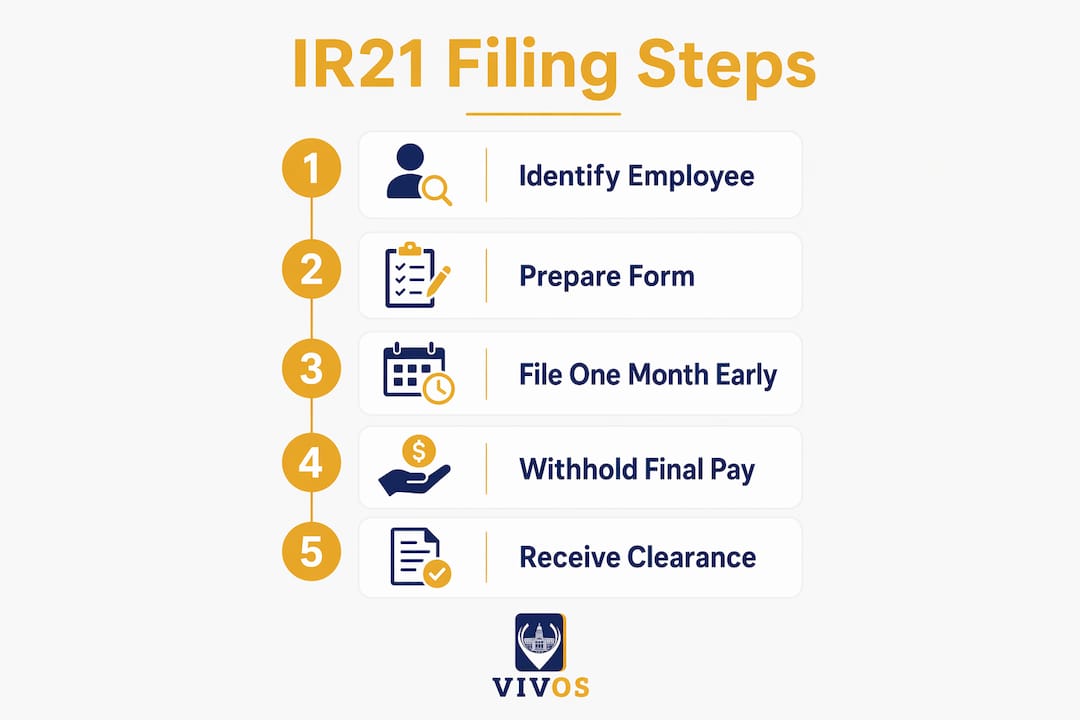
File Form IR21) at least one month before a non-Singapore citizen employee ceases employment, is posted overseas, or leaves Singapore for more than three months — and withhold all monies due from the moment you are aware of the departure. That is the core obligation. Miss it, and fines apply/getting-tax-clearance-a-step-by-step-guide) apply, plus potential personal liability for the employee’s unpaid tax.
What to do in the next 24–72 hours:
Confirm the employee’s last day of employment or departure date.
Gather the employee’s ID/passport number, work pass type, and last pay details.
Collect spouse and children particulars (names, ID numbers, relationship) for tax relief purposes.
Verify your company’s Corppass access and authorized user roles for myTax Portal.
Calculate all monies due: salary, bonuses, leave pay, gratuities, allowances, and overtime.
Immediate action checklist:
Set the filing deadline: count back one month from the cessation or departure date.
Begin withholding all monies from the date of awareness.
Log in to myTax Portal/filing-tax-clearance) and initiate the IR21 e-filing.
Submit and save the acknowledgement reference number.
Monitor the portal for the Clearance Directive (typically within 21 days).
Pro Tip:E-file via myTax Portal rather than submitting a paper form. You receive immediate acknowledgement, faster processing, and can access the electronic Clearance Directive online without waiting for postal delivery.
Tax clearance applies) to all non-Singapore citizen employees, including every category of work pass holder. The obligation is broad by design.
Employee categories that trigger IR21 filing:
All non-Singapore citizens ceasing employment in Singapore.
Singapore Permanent Residents (SPRs) going on overseas postings or employment.
All work pass holders: Employment Pass, S Pass, Work Permit, Personalised Employment Pass (PEP), and Overseas Networks & Expertise Pass (ONE Pass) holders.
Employees on Special Passes pending departure.
Scenarios that trigger filing:
Employee resigns or is terminated and ceases employment in Singapore.
Employee is posted overseas (unless specific exemption conditions are met).
Employee leaves Singapore for any period exceeding three months.
End of fixed-term contract where the employee will not be re-engaged.
When IR21 is NOT required:
Certain scenarios are exempt. Tax clearance is not required when:
The employee is an SPR with no intention of leaving Singapore permanently, and you obtain a Letter of Undertaking from the employee for your records.
The overseas posting does not exceed six months, the employee holds a valid work pass under the same employer during the posting, and the Singapore employer continues paying remuneration throughout.
The employee has not been previously employed by another employer in Singapore within the cessation year or the year prior. If you are unsure of the employee’s past employment history, IRAS recommends e-filing the IR21 anyway — the portal will return an immediate notification if clearance is not required.
For exempt cases, submit the employee’s employment income via Form IR8A or the Auto Inclusion Scheme (AIS) by March 1 of the following year instead.
Pro Tip:When in doubt about whether an exemption applies, e-file the IR21. The myTax Portal will notify you immediately if tax clearance is not required, eliminating the risk of a missed filing.
When must you file Form IR21?
The one-month rule is non-negotiable. File at least one month before the employee’s last day of employment, the start of an overseas posting, or the departure date for a stay exceeding three months.
How the clock starts:
The filing deadline is calculated from the date you become aware of the impending cessation or departure, not from the official resignation letter date. If an employee verbally confirms departure on March 2, withholding begins on March 2 and the IR21 must be filed by the date one month before the cessation date.
Calendar examples:
Resignation with notice: Employee resigns on March 2 with a last day of April 30. File IR21 by March 30 (one month before April 30). Begin withholding from March 2.
Immediate resignation: Employee resigns on March 2 with no notice period, effective immediately. File IR21 as soon as possible and state the reason (immediate resignation) in the form. IRAS grants a 10-day grace period/getting-tax-clearance-a-step-by-step-guide) beyond the one-month window for valid reasons — treat this as a last resort, not standard practice.
Overseas posting: Employee is posted overseas starting May 15. File IR21 by April 15.
If you cannot meet the one-month deadline
Complete the IR21 and state the reason clearly in the form.
Submit supporting documentation (resignation letter, email confirmation of departure).
File as soon as possible — unexplained delays still attract penalties even within the grace period.
Pro Tip:Build the IR21 filing date into your HR offboarding checklist the moment an employee hands in notice. Waiting until the final week creates avoidable risk.
How to file Form IR21 via myTax Portal
E-filing is the preferred method. IRAS strongly recommends/filing-tax-clearance) it for immediate acknowledgement, faster processing, and online access to the Clearance Directive.
Step-by-step e-filing process:
Log in to myTax Portal using your company’s Corppass credentials.
Navigate to “Employers” and select “File IR21.”
Enter the employee’s identification details (NRIC/FIN, passport number, work pass type).
Input employment income by calendar year: base salary, bonuses, overtime, allowances, leave pay, gratuities, and any lump-sum payments.
Enter ESOP/ESOW details if applicable (see note on Tracking Option below).
Complete spouse and children particulars to allow IRAS to apply relevant tax reliefs — including these details/filing-tax-clearance/how-to-complete-the-form-ir21) reduces the likelihood of a revised Clearance Directive.
Enter the amount withheld and the reason if you cannot withhold the full amount.
Review all entries, submit, and save the acknowledgement reference number.
Paper filing fallback:
Download the IR21 form (DOCX/PDF) from the IRAS website, complete it manually, and mail it to IRAS. Paper forms take longer to process and delay Clearance Directive delivery. Use this route only when Corppass access is unavailable.
Required documents and data to collect before filing:
Total monies withheld and breakdown by payment type
Spouse and children
Full name, ID number, relationship, date of birth
ESOP/ESOW details
Grant date, exercise date, gains (or Tracking Option status)
Reason for late filing
If applicable, supporting documentation
ESOP/ESOW note: IRAS allows a Tracking Option for certain share plan gains so employers can report actual realized gains instead of deemed exercise values. Employers must apply for this option and meet qualifying conditions before using it on the IR21.
Pro Tip:Reconcile the last pay period’s pro-rata amounts before completing the “amount withheld” field. IRAS explanatory notes include worked examples for salary paid in advance — review these to avoid the most common revision trigger.
Withholding final pay: what to hold back and how to account for it
From the date you are aware of the impending cessation or departure, withhold all monies/getting-tax-clearance-a-step-by-step-guide) due to the employee. This is a legal obligation, not a discretionary step.
Monies subject to withholding:
Base salary (including any salary paid in advance)
Bonuses and commissions
Overtime pay
Annual leave encashment
Gratuities and ex-gratia payments
Allowances (housing, transport, meal, and others)
Reimbursements that form part of employment income
Lump-sum payments on termination
Payroll withholding workflow:
Flag the employee’s payroll record as “pending tax clearance” from the date of awareness.
Calculate all monies due through the cessation date, including pro-rata amounts.
Hold the full calculated amount in a designated payroll suspense account.
Record the withheld amount and its breakdown on the IR21 form.
Release funds only after receiving the Clearance Directive from IRAS.
If you cannot withhold the full amount:
Document the reason clearly in the IR21 form. Failure to explain/getting-tax-clearance-a-step-by-step-guide) why monies were not withheld may result in the employer being held personally liable for the employee’s unpaid tax. Common valid reasons include an employee who has already left Singapore before the employer became aware, or a case where the employee had no remaining pay due.
Employer liability is real. If you release monies before receiving the Clearance Directive and the employee has an outstanding tax balance, IRAS may pursue the employer directly for that amount. The withholding obligation is the employer’s primary protection against this outcome.
Internal controls to implement:
Designate a named HR or payroll officer responsible for IR21 cases.
Require dual sign-off before any withheld amount is released.
Maintain a log of all IR21 cases with filing dates, withheld amounts, and Clearance Directive receipt dates.
Pro Tip:Coordinate between HR, payroll, and finance at the point of resignation — not at the point of filing. Delays in internal communication are the most common reason employers miss the withholding start date.
What IRAS does after you file: processing times and Clearance Directives
IRAS processes most IR21 forms in a few weeks. E-filed forms are processed faster, and the electronic Clearance Directive is available on myTax Portal shortly after processing. Paper submissions take longer and the postal Clearance Directive adds some extra days for delivery.
Two possible Clearance Directive outcomes:
Directive to Pay Tax: IRAS has assessed a tax liability. The employer must remit the outstanding tax within 10 days of the Directive. GIRO is not applicable for tax clearance cases — payment must be made immediately by the due date stated on the Directive.
Notification to Release Monies: No tax is outstanding. The employer releases the withheld amount to the employee.
After the Directive arrives:
Check myTax Portal for the electronic copy (available within three working days of processing).
For a Directive to Pay Tax: remit the assessed amount within 10 days. If the withheld amount is insufficient, the employee must pay the shortfall within seven days of receiving the Statement of Account.
For a Notification to Release Monies: release the full withheld balance to the employee promptly.
If additional income arises after the original IR21 (e.g., a bonus paid post-cessation), file an Additional/Amended IR21 before releasing that income.
Refunds and overpayments:
If the withheld amount exceeds the assessed tax, IRAS will refund the excess to the employee directly. Employers do not need to manage the refund process — the IR21 tax refund flow is handled between IRAS and the employee once the Directive is issued.
Pro Tip:Check myTax Portal for the electronic Clearance Directive rather than waiting for the postal copy. The three-working-day electronic turnaround after processing means you can act on the Directive significantly faster than the postal timeline allows.
Penalties and common IR21 filing mistakes to avoid
Employers who file late or not at all without a valid reason face fines/getting-tax-clearance-a-step-by-step-guide) may be imposed. Beyond the fine, releasing withheld monies before the Clearance Directive arrives can make the employer personally liable for the employee’s unpaid tax.
Most common IR21 filing errors:
Incorrect cessation date entered on the form.
Salary paid in advance not declared as income for the correct period.
Spouse and children particulars omitted, preventing IRAS from applying reliefs and potentially increasing assessed tax.
Withholding amount miscalculated due to pro-rata errors on the final pay period.
Late filing with no reason stated in the form.
Releasing monies before the Clearance Directive is received.
Filing a paper form when Corppass e-filing access is available.
Authorized signatory on the IR21 does not match the company’s registered signatories.
Preventive checklist (8 items):
Confirm the cessation date against the employment contract and resignation letter.
Declare all income including salary paid in advance, referencing IRAS explanatory notes/filing-tax-clearance/how-to-complete-the-form-ir21) for worked examples.
Complete spouse and children particulars in full before submitting.
Reconcile payroll records to the IR21 income figures before filing.
Verify the authorized signatory matches the company’s registered details.
State the reason for any late filing or inability to withhold in the form.
Save the e-filing acknowledgement reference and file date.
Do not release withheld monies until the Clearance Directive is in hand.
If IRAS queries your IR21: Prepare payroll records, the employment contract, the resignation letter, and all supporting income documentation. Respond promptly and in writing. Delays in responding to IRAS queries extend the processing timeline and delay the Clearance Directive. For complex disputes or assessments, tax dispute resolution support from a qualified corporate services provider reduces response time and risk.
How Vivos supports employers with IR21 and tax clearance compliance
Vivos provides end-to-end IR21 support for employers in Singapore, covering every stage from payroll reconciliation to Clearance Directive receipt. The service is designed for HR, payroll, and finance teams that need reliable, compliant filing without building the process in-house.
What Vivos delivers:
Pre-filing payroll reconciliation: verifying all income items, pro-rata calculations, and withholding amounts against payroll records.
IR21 drafting and e-filing via myTax Portal using Corppass authorization.
Authorized signatory support and document pack preparation.
Handling IRAS queries and follow-up correspondence until the Clearance Directive is issued.
Remittance coordination for Directive to Pay Tax cases.
Amended IR21 filing for post-cessation income adjustments.
Vivos engagement process:
Employer provides employee details, employment records, and payroll data.
Vivos reconciles income figures and prepares the IR21 draft for employer review.
Employer approves; Vivos e-files via myTax Portal and provides the acknowledgement reference.
Vivos monitors the portal and notifies the employer when the Clearance Directive is available.
Vivos advises on payment or release of withheld monies per the Directive.
Vivos works directly with HR, payroll, and finance contacts within the employer’s organization. For straightforward cases, turnaround from document receipt to e-filing submission is typically within two to three business days. Complex cases involving ESOP/ESOW, multiple income streams, or cross-border elements take longer but follow the same structured process.
Beyond IR21, Vivos’s capabilities in annual tax filing, withholding tax advisory, and tax dispute resolution mean employers have a single point of contact for the full range of Singapore employer tax obligations.
Pro Tip:Engage Vivos at the point of resignation, not at the filing deadline. Early engagement allows payroll reconciliation to run in parallel with the notice period, eliminating last-minute errors and missed withholding.
Key Takeaways
Employers in Singapore must file Form IR21 sufficiently before a non-Singapore citizen employee’s cessation date, withhold all monies from the date of awareness, and act on the Clearance Directive within the prescribed deadlines to avoid fines and personal liability.
Point
Details
File one month early
Submit Form IR21 at least one month before cessation, overseas posting, or departure exceeding three months.
Withhold all monies immediately
Hold salary, bonuses, leave pay, gratuities, and all other payments from the date you become aware of the departure.
E-file via myTax Portal
E-filing provides immediate acknowledgement and electronic Clearance Directive access within three working days of processing.
Act on the Clearance Directive within 10 days
Remit tax per a Directive to Pay Tax within 10 days; GIRO is not accepted for tax clearance payments.
Engage Vivos for complex cases
ESOP/ESOW elements, tight notice periods, or IRAS queries benefit from Vivos’s end-to-end IR21 and tax clearance support.
What practitioners who handle IR21 regularly know
Most IR21 errors are not caused by ignorance of the rules. They are caused by process gaps: the payroll team files the form before HR has confirmed the final bonus, or the finance team releases withheld funds because the employee is pressing for payment and the Clearance Directive hasn’t arrived yet. The form itself is not complicated. The coordination is.
The single most valuable step any payroll team can take is reconciling the last pay period before touching the IR21 form. IRAS’s own explanatory notes include worked examples for salary paid in advance precisely because this is where most revisions originate. A revised Clearance Directive adds weeks to the process and creates friction with a departing employee who is waiting for their final pay.
Spouse and children particulars deserve more attention than they typically get. Many employers skip this section because it feels like the employee’s responsibility. It is not. Including complete family details allows IRAS to apply relevant reliefs, which can reduce the assessed tax and eliminate the need for an amended filing. That is a small pre-filing step with a disproportionately large payoff in processing speed.
One more point that practitioners see repeatedly: employers who use e-filing and keep a scanned copy of the signed IR21 in their records resolve IRAS queries in a fraction of the time it takes employers who filed on paper. The audit trail is immediate and complete. For Singapore personal income tax matters that follow the IR21, having that documentation in order also protects the employer if the employee later disputes the income figures reported.
Vivos handles IR21 filing so your team doesn’t have to
Vivos is the practical alternative to managing IR21 tax clearance in-house, particularly for SMEs, multinational employers, and payroll outsourcers handling multiple departing employees at once. The concrete difference: your team hands over the payroll data and employee details, and Vivos handles reconciliation, drafting, e-filing, IRAS correspondence, and Clearance Directive follow-up from start to finish.
For employers dealing with tight notice periods, ESOP/ESOW complications, or employees who have already left Singapore, Vivos’s structured process reduces the risk of late filing penalties and employer liability. The service covers corporate secretarial compliance, tax filing, and payroll reconciliation under one engagement, so IR21 does not sit in a gap between departments.
Contact Vivos for an IR21 health check or end-to-end filing support. Turnaround from initial document submission to e-filing is typically two to three business days for standard cases. Reach the Vivos team at vivos.com.sg to get started.
Useful official resources for IR21 and tax clearance
The following IRAS pages are the authoritative source documents for all IR21 filing requirements. Bookmark these for your HR and payroll teams.
Official IRAS links:
Tax Clearance for Foreign & SPR Employees (IR21)) — overview, scope, and exemptions.
For employee-side guidance on Singapore income tax rates and what to expect after the IR21 assessment, the Singapore income tax rates guide provides a useful reference on current marginal rates.
This article provides general information on IR21 tax clearance obligations in Singapore. It is not legal or tax advice. Employers should verify current requirements directly with IRAS or consult a qualified tax professional for their specific circumstances.
A quick-reference glossary of Singapore immigration, corporate structuring and family office terms — GIP, EP, COMPASS, Section 13O/13U, VCC, PTC and more — each linked…
Singapore has no estate duty, no inheritance tax and no capital gains tax. Here's how HNW families use Private Trust Companies, reserved-powers trusts and the…
There's no special family-office visa. SFO principals and key staff go through an ordinary Employment Pass under MOM's COMPASS framework — here's the salary benchmark,…