

Avoid 10% Treasury Breach: Share Buyback Rules for Singapore Directors

Compliance first buyback guide for Singapore directors. Covers the 20% cap, 10% treasury limit, solvency statement and ACRA filing steps.
Published: 12 September 2026
An allotment of shares is the company issuing new shares to a new or existing shareholder, most often to raise capital, bring on a co-founder, or grant equity to employees. In Singapore, the Companies Act requires you to notify ACRA through BizFile+: public companies must lodge the return of allotment promptly, while a private company’s allotment only takes legal effect once ACRA updates the electronic register of members.
TL;DR:
- Shareholders must be properly identified, and addresses verified to meet ACRA requirements before filing the return of allotment to avoid rejection.
- The allotment only becomes legally effective once ACRA updates the electronic register of members; filing delays can impact investor rights and issuance of certificates.
- Private companies cannot backdate allotments; they take effect only when the filing is completed and ACRA confirms the transaction.
- For overseas investors, coordinating wire transfers and considering the timing of consideration receipt is crucial for compliance and accurate filing.
- Using a corporate secretary or secretarial service helps ensure proper procedure, documentation, and timely submission, reducing risks of errors and delays.
An allotment is distinct from a share transfer. A transfer moves existing shares from one shareholder to another. An allotment creates brand-new shares out of the company’s authorized capital and issues them for the first time, whether that’s to a venture investor writing a check, a co-founder joining after incorporation, or an employee exercising a stock option.
Companies allot shares for a handful of recurring reasons: a funding round where a new investor wants equity, a co-founder buy-in where sweat equity gets converted into shares, or an employee share scheme where option grants convert into actual holdings. Each of these triggers the same statutory machinery under the Companies Act, and each one needs to be reported to ACRA through BizFile+, the government’s company registry filing portal.
For private companies, which cover the overwhelming majority of Singapore entities, an allotment doesn’t become legally effective the moment the board signs off. It becomes effective only when ACRA updates the electronic register of members (EROM) upon filing. You cannot backdate this. If your investor wired funds in March but you file the return in May, the shares are legally allotted in May, not March. That timing gap catches a lot of first-time founders off guard, particularly those closing rounds with overseas investors on a tight schedule.
The process runs through a fixed sequence. Skipping a step, or doing them out of order, is the fastest way to end up with a rejected BizFile+ submission or a cap table that doesn’t match your statutory records.
If you’re closing a round with an overseas investor, coordinate steps 4 through 7 tightly. Wire transfers from foreign accounts can take days to clear, and you don’t want to file a return of allotment before the funds have actually landed. A shareholders agreement drafted alongside the allotment terms helps lock in expectations around timing, valuation, and any pre-emption waivers before money changes hands.
A few checks up front save you from a rejected filing or a messy cap table later.
Pro Tip: Run the cap table reconciliation before the board meeting, not after. Catching a mismatched share count or an inconsistent currency label before you pass the resolution is far less painful than discovering it mid-filing on BizFile+.
BizFile+ is ACRA’s eService portal, and the “Update shares information” transaction is where you report an allotment.
The most common rejection triggers are address jurisdiction mismatches, incorrect paid-up figures, and mislabeled share classes or subclasses. ACRA’s own instructional pages for BizFile+ share filings walk through each field, and it’s worth reading them once even if your corporate secretary is handling the submission.
Once you submit, private-company allotments take effect the moment ACRA updates the EROM. You’ll get a filing receipt confirming the transaction, and that receipt is your proof of the effective date, useful for investor documentation and future due diligence.
Public companies must lodge the return of allotment within 14 days of the allotment date, as set out in the Companies Act. Private companies face a different mechanic entirely: the allotment doesn’t take effect until the return is filed and ACRA updates the register of members, and it can’t be backdated to an earlier date. In practice, that means share certificates shouldn’t be issued, and investor rights shouldn’t be treated as active, until the BizFile+ filing has gone through and been confirmed.
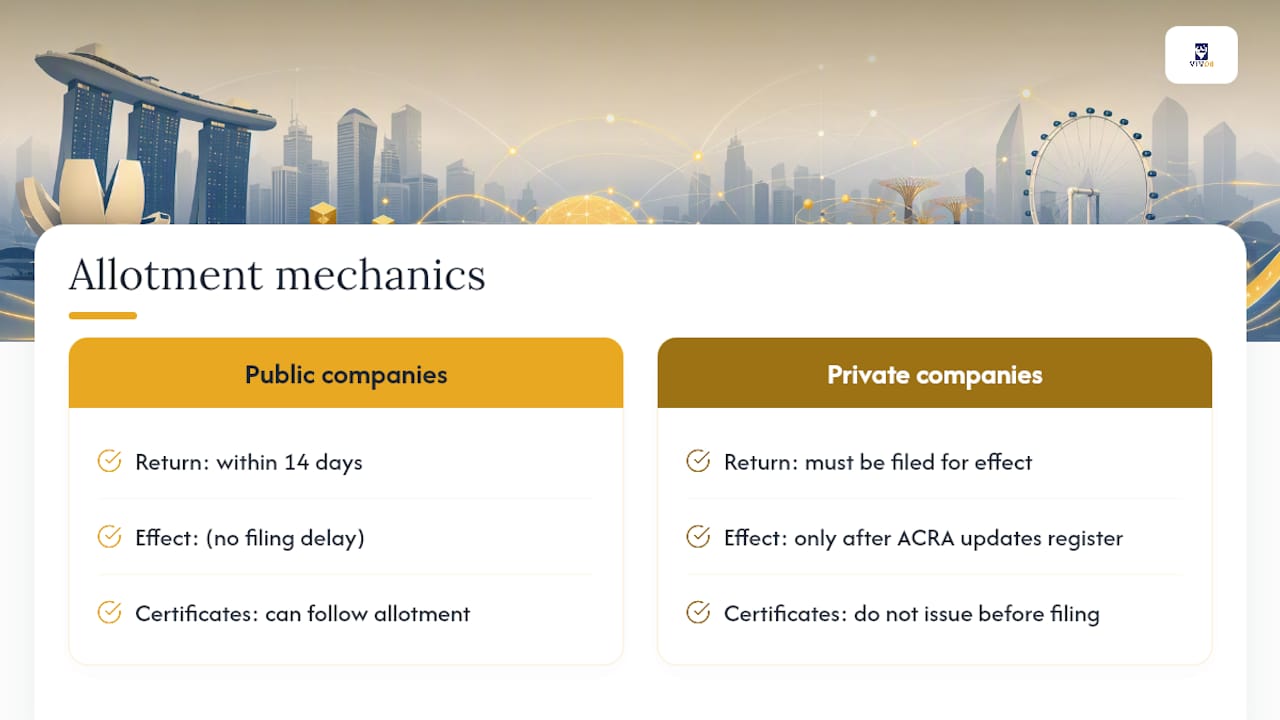
Pre-emption rights aren’t automatic under the Companies Act. They exist only if your company’s constitution grants them, typically requiring the company to offer new shares to existing shareholders proportionally before issuing to an outside party.
Non-cash consideration, think intellectual property, equipment, or services rendered, needs a signed contract or valuation memo attached to your BizFile+ filing.
Most rejected filings trace back to the same handful of errors.
Pro Tip: Keep a submission folder with the signed resolution, evidence of consideration, the reconciled cap table, and a saved copy of the BizFile+ filing receipt. If ACRA ever queries the filing, you want everything in one place rather than reconstructing it under time pressure.
If an error slips through after filing, correcting it usually means submitting a Notice of Error through ACRA. In cases where the error is contested or ACRA can’t process a straightforward correction, you may need a court order to amend the register. Reconciling your cap table before filing, rather than after, is the cheapest way to avoid both outcomes.
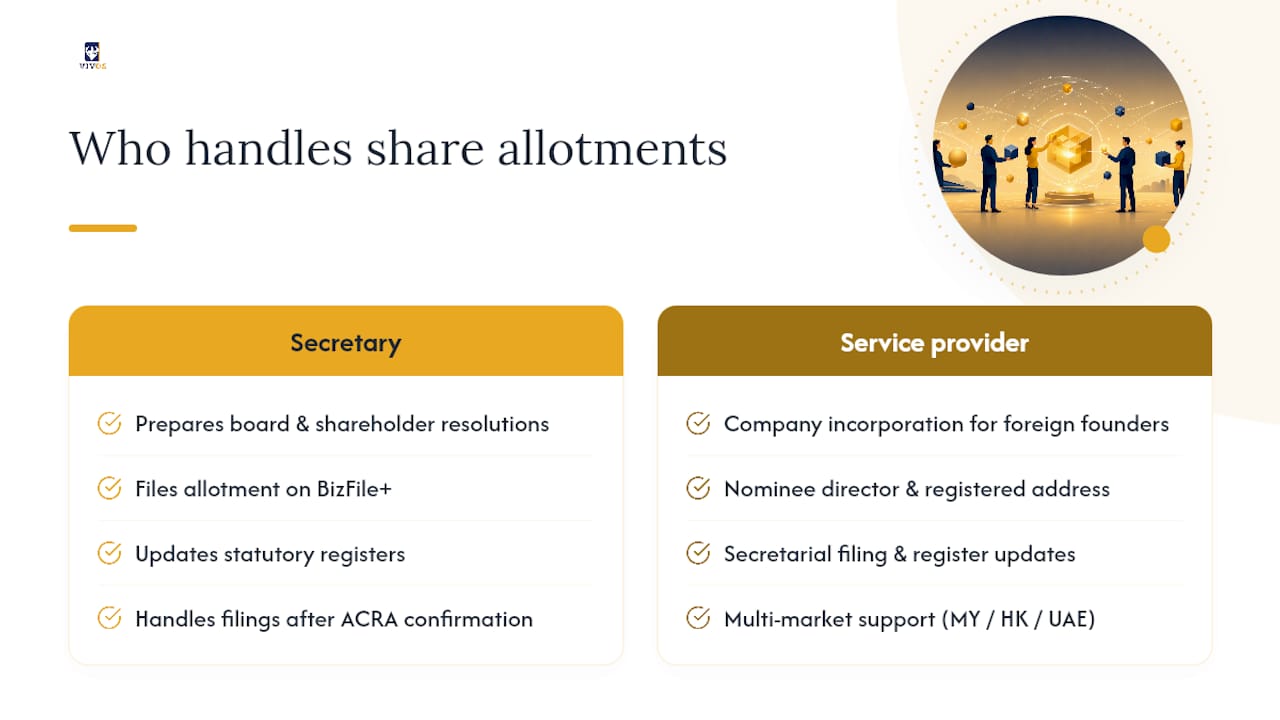
A corporate secretary typically prepares the board and shareholder resolutions, files the return of allotment on BizFile+, and updates the statutory register of members and register of shareholders once ACRA confirms the transaction. For a solo founder or a lean team, this is usually the point where outside help becomes worth it, especially when investors are overseas and every day of delay affects a closing timeline; consider engaging an experienced app developer Singapore for SMEs to support your administrative tools and integrations.
Corporate service providers offer Singapore company incorporation for foreign founders, including nominee resident director services, registered addresses, and corporate secretarial handling of the allotment and filing process itself. That secretarial function covers the entire cycle, drafting the resolution, filing on BizFile+, and issuing the updated share register, so the founder isn’t reconstructing Companies Act procedure from scratch mid-round. Some providers also operate in Malaysia, Hong Kong, and the UAE, with bilingual English-Mandarin support for founders coordinating across those markets.
That’s Ray Tay, Managing Director of Vivos, on why compliance-first sequencing protects directors from personal liability rather than just satisfying a filing requirement. For founders juggling incorporation, banking, and a funding round simultaneously, having a corporate secretary who handles allotments and filings as a standing service, rather than a one-off task, tends to be the difference between a clean cap table and a scramble before the next round.
Foreign founders issuing shares to overseas investors run into the same three snags repeatedly: a resident director requirement they didn’t plan for, a shareholder address that doesn’t match the jurisdiction on file, and a cap table that quietly drifts out of sync across time zones and currencies. None of these are complicated on their own. They become expensive when they surface mid-closing.
Fix them early. Confirm your resident director arrangement before you need it, verify every shareholder’s address against their actual jurisdiction, and reconcile your cap table in one currency before the board resolution gets drafted. Vivos works with foreign founders on exactly this kind of cross-border sequencing.
— Ray
Handling an allotment yourself means tracking Companies Act deadlines, BizFile+ field requirements, and cap table reconciliation on top of actually running your business, and a missed step can delay a funding round by weeks. Vivos gives foreign founders a faster path: a corporate secretary who prepares your resolutions, files the return of allotment on BizFile+, and updates your statutory registers as a standing part of the service, not a one-off request.

That package pairs with the nominee resident director and registered address foreign founders often need to incorporate in the first place, plus bilingual English-Mandarin support if your investors or co-founders are coordinating across Singapore, Malaysia, Hong Kong, or the UAE. Whether you’re closing a seed round or bringing on a co-founder post-incorporation, the goal is the same: get the filing right the first time and keep your share register clean.
If you’re setting up now, start with Singapore company incorporation for foreign investors. If you’re already incorporated and need ongoing filing support, look at corporate secretarial services to see how allotments, registers, and compliance deadlines get handled going forward.
The company’s board passes a resolution, obtains shareholder approval where required under section 161, finalizes the terms, confirms receipt of consideration, and files a return of allotment on BizFile+, after which share certificates and the register of members are updated.
Public companies must lodge the return of allotment within 14 days under the Companies Act; private companies have no fixed deadline, but the allotment only takes legal effect once ACRA updates the electronic register of members on filing.
Restrictions typically come from the company’s constitution, which may grant existing shareholders pre-emption rights, and from the Companies Act’s section 161 requirement for shareholder approval before directors can allot new shares in most circumstances.
The allotment amount is the number of shares multiplied by the issue price agreed in the resolution; for non-cash consideration, IRAS guidance values the shares based on either the allotment price or net asset value depending on the transaction.

 2 January, 2025
 2 January, 2025
Compliance first buyback guide for Singapore directors. Covers the 20% cap, 10% treasury limit, solvency statement and ACRA filing steps.

ECI at 3 months, AGM at 6, Annual Return at 7, tax return by 30 November, plus CPF, GST, IR8A and ACRA change notices: the…
VIVOS holds both an ACRA filing-agent licence (FA20240323) and a MOM employment-agency licence (24S2425), so incorporation and the Employment Pass are handled by one team…