Avoid the 14 Working Day Wait: Change Your Singapore FYE on BizFile+

File an FYE change on BizFile+. Learn when ACRA approval applies, the 18 month and five year rules, GST checks, and how Vivos files it.

Published: 24 July 2026
Seed funding in Singapore is early-stage capital that helps startups validate their business model and reach initial scale. The ecosystem combines government-linked co-investment schemes, institutional venture capital, and private angel investors. Key players include:
Singapore’s seed funding ecosystem is structured around three distinct capital tracks, each with different mandates and pitch requirements.
SG Growth Capital does not lead rounds. It matches private lead investors once terms are set. Founders must secure a committed private lead before approaching government co-investment.
SEEDS Capital co-invests at specific ratios by sector:
| Category | Investment cap | Co-investment ratio (first round) |
|---|---|---|
| General tech | S$2 million | — |
| Deep tech | — | 2:1 up to first S$1 million; 1:1 up to S$4 million; 1:2 up to S$8 million; 1:3 up to — |
SEEDS Capital’s portfolio covers over 100 deep tech startups and more than 50 co-investment partners.
The NTU Seed Fund, established recently, targets NTU-affiliated startups with validated business models, defensible IP, and committed founding teams. It runs two application windows annually: Spring cycle closing April 30 and Summer cycle closing September 30. Shortlisted companies pitch to an Investment Committee in a 10-minute presentation followed by a 15-minute Q&A.

Active Singapore seed VCs cluster around a short list of firms with distinct sector focuses:
Most institutional VCs want $10K–$100K monthly recurring revenue before issuing a term sheet. Strong retention and referral metrics convert conversations to commitments.
Pro Tip: Run three pitch tracks simultaneously: government-linked capital, regional generalists, and country specialists. Each requires a distinct pitch narrative — pitching cross-border TAM to SG Growth Capital produces a polite pass.
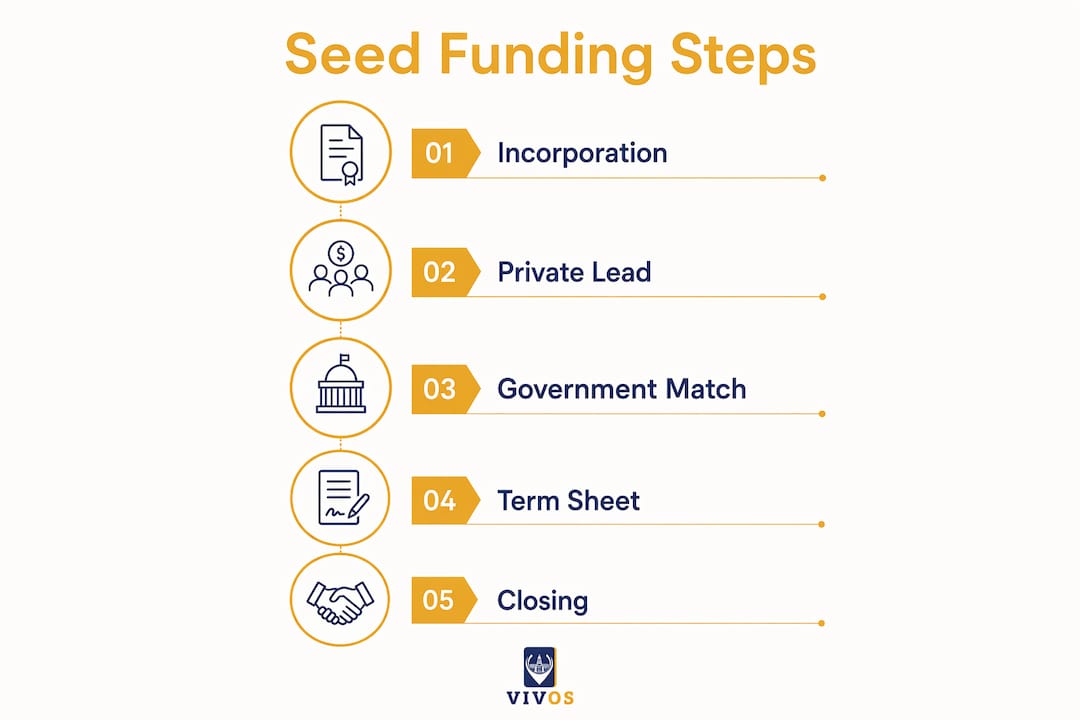
The typical fundraising process runs as follows:
Singapore seed rounds tend to target S$1M–S$5M pre-money valuations with 15%–25% equity dilution. B2B SaaS companies command higher premiums than consumer plays. Legal and structuring costs vary by complexity but are a real budget line: cap table setup, term sheet negotiation, and shareholder agreements all require professional handling. Government co-investment through SEEDS Capital adds no direct cost but requires compliance with eligibility criteria and sector alignment.
Singapore incorporation as a Pte Ltd is the standard prerequisite for accessing SEEDS Capital co-investment and most regional VC term sheets. Cayman incorporation remains viable when the cap table is predominantly US-based, but Singapore Pte Ltd is the cleaner structure for Southeast Asia regional strategies. Founders must also ensure IP is properly assigned or licensed, shareholder agreements comply with Singapore law, and any securities issuance follows Monetary Authority of Singapore guidelines.
pQCee (quantum-safe cybersecurity) raised an initial US$2.8 million seed round co-led by Wavemaker Ventures and SEEDS Capital, then secured a follow-on round just under four million US dollars co-led by SGInnovate and Lotus One Investment. ChemT Biotechnology closed a US$4 million seed round led by Wavemaker Ventures with SEEDS co-investment, funding AI infrastructure for biomanufacturing. Both cases illustrate the standard pattern: a private institutional lead sets terms, SEEDS co-invests alongside, and the round closes with strategic angels filling the remainder.
International founders raising seed capital in Singapore face two parallel challenges: getting the corporate structure right and getting investor-ready fast. Vivos addresses both.
Vivos provides company incorporation for international founders, corporate secretarial services to maintain compliance, and dedicated fundraising preparation advisory to position startups for investor conversations. The team supports SEEDS Capital eligibility checks, cap table structuring, and regulatory filings. For founders ready to engage Singapore’s seed ecosystem, contact Vivos to start the incorporation and investor-readiness process.
Singapore seed funding requires a private lead investor before government co-investment through SG Growth Capital can be triggered, with rounds typically closing in 6–10 weeks at 15%–25% dilution.
| Point | Details |
|---|---|
| Secure a private lead first | SG Growth Capital co-invests only after a private investor commits and sets terms. |
| Equity and valuation norms | Seed rounds in Singapore typically target S$1M–S$5M pre-money valuations with 15%–25% equity dilution. |
| NTU Seed Fund timing | Two annual windows: Spring (April 30) and Summer (September 30) cutoffs. |
| Three-track pitch strategy | Tailor separate decks for government-linked, regional generalist, and country-specialist investors. |
| Vivos incorporation support | Vivos handles Singapore Pte Ltd incorporation and investor-readiness advisory for international founders. |
 2 January, 2025
 2 January, 2025
File an FYE change on BizFile+. Learn when ACRA approval applies, the 18 month and five year rules, GST checks, and how Vivos files it.

A practitioner how-to for foreign founders opening a Singapore business account remotely. Follow a MAS-aligned checklist, draft a clear economic purpose,...

Compliance first buyback guide for Singapore directors. Covers the 20% cap, 10% treasury limit, solvency statement and ACRA filing steps.


Incorporated in Singapore under the Companies Act 1967 UEN 202416468C | ACRA Registered Filing Agent FA20240323 | MOM Employment Agency Licence 24S2425
Malaysia – VIVOS (M) Sdn. Bhd. | Registration Number:
People’s Republic of China, Hong Kong – VIVOS CORPORATE SERVICES (HK) LTD. | Business Registration Number: 80545137
United Arab Emirates, Dubai – VIVOS CORPORATE SERVICES L.L.C. | Commercial Licence Number: 1638200