
Avoid 10% Treasury Breach: Share Buyback Rules for Singapore Directors

Compliance first buyback guide for Singapore directors. Covers the 20% cap, 10% treasury limit, solvency statement and ACRA filing steps.
Published: 14 September 2026
Foreign founders can open a Singapore corporate bank account remotely, but the path depends on who you bank with. Fintechs like Aspire, Airwallex, and Wise Business generally allow full remote onboarding. Traditional banks such as DBS, OCBC, and UOB usually require video-KYC or an in-person visit. Both paths sit under MAS non-face-to-face (NFTF) and AML/CFT rules, which as of 2026 shape exactly how much verification each route demands.
TL;DR:
- Remote onboarding using fintech providers like Aspire and Airwallex typically requires only digital identity verification and can be completed within a week, while traditional banks may take several weeks and often require in-person visits.
- Applicants must ensure their company’s documents, including beneficial ownership details and economic purpose statements, are current, well-organized, and specifically tied to Singapore-linked activities to avoid delays or rejection.
- MAS rules demand rigorous verification controls for non-face-to-face onboarding, including document authenticity checks, video verification, and source-of-funds validation, especially for foreign companies.
- Using an experienced intermediary can help streamline the process by ensuring documents match bank expectations and clarifying compliance requirements, reducing application delays and rejection risks.
- Ongoing compliance responsibilities, such as statutory filings and updates to ownership details, remain after account opening and are critical to maintaining a healthy banking relationship and avoiding red flags.
Yes, provided you pick the right type of provider and your documents hold up under scrutiny. Digital fintechs built their onboarding flows around remote verification from day one, so a founder in London or Dubai can complete the entire process without booking a flight. Traditional banks operate differently. They were built for face-to-face relationship banking, and while MAS guidance permits non-face-to-face customer due diligence, most legacy banks still lean on video calls, call-backs to verified numbers, or an actual branch visit before they release a fully functional account.
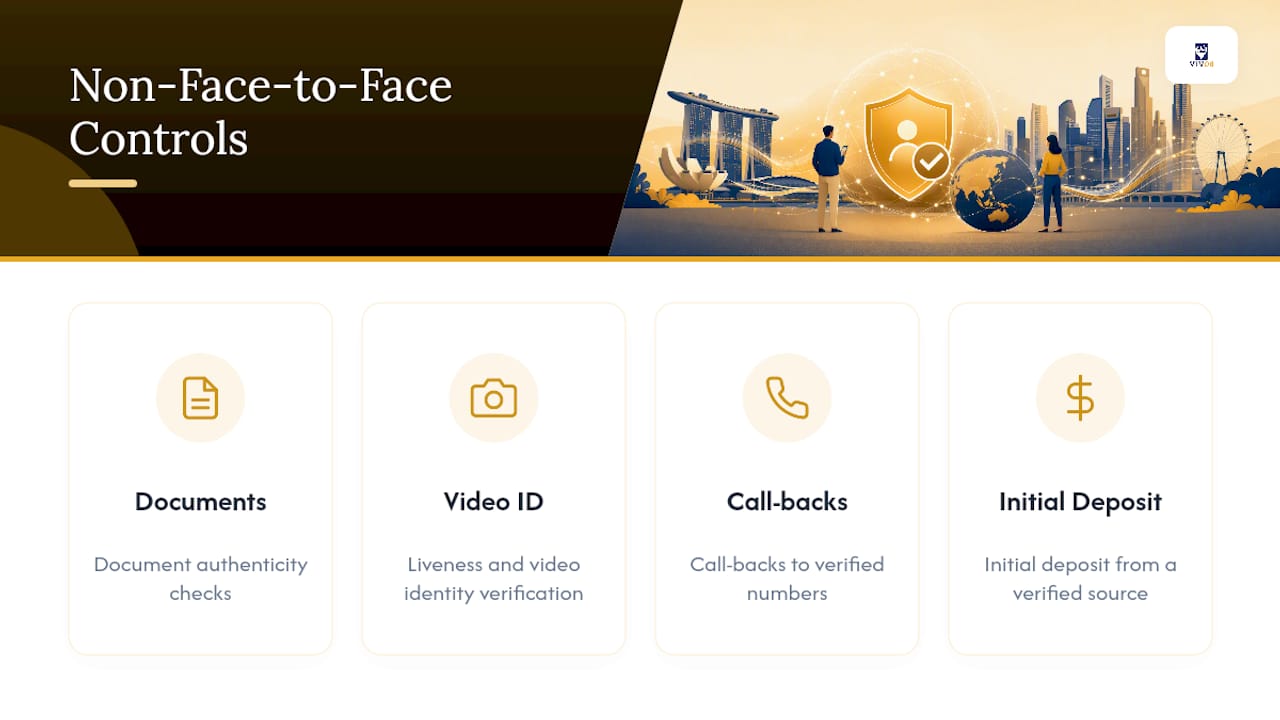
The distinction matters because it changes your timeline and your paperwork burden. A fintech account might be live in days. A traditional bank account, especially for a company with no physical presence in Singapore, can take weeks and may still require someone to show up in person if the risk profile looks unusual. MAS guidance on non-face-to-face customer due-diligence measures describes the additional controls institutions apply when they skip the in-person step: document authenticity checks, liveness and video ID verification, call-backs, and sometimes an initial deposit from a verified source.
The honest answer is that it varies by institution and by your company’s risk profile, but the pattern across the market is consistent enough to plan around.
| Provider Type | Full Remote Onboarding | Typical KYC Method | Typical Approval Time |
|---|---|---|---|
| Digital fintechs (e.g., Aspire, Airwallex) | Usually yes | Video ID verification, document upload, liveness check | A few days to about a week |
| International payment platforms (e.g., Wise Business) | Usually yes | Digital ID verification, MyInfo where applicable, document upload | A few days |
| Traditional banks (e.g., DBS, OCBC, UOB) | Sometimes, case by case | Video-KYC call, call-back verification, occasionally an in-person branch visit | Typically several weeks |
Exceptions run in both directions. A traditional bank may fast-track a founder who already banks with them personally or who has a clear Singapore operating presence. A fintech may pause an application and request extra documentation if the beneficial ownership structure looks layered or the stated business activity does not match the expected transaction pattern. Approval time ranges above are general industry patterns, not guarantees, and individual cases move faster or slower depending on document quality and how quickly you respond to follow-up requests.
A clean application is mostly about sequencing. Do these steps out of order and you invite delays. Follow them in order and most reviewers move fast because there is nothing left to question.
Pro Tip: Draft your economic purpose statement before you ever contact a bank. Reviewers spend the first few minutes of any file deciding whether the business makes sense on paper, and a vague or missing purpose statement is what gets applications parked in a queue.
For a broader walkthrough of the account opening process, Vivos has published a step-by-step guide for overseas founders covering eligibility and typical bank requirements.
Foreign-incorporated companies face a heavier document load than local ones, largely because the bank cannot rely on a domestic registry to confirm your company’s status. The core checklist looks like this:
Bank-side checklists like DBS’s account opening checklist spell out exactly this kind of documentation for foreign entities, and the pattern holds across most institutions. Missing even one item rarely kills an application outright, but it almost always adds a week or more while the bank chases the gap. For non-resident founders specifically, Vivos has broken down what a Singapore business account requires when you are not based locally.
MAS Notice 626 requires banks to perform customer due diligence and understand the purpose and intended nature of every business relationship before opening an account. That obligation does not disappear because a founder is applying from abroad. It gets heavier.
When onboarding happens non-face-to-face, MAS guidance under AMLD 01/2022 directs institutions to add controls that compensate for the missing in-person step: document authenticity verification, liveness and video checks, call-backs to independently verified contact numbers, and sometimes an initial deposit sourced from a regulated bank account.
Banks also assess where the relationship is actually managed. The guidelines to MAS Notice 626 note that a bank may rely on a related entity’s due diligence only when relationship management is substantively based in Singapore, not merely registered there on paper.
Common red flags include an unclear economic purpose, nominee director or shareholder arrangements with no disclosed control, multiple unrelated companies registered at the same address, foreign documents that cannot be independently verified, and abrupt changes to ownership or signatories shortly after the account opens.
Transaction size matters too. Notice 626 flags certain cross-border transfers and larger transactions for additional checks, meaning a company that structures its stated activity around irregular, high-value transfers should expect closer scrutiny from the outset.
A company incorporation service for foreign founders may include a nominee resident director, a registered address, corporate secretary services, and bank account introductions. That combination exists because each piece solves a specific problem a remote applicant runs into.
A foreign-incorporated company without a resident director cannot legally operate in Singapore, and a bank reviewing an application without one will usually stop right there. Vivos supplies that nominee resident director alongside a registered address, so the application has the local anchor a reviewer expects to see.
Beyond incorporation, the service provider may:
Some providers also incorporate companies in Malaysia, Hong Kong, and the UAE, with support available in English and Mandarin for founders operating across those markets. Whether the entity is a Singapore company or a parallel structure elsewhere, similar nominee resident director, registered address, corporate secretary, and bank introduction packages may apply.
Pro Tip: If you are incorporating and banking at the same time, start the corporate secretary and registered address setup first. Most bank delays trace back to incomplete company records, not the bank itself.
For a complete look at the incorporation service that underpins this process, see Vivos’s guide to Singapore company incorporation for foreigners.
Three fixes address most of what Ray describes. First, refresh every corporate document so nothing is older than the bank’s stated window, typically twelve months. Second, cross-check beneficial ownership disclosures across every single form before submission. Third, rewrite any generic purpose statement into something specific enough that a stranger could explain your business back to you after reading it once. Follow the numbered steps above and most of these issues never surface in the first place.
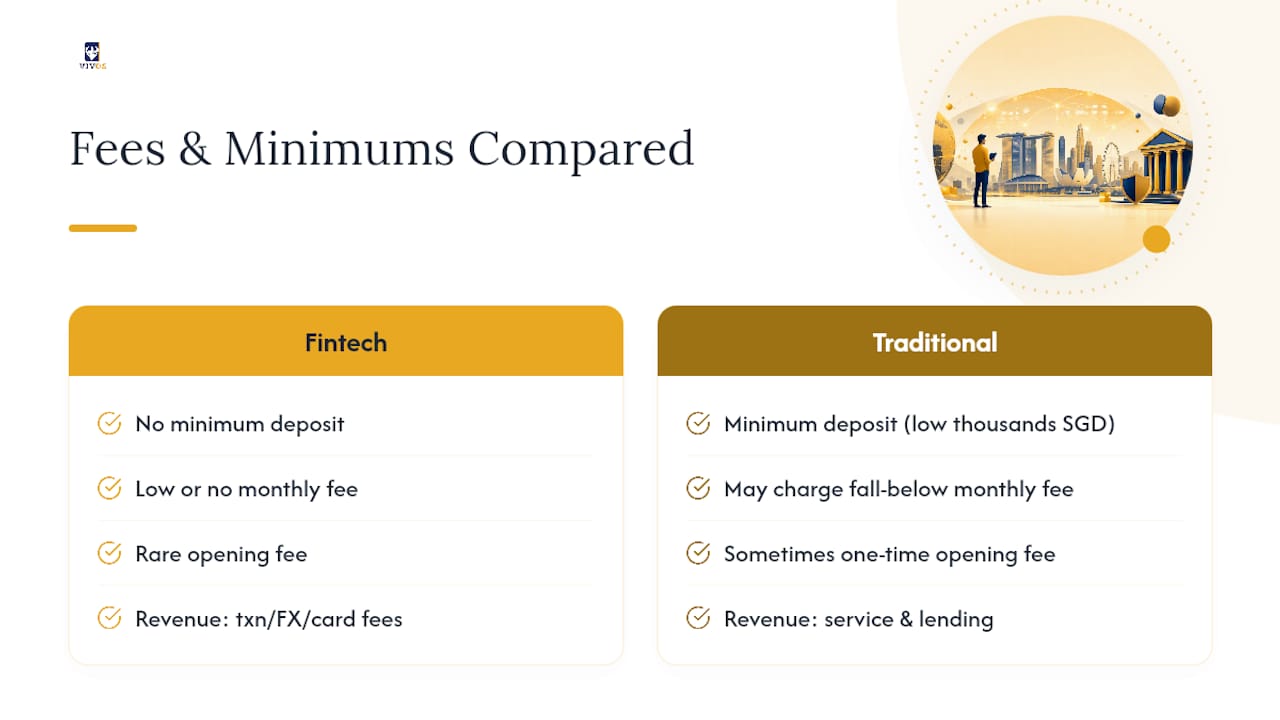
Fee structures split cleanly along the same fintech versus traditional bank line that shapes onboarding. Digital fintechs typically advertise no minimum initial deposit and low or no monthly account fees, recovering revenue instead through transaction fees, foreign exchange spreads, or card-issuing charges. That structure makes them attractive to a founder who needs an account running before revenue starts flowing.
Traditional banks tend to require a minimum initial deposit, often in the low thousands of Singapore dollars, and may charge a monthly fall-below fee if the account balance drops beneath that threshold. Some banks also charge a one-time account opening or processing fee, particularly for foreign-incorporated companies that require extra due diligence.
Exact figures vary by bank and change periodically, so confirm current numbers directly with the institution or through Vivos before applying rather than relying on a figure you saw somewhere online. What stays consistent is the logic: fintechs compete on low barriers to entry, traditional banks compete on service depth and lending relationships, and the deposit requirement reflects which of those two things the institution is optimizing for. Founders who plan to apply for trade financing, letters of credit, or multi-currency facilities down the line usually find the traditional bank’s higher deposit worth the tradeoff. Vivos’s overview of banking and financing solutions breaks down where that tradeoff tends to pay off.
Using an intermediary is less about outsourcing paperwork and more about reducing the number of times a bank has to ask you a follow-up question. A corporate service provider that has run dozens of applications through a given bank knows exactly which document format that bank rejects, which questions its compliance team asks first, and how long its review genuinely takes versus what the marketing page claims.
That local knowledge matters more for remote applicants than for anyone else, because a founder abroad cannot walk into a branch to sort out a discrepancy in person. An intermediary who already has a working relationship with the bank’s business banking team can often clarify a query in a single email exchange instead of a week of back-and-forth across time zones.
The risk with intermediaries runs the other direction: some agents overpromise guaranteed approval, which no legitimate provider can offer since approval decisions sit entirely with the bank’s compliance team. A reasonable intermediary sets expectations honestly, prepares the file to the bank’s actual standard, and makes the introduction. It does not promise outcomes it cannot control. If you’re weighing whether to handle bookkeeping and account coordination yourself or bring in outside support, providers like Ready Accounting outline how outsourced financial support tends to reduce the back-and-forth that slows remote applications generally.
Opening the account is the beginning of an ongoing relationship with obligations attached, not the finish line. Banks that opened your account under non-face-to-face controls typically schedule periodic reviews to refresh customer due diligence, especially if your transaction volumes shift meaningfully from what your originally stated economic purpose described.
Any change to beneficial ownership, directors, or authorized signatories needs to be reported to the bank promptly. Guidelines under MAS Notice 626 flag abrupt post-opening ownership or signatory changes as a red flag precisely because undisclosed changes are one of the more common patterns in accounts later flagged for suspicious activity.
Beyond the bank relationship itself, a Singapore-incorporated company carries its own statutory obligations: annual filings with the Accounting and Corporate Regulatory Authority, corporate tax filing with the Inland Revenue Authority of Singapore, and proper bookkeeping that reconciles with your bank statements. None of this is unique to remote applicants, but founders managing everything from another country sometimes underestimate how quickly these deadlines arrive. Falling behind on statutory filings can itself become a red flag the next time your bank runs a periodic review. Vivos’s statutory accounts compliance service and annual tax filing guidance cover what stays due once the account is live.
If you’re ready to move from research to application, Vivos handles the full sequence for foreign founders: incorporation with a nominee resident director and registered address, corporate secretary support, and direct bank introductions once your file is ready. The same team also incorporates in Malaysia, Hong Kong, and the UAE, with English and Mandarin support for founders running cross-border structures. Start with Vivos’s incorporation service for foreign founders to see exactly what the process looks like from your specific starting point.
The conventional advice on this topic treats “remote account opening” as a single yes or no question, and that framing misleads more founders than it helps. The real question is which type of institution matches your risk profile and timeline, and most guides skip that distinction entirely.
What the MAS guidance makes clear is that non-face-to-face onboarding was never meant to be frictionless. It was built to be possible, with compensating controls attached. Founders who treat those controls as obstacles tend to get frustrated. Founders who treat them as a checklist tend to get approved faster than they expected.
The single highest-leverage thing a founder can do is write a specific, honest economic purpose statement before contacting any bank. It costs nothing, takes an afternoon, and addresses the root cause of more rejections than any document formatting issue ever will. Everything else, the certified copies, the video-KYC, the call-backs, is procedural. The purpose statement is where reviewers actually decide whether your file gets a second look.
— Ray
Yes, particularly through digital fintechs like Aspire, Airwallex, or Wise Business, which generally support complete remote onboarding. Traditional banks such as DBS, OCBC, and UOB often require video-KYC or an in-person visit depending on the applicant’s risk profile.
Fintech accounts often open within a few days to about a week. Traditional bank accounts for foreign-incorporated companies typically take two to six weeks, depending on document completeness and risk review.
You need a certificate of incorporation, register of directors or certificate of incumbency dated within twelve months, a board resolution naming signatories, proof of beneficial owners, and sometimes a legal opinion if your company has no Singapore establishment.
MAS Notice 626 and related guidance require banks to verify economic purpose and beneficial ownership clearly. Applications with vague business descriptions, nominee arrangements, or unverifiable foreign documents commonly trigger extra scrutiny or rejection.
 2 January, 2025
 2 January, 2025
Compliance first buyback guide for Singapore directors. Covers the 20% cap, 10% treasury limit, solvency statement and ACRA filing steps.

8 steps to file share allotments in Singapore: board resolution, section 161 checks, BizFile+ filing and register updates.

ECI at 3 months, AGM at 6, Annual Return at 7, tax return by 30 November, plus CPF, GST, IR8A and ACRA change notices: the…