
$900 at Stake per $10,000 Expense: Zero Rated vs Exempt in Singapore
Published: 10 September 2026 · Last reviewed: 30 September 2026 · Reviewed by Ray Tay, Co-Founder & Managing Director, VIVOS PTE. LTD. (ACRA Filing Agent FA20240323 · MOM EA Licence 24S2425)
The Inland Revenue Authority of Singapore (IRAS)/charging-gst-(output-tax)/when-is-gst-not-charged/supplies-exempt-from-gst) draws this line as of 2026, and it decides whether the GST on your business expenses comes back to you or sits on your balance sheet as a sunk cost.
TL;DR:
- Businesses must accurately classify their sales as zero-rated or exempt, as the distinction affects input tax claims and GST registration requirements.
- Zero-rated exports and international services allow full GST recovery, but require proper documentation to prove the overseas status and export evidence.
- Exempt supplies, such as financial services or residential property, do not permit input tax recovery and do not count toward the GST registration threshold.
- Mixed supplies necessitate careful apportionment of input tax, especially when exempt income surpasses a small threshold, to avoid penalties or missed recoveries.
- Proper record-keeping and regular classification reviews are essential to prevent IRAS audit issues, especially for businesses with evolving revenue structures.
Table of Contents
- Zero Rated vs Exempt: What’s the Real Difference?
- Zero-Rated vs Exempt vs Standard-Rated at a Glance
- What Qualifies as a Zero-Rated Supply in Singapore?
- What Qualifies as an Exempt Supply and Why?
- Which Is Better, Zero Rated or Exempt, for Your Business?
- Documenting Zero-Rated Supplies: What IRAS Expects
- A Worked Example: Same $10,000 Expense, Two Outcomes
- GST Reporting: How Classification Shows Up on Your Return
- How Do Other Countries Treat Zero-Rated and Exempt Supplies?
- Mixed Supplies: When You Make Both Zero-Rated and Exempt Sales
- Recent Regulatory Context for 2026
- Where GST Audits Go Wrong on Zero-Rated and Exempt Claims
- Building a Practical Evidence File Before You File
- Who Handles This: Company Setup and GST Compliance for Foreign Founders
- An Editor’s Take on Getting This Right the First Time
- Sources
Zero Rated vs Exempt: What’s the Real Difference?
The categories work on opposite logic underneath.
A zero-rated supply is still a taxable supply. Because it is taxable, a GST-registered business making zero-rated sales can claim input tax on the purchases that feed that sale. Exports of goods and specified international services fall into this bucket.
An exempt supply sits outside the taxable system entirely. Financial services, the sale and lease of residential property, and digital payment tokens are the standard Singapore examples. Because these supplies never enter the taxable-turnover calculation, the GST paid on related purchases generally cannot be recovered. That single distinction, taxable at zero versus outside the system, drives everything else in this article: registration thresholds, input tax claims, pricing, and audit exposure.
Zero-Rated vs Exempt vs Standard-Rated at a Glance
The middle column is where most confusion starts. A Singapore-incorporated consultancy billing a client in London and a landlord renting out a condo unit both show “$0 GST” on their invoices. One can claim back every dollar of GST on its laptops and software subscriptions. The other cannot claim a cent on the agent’s commission or the maintenance fees. Classification, not the invoice, is what IRAS checks.
What Qualifies as a Zero-Rated Supply in Singapore?
A supply that qualifies for zero-rating is not a discount or an exemption in disguise. That distinction matters for your GST registration count, which the next section covers in detail.
IRAS recognizes two main zero-rated categories relevant to most Singapore companies. The first is the export of goods, where the goods are shipped out of Singapore and the exporter holds evidence proving that. The second is international services, defined broadly enough to cover consulting, software development, marketing, and design work performed for a client who “belongs” outside Singapore under the GST Act’s rules. A Singapore-based SaaS founder billing a customer in Jakarta, or a design studio invoicing a brand in Sydney, typically zero-rates that revenue.
On a GST return, zero-rated sales get reported in Box 2 (zero-rated supplies) as part of total taxable supplies, and the corresponding input tax gets claimed in the normal input tax box. Nothing about the invoicing process looks unusual to the customer. The paperwork sitting behind that invoice, however, needs to prove the export or the customer’s overseas status, which is where many founders underprepare.
What Qualifies as an Exempt Supply and Why?
Singapore exempts certain supplies from GST for policy reasons rather than trade competitiveness. Financial services (loans, currency exchange, most insurance) are exempt because taxing the margin on money itself creates distortions that are hard to price fairly. Residential property sales and leases are exempt to avoid adding GST on top of an already significant asset class for ordinary buyers and tenants. Digital payment tokens, covering cryptocurrencies used as a medium of exchange, were carved into the exempt category once IRAS recognized them as closer to currency than to a taxable service or good.
The consequence is direct: input tax tied to making these exempt supplies generally cannot be claimed. A property fund paying GST on legal fees for a residential acquisition, or a fintech paying GST on compliance software used to run a token exchange, typically absorbs that GST as a real cost.
Once exempt supplies grow beyond a small share of total revenue, partial exemption rules kick in, requiring apportionment of input tax between taxable and exempt activity. That’s a materially different compliance burden than a business making purely zero-rated or standard-rated sales.
Which Is Better, Zero Rated or Exempt, for Your Business?
Neither classification is “better” in the abstract. What matters is which one actually applies to your revenue, because the financial outcomes diverge sharply once you look at cash flow, registration, and risk.
Input tax recovery is the clearest divide. A zero-rated exporter recovers the GST charged on rent, software, and professional fees tied to that export. A business making exempt supplies typically cannot, turning what would have been a recoverable tax into a permanent cost that eats into margin.
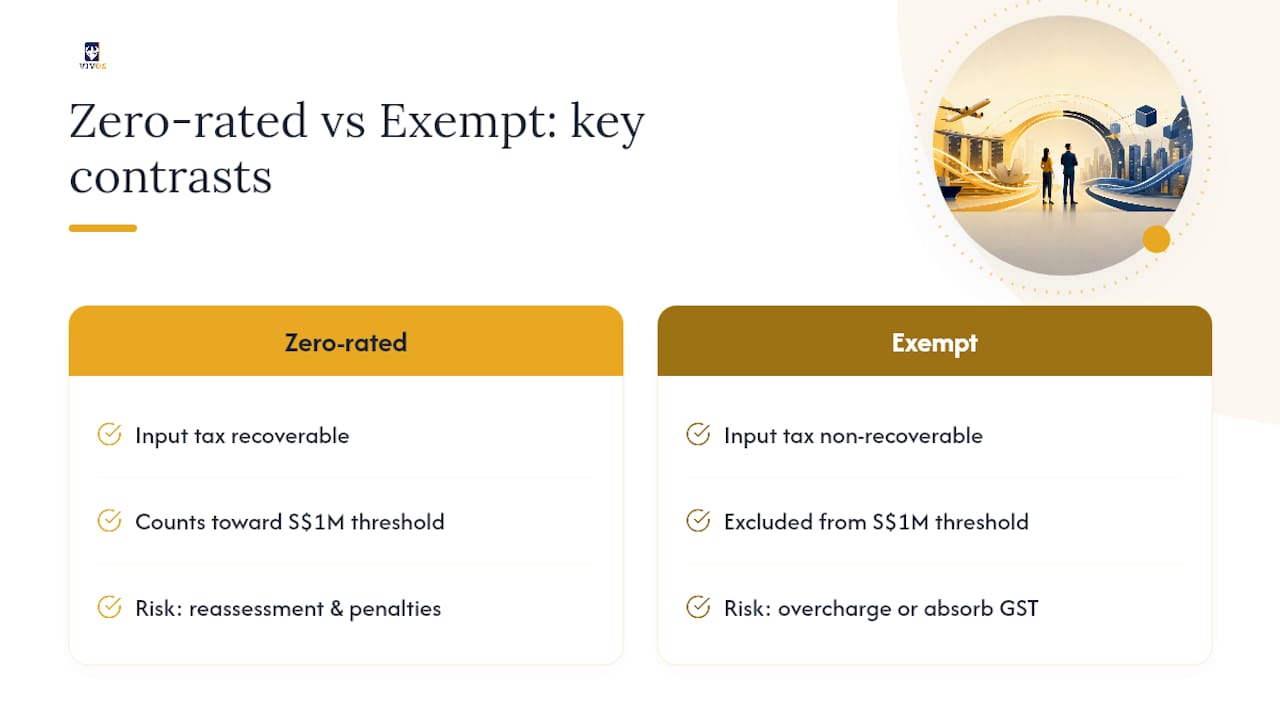
GST registration treatment differs too. Zero-rated sales count toward the S$1 million annual taxable turnover threshold that triggers mandatory GST registration in Singapore. A software exporter billing $80,000 a month to overseas clients will cross that threshold within the year and must register, even though every invoice shows 0% GST. Exempt sales never count toward that threshold, so a company making only exempt supplies may never need to register at all, and if it does register for other reasons, its exempt revenue still sits outside the taxable turnover calculation.
Commercial outcomes follow from both. A founder who misclassifies an exempt supply as zero-rated risks an IRAS reassessment, penalties, and interest on top of the original underpaid GST. A founder who fails to zero-rate a genuinely qualifying export overcharges the client or absorbs GST unnecessarily, quietly shrinking margin on every invoice.
Documenting Zero-Rated Supplies: What IRAS Expects
Getting the classification right on paper means nothing if you cannot prove it later. IRAS auditors ask for evidence first, arguments second.
For goods exports, keep commercial invoices, the bill of lading or airway bill, and the export declaration filed through TradeNet. For services, retain the signed contract showing the client’s registered address and business location, correspondence confirming the client operates and consumes the service outside Singapore, and proof of delivery, such as project sign-off emails or software access logs tied to an overseas account.
IRAS’s record-keeping guidance sets retention expectations that GST-registered businesses should build into standard filing habits, not scramble to reconstruct at audit time. The most common documentary failure is not fraud. It’s founders who zero-rate correctly but never save the shipping paperwork or the client’s registered address, leaving nothing to show an auditor eighteen months later.
A Worked Example: Same $10,000 Expense, Two Outcomes
What happens to that $900 depends entirely on how the company’s own revenue is classified.
- If the company sells internationally and zero-rates that revenue, it claims the full $900 as input tax on its next GST return, reducing net cost of the expense to $10,000.
- If the company’s revenue is exempt (say, a residential property leasing business), that $900 is generally unrecoverable and simply gets absorbed into the cost of the expense, making the true cost $10,900.
For a foreign founder exporting software or consulting services from a Singapore entity, that $900 difference on one invoice compounds fast across a full year of vendor spend. It is the single clearest reason to get the classification right before, not after, your first GST return.
GST Reporting: How Classification Shows Up on Your Return
Every GST F5 return has dedicated boxes for this exact distinction, and getting the boxes wrong is one of the fastest ways to attract an IRAS query. Zero-rated supplies go into Box 2, standard-rated supplies into Box 1, and exempt supplies into Box 3. Total input tax claimed goes into Box 7, and it should only include tax tied to standard-rated and zero-rated activity, not exempt activity.
A practical filing checklist looks like this:
- Confirm each sale’s classification before invoicing, not at return time.
- Match input tax claims to the taxable supplies they relate to, excluding anything tied purely to exempt revenue.
- Reconcile Box 2 (zero-rated) and Box 3 (exempt) totals against your accounting system’s sales ledger each quarter.
- Keep export and international-service evidence filed against the specific invoice, not in a general folder.
- Flag any month where exempt revenue grows as a share of total sales, since that can trigger partial exemption calculations.
Filing errors on this specific point, misclassifying an exempt sale as zero-rated or vice versa, are among the most common reasons IRAS opens a query on an otherwise clean GST return. A business that keeps its classification logic consistent between invoicing and filing avoids most of that exposure entirely.
How Do Other Countries Treat Zero-Rated and Exempt Supplies?
Singapore’s framework mirrors the structure used across most VAT and GST jurisdictions, which helps foreign founders coming from Europe, Australia, or the UK adapt quickly. The United Kingdom’s VAT system uses near-identical language: zero-rated goods (most food, books, children’s clothing) remain within the VAT system with full input tax recovery, while exempt supplies (insurance, certain education and health services) sit outside it with blocked input tax.
Australia’s GST system uses the term “GST-free” instead of zero-rated, covering exports and basic food, while “input-taxed supplies” is the local label for what Singapore calls exempt, covering financial supplies and residential rent. The mechanics are the same even though the vocabulary differs.
The European Union’s VAT directive draws a comparable line, though EU exemptions extend further into public-interest categories like postal services and certain cultural activities, reflecting policy choices beyond pure financial-sector logic. What stays consistent across all these systems is the core principle: zero-rating supports export competitiveness by keeping businesses whole on their input costs, while exemption reflects a policy judgment that a sector shouldn’t carry GST at all, recoverable or not.
For a foreign founder structuring cross-border sales from Singapore, this consistency is useful. The classification logic you learn here largely transfers if you also register for VAT or GST in a market with a similar system, though the specific category lists and thresholds always need local verification.
Mixed Supplies: When You Make Both Zero-Rated and Exempt Sales
A growing number of Singapore businesses do not fall neatly into one category. A fintech might sell software services (zero-rated, if the client is overseas) while also earning income from currency exchange margins (exempt).
A property developer might sell units overseas (potentially zero-rated) while leasing residential units locally (exempt).
When a business makes both taxable supplies, including zero-rated ones, and exempt supplies, input tax on shared costs such as office rent, accounting software, or a shared legal retainer cannot simply be claimed in full. IRAS requires apportionment, typically using a formula based on the ratio of taxable to total turnover, to determine how much of that shared input tax is actually recoverable.
The practical trigger point is scale. A business with a small, incidental amount of exempt income (interest earned on a corporate bank account, for instance) usually falls under a de minimis allowance and can still claim input tax in full. Once exempt activity becomes a meaningful part of the business, the apportionment calculation becomes mandatory and needs to be run every filing period, not just annually.
Getting this wrong in either direction carries cost. Over-claiming input tax on exempt-linked expenses invites a repayment demand plus penalties. Under-claiming on the taxable side means leaving recoverable GST on the table quarter after quarter. Businesses with a genuine mixed-supply profile are the ones most likely to benefit from a dedicated GST review rather than a standard annual filing pass.
Recent Regulatory Context for 2026
What has shifted is enforcement emphasis. IRAS audit activity increasingly focuses on documentary proof for zero-rated international services, given how easy it is to zero-rate a sale on paper without holding evidence of where the client actually belongs. Businesses claiming zero-rating on services delivered digitally, software, consulting, design work, face closer scrutiny of contracts and delivery evidence than businesses exporting physical goods with customs paperwork already in hand.
Foreign founders setting up a Singapore company specifically to serve overseas clients should treat this as a standing compliance item, not a one-time registration task. GST guidance updates periodically, and a company’s own client mix, industries served, and delivery model can shift a supply’s classification even when the underlying law hasn’t changed. Reviewing classification annually, alongside your GST registration status and any new revenue lines, catches these shifts before a return gets filed incorrectly.
Where GST Audits Go Wrong on Zero-Rated and Exempt Claims
Most GST disputes on this topic trace back to a small set of recurring errors rather than deliberate misreporting. The second is the reverse: zero-rating a service without confirming the client’s belonging status, then having no contract or correspondence to prove it when IRAS asks.
A third error shows up in mixed-supply businesses that skip apportionment entirely, claiming full input tax on shared costs regardless of exempt income. A fourth, more procedural error is inconsistent box reporting on the GST F5, where a sale gets invoiced as zero-rated but reported in the wrong box on the return, creating a mismatch that flags for review.
None of these require intent to trigger a problem. IRAS penalties for incorrect GST filing scale with the size of the error and whether it appears deliberate, but even a genuine mistake means repaying the shortfall plus interest. The businesses that avoid this outcome are the ones that document the classification decision at the point of invoicing, not months later when a query lands. A supplier that reviews each new client contract against the belonging-status test before the first invoice goes out rarely needs to relitigate that classification during an audit.
Building a Practical Evidence File Before You File
The gap between a defensible zero-rating position and a rejected one usually comes down to what’s sitting in your files, not what’s in the law. Start with a standing folder structure per client or shipment: contract, invoice, proof of delivery, and any correspondence confirming location or export status, filed the same week the transaction happens.
For goods, that means the export declaration and transport document filed alongside the commercial invoice. For services, it means the signed contract showing the client’s registered address, plus evidence the work was consumed outside Singapore, project sign-offs, delivery confirmations, or platform access logs tied to an overseas account. IRAS’s guidance on international services is specific about what counts as proof of belonging status, and it’s worth checking against that list rather than guessing.
Retention matters as much as collection. IRAS record-keeping expectations call for these documents to be kept for a set period after filing, accessible on request rather than archived somewhere unrecoverable. A quarterly internal check, reconciling what’s been zero-rated against what’s actually filed in the evidence folder, catches gaps long before an audit notice does. Businesses that build this into their monthly accounting close, rather than treating it as a year-end scramble, consistently fare better when IRAS does ask questions.
Who Handles This: Company Setup and GST Compliance for Foreign Founders
Getting the classification right is one problem. Building the company structure, registration timeline, and accounting habits that keep it right every quarter is a different, ongoing task, and it’s the one most foreign founders underestimate when they first set up in Singapore.
Some corporate service providers offer Singapore company incorporation for foreign founders, including nominee resident director, registered address, and corporate secretary services. Tax support may include GST registration and accounting to help build zero-rated versus exempt classification correctly into invoicing and filing from the start. Providers may also incorporate companies in Malaysia, Hong Kong, and the UAE, sometimes offering bilingual support for founders coordinating across those markets.
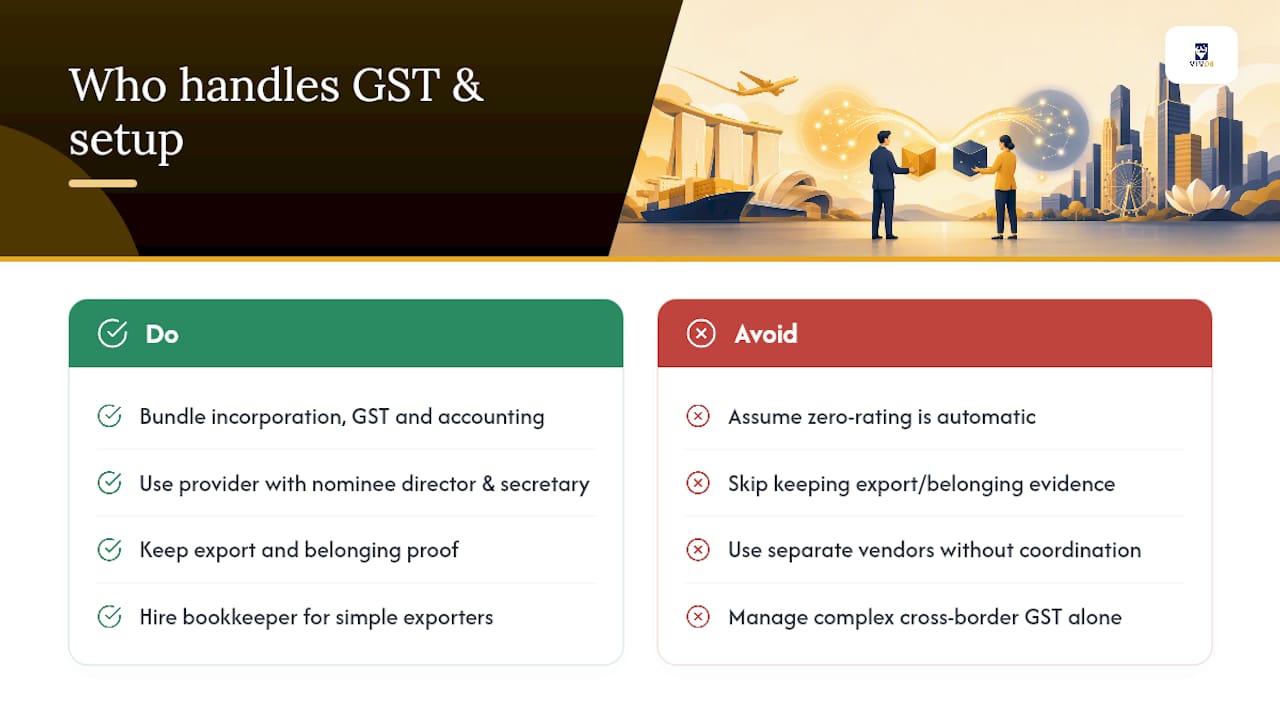
Some foreign founders exporting services from Singapore may assume zero-rating is automatic once a client is overseas, but IRAS requires proof of belonging status and export evidence. Businesses audited without such proof risk repaying GST they believed was already claimed correctly.
For a founder still deciding whether to manage GST in-house, the practical test is volume and complexity. A single-product exporter with straightforward client contracts can often handle filing with a competent bookkeeper. A business with mixed supplies, cross-border service delivery, or multiple entities across Singapore, Malaysia, Hong Kong, and the UAE benefits from incorporation, GST registration, and accounting handled as one coordinated engagement rather than three separate vendors working from different assumptions.
If your company is ready to register for GST or needs its structure reviewed before the next filing, VIVOS’s GST registration and filing service is the direct next step, and incorporating your Singapore entity is where that process starts for founders building a new export or services company from outside Singapore.
An Editor’s Take on Getting This Right the First Time
The businesses that get burned on zero-rated versus exempt classification are rarely the ones ignoring the rules. They’re the ones who read the definition once, assumed it applied cleanly to their revenue, and never revisited it as their client mix changed. A consulting firm that started purely local and picked up two overseas clients last quarter now has a mixed-supply question it may not know it’s facing.
Three things are worth doing before your next GST return, not after. First, classify every revenue line individually, export, international service, financial supply, property, rather than assuming one label covers the whole business. Second, gather the evidence for each classification now, while contracts and shipping records are easy to find, not during an audit eighteen months from now. Third, have someone outside your own accounting function review the classification before filing, especially once exempt revenue starts showing up alongside taxable sales.
Partial exemption rules become material faster than most founders expect, often once exempt income crosses a modest share of total turnover. Watching that ratio quarterly, not annually, is the difference between catching it early and discovering it during a repayment demand. Before engaging any corporate service provider, have your contracts, invoices, and export documents organized. It saves real time in the first review.
— Ray
Recommended
- Audit Exemption Singapore: 2026 Guide for Directors
- Singapore Corporate Tax Rate 2026: What Founders Actually Pay
- Singapore’s Start-Up Tax Exemption: What Founders Get in 2026
- Estimated Chargeable Income Singapore: A Director’s Guide
Related guides
Most Popular
 2 January, 2025
Why Singapore Comes Into Action For Chinese Companies
 2 January, 2025
Malaysia’s Budget 2025: What The Dividend Tax Means For You
Recents Blogs



新加坡海外收入汇回:2026年公司与个人的纳税规则与免税条件

海外收入汇回新加坡何时需纳税?本文解析第10(25)条“汇入”定义、第13(8)条三项免税条件、外国税收抵免、第10L条及文件留存要求。
Long-Term Visit Pass for Parents in Singapore: Who Qualifies? (2026)
Employment Pass holders can bring their parents to Singapore on a Long-Term Visit Pass only if they earn a fixed monthly salary of at least…