


Unaudited Financial Statements Singapore: 2026 Guide

Discover key insights on unaudited financial statements in Singapore. Learn the requirements, exemptions, and responsibilities for business owners.
A business license in Singapore is a government-issued permit that authorizes specific business activities, ensuring legal compliance and operational legitimacy. Every entrepreneur starting a business in Singapore must understand that business licenses singapore requirements vary by industry, business structure, and the regulatory authority involved. Key bodies include the Accounting and Corporate Regulatory Authority (ACRA), the Monetary Authority of Singapore (MAS), and the Singapore Food Agency (SFA). Operating without the correct permits is a criminal offense that can result in immediate business closure. Getting this right from day one protects your investment and your reputation.
Singapore classifies business permits into three distinct categories: compulsory licenses, occupational licenses, and activity-based licenses. Each type serves a different purpose and applies to different situations.
Compulsory licenses apply to the business entity itself. Any company operating in a regulated sector must hold one before trading. Occupational licenses apply to individual practitioners, such as doctors, lawyers, or financial advisors, who need personal certification to practice. Activity-based licenses cover specific tasks or operations, such as running a food stall or selling liquor.
Industry-specific requirements vary widely. Here are the most common categories international entrepreneurs encounter:
Your Singapore Standard Industrial Classification (SSIC) code determines which licenses apply to your business. The SSIC code is assigned during company incorporation and directly maps your declared activities to the relevant regulatory requirements.
Pro Tip: Choose your SSIC code carefully during registration. An incorrect code can trigger the wrong license requirements or leave you without the permits your actual operations need.

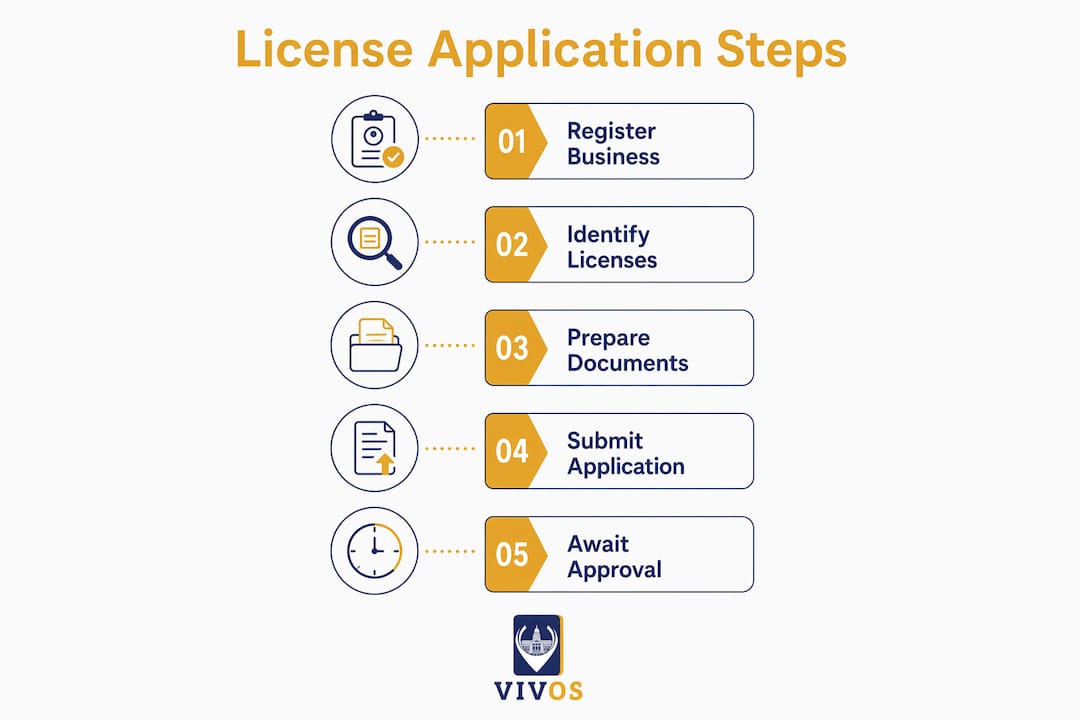
The application process follows a clear sequence. ACRA registration comes first. You must incorporate your company and receive your Unique Entity Number (UEN) before applying for any industry-specific license.
When your business activities change, update your SSIC code and reassess your license requirements immediately. Expanding into a new product line or service category can trigger entirely new permit obligations.
Pro Tip: A thorough business plan clarifies your operations for regulators and makes the license identification process significantly faster. Regulators use your declared activities to determine what you need.
Singapore distributes licensing authority across multiple government agencies. Each agency covers a specific sector and issues its own permits.
| Regulatory Authority | Sector Covered | Key License Issued |
|---|---|---|
| ACRA | All business entities | Business registration, UEN |
| MAS | Finance and FinTech | Major Payment Institution, Capital Markets Services |
| SFA | Food and beverage | Food Shop License |
| MOM | Employment and manpower | Employment Agency License, work permit declarations |
| BCA | Construction | Contractor’s License |
| URA | Real estate development | Housing Developer’s License |
MAS maintains a rigorous licensing regime for financial activities, reflecting Singapore’s role as a global financial hub. Financial license applications require detailed compliance frameworks, anti-money laundering policies, and minimum capital requirements. These are among the most demanding permits in the Singapore system.
MOM adds another layer of complexity for businesses hiring foreign staff. Employers must declare their business activity before submitting Work Permit or S Pass applications. This declaration assigns the organization to a relevant sector and directly affects hiring quotas and levy rates. Getting this declaration wrong creates downstream problems across your entire workforce planning.
Foreign-owned businesses face the same licensing requirements as locally owned ones. Singapore does not impose additional permit categories based on ownership nationality. The challenges are practical, not structural.
Incorporating your company with the correct business activity declaration is the single most important step before any license application. Everything downstream depends on it. International entrepreneurs unfamiliar with Singapore’s regulatory structure benefit from working with a corporate services provider who knows which agencies to engage and in what order.
Before starting a home-based business, review the specific compliance requirements for your activity type. Home-based rules in Singapore are more specific than most entrepreneurs expect.
Business licenses in Singapore are legally required permits tied to your SSIC code, issued by sector-specific authorities, and must be secured after ACRA incorporation before any regulated activity begins.
| Point | Details |
|---|---|
| Incorporate first | Register with ACRA and obtain your UEN before applying for any industry license. |
| SSIC code accuracy | Your SSIC code determines which licenses apply; an incorrect code creates compliance gaps. |
| Use GoBusiness | The GoBusiness portal centralizes license search and application using your UEN. |
| Know your authority | Each sector has a designated regulator: MAS for finance, SFA for food, BCA for construction. |
| Renew on schedule | Expired licenses carry the same legal risk as never holding one; track all renewal dates. |
The most expensive mistake I see international entrepreneurs make is treating licensing as an afterthought. They spend months on product development, branding, and hiring, then discover two weeks before launch that their MAS application takes six months to process. The license was always the critical path item. Nobody told them.
The second mistake is assuming Singapore’s reputation for business-friendliness means licensing is simple. It is transparent and well-organized, which is different from easy. The GoBusiness portal is genuinely excellent. But the underlying regulatory requirements for finance, food, and healthcare are demanding by design. Singapore protects its reputation as a trusted financial and commercial center by holding businesses to a high standard.
My practical advice: identify every license you need on day one, before you sign a lease or hire anyone. Build the approval timeline into your launch plan. And if you are entering a regulated sector, engage a corporate services advisor who has navigated that specific agency before. The cost of that advice is a fraction of the cost of a delayed launch or a compliance penalty.
— Ray
Getting your licensing right from the start requires more than reading a checklist. It requires knowing which agencies to engage, in what order, and with what documentation.
Vivos provides corporate secretarial services that cover the full licensing and compliance process for international entrepreneurs setting up in Singapore. From ACRA incorporation and SSIC code selection to license identification, application support, and renewal tracking, Vivos manages the regulatory workload so you can focus on building your business. The team has direct experience with MAS, SFA, MOM, and BCA requirements across multiple industries. For complex licensing needs, Vivos also offers licensing and compliance advisory tailored to your specific business activities.
A business license in Singapore is a government-issued permit that authorizes a company to conduct specific regulated activities. Licenses are issued by sector-specific agencies such as ACRA, MAS, SFA, and MOM.
Use the GoBusiness Licensing portal with your UEN and SSIC code to identify all applicable licenses. Your SSIC code, assigned during ACRA incorporation, maps your declared business activities to the relevant regulatory requirements.
License fees vary by type. Some licenses cost S$30 per year or S$90 for three years, while specialized financial or construction licenses can run several hundred dollars or more depending on the issuing authority.
Operating without a required license is a criminal offense in Singapore and can result in immediate business closure and financial penalties.
Yes. Foreign-owned companies face the same licensing requirements as locally owned businesses. Incorporation with ACRA is the first step, followed by applying for the relevant industry licenses through the appropriate regulatory authorities.
 2 January, 2025
 2 January, 2025
Discover key insights on unaudited financial statements in Singapore. Learn the requirements, exemptions, and responsibilities for business owners.

Discover the key steps for successful annual return filing in Singapore. Avoid penalties and ensure compliance with our 2026 guide.
Yes — a non-resident founder can open a Singapore business bank account without living in Singapore, and in most cases without flying in. Fintech accounts…