Same Day Compliance: Singapore Resident Director for Foreign Founders
Published: 30 August 2026 · Last reviewed: 15 September 2026
Short answer — updated 9 September 2026
Yes — a foreigner needs a local director to open a Singapore company in 2026: every Singapore company must have at least one director who is ordinarily resident in Singapore under Section 145 of the Companies Act 1967, but you never need a local shareholder, and if you have no local person a nominee director can be appointed only through an ACRA-registered corporate service provider, typically for S$3,500–5,000 a year (market rate as at September 2026).
You do not have to move to Singapore, and foreigners can still own 100% of the shares. The residency test applies to the director, not to the owner.
Since 9 June 2025, informal nominee arrangements — a friend, a relative, an employee signing as your “local director” — are no longer permitted: the nominee must come through a registered corporate service provider and must pass a fit-and-proper assessment.
A professional nominee holds no shares and runs nothing. Day-to-day control of the company stays with you.
Facts verified against ACRA and the Companies Act 1967 on 1 September 2026. The nominee fee range is a 2026 market/VIVOS pricing range, not a statutory figure.
Watch (1:31): Nominee Director in Singapore: Does a Foreigner Need One? (2026) — presented by an AI-generated avatar and voice of Ray Tay, co-founder of VIVOS PTE. LTD. The full transcript is further down this page.
Every Singapore company must have at least one director who is ordinarily resident in Singapore, under Section 145 of the Companies Act 1967, as of 2026. That director must be a citizen, permanent resident, or eligible pass holder. Since most foreign founders don’t hold that status yet, they appoint a nominee resident director to incorporate immediately and stay compliant while relocation or an Employment Pass is sorted out.
TL;DR:
Foreign founders can own 100% of a Singapore company without moving, but must appoint a resident director who is a citizen, permanent resident, or eligible pass holder.
Nominee directors are commonly used for compliance, with fees typically in the low thousands of dollars annually, plus refundable deposits.
The nominee’s main legal duty is to hold the statutory director role, but they carry liability and should have a written indemnity agreement and D&O insurance.
Transitioning from a nominee to a self-appointed resident director requires timely filing of resignations and appointments, preferably on the same day to avoid non-compliance.
Using a nominee director involves risks such as vague agreements or lack of registration; safeguards include verified contracts, clear indemnities, and confirmation of provider registration.
Who Must Be a Resident Director and Who Qualifies?
Section 145 doesn’t care where your headquarters sits or where your revenue comes from. It cares about one thing: whether a natural person tied to the company is “ordinarily resident” in Singapore. ACRA’s guidance on director eligibility treats this as a factual question of habitual presence, not a checkbox on an application form. A director who spends most of the year overseas, even with a local address on file, risks failing the test if the Registrar looks closely.
Three categories of people satisfy the requirement:
Singapore citizens
Singapore permanent residents
Holders of an eligible work pass, such as an Employment Pass or EntrePass, who are genuinely based in Singapore
That third category is where most confusion lives. Holding an Employment Pass doesn’t automatically make someone eligible. The Ministry of Manpower’s guidance determines whether a pass holder can be registered as a director of a separate entity, and pass conditions vary by case. Founders relying on their own future EP to satisfy Section 145 should confirm eligibility with MOM before assuming the pass will do the job.
Disqualifications matter just as much as qualifications. A person cannot serve as a resident director if they are under 18, an undischarged bankrupt, or barred by a court order. ACRA’s rules on resignation and disqualification also block a director from resigning if doing so would leave the company with zero Singapore-resident directors on the board. That single clause is what makes nominee arrangements necessary in the first place.
Can a Foreigner Own 100% of a Singapore Company Without Moving?
Yes. Singapore places no restriction on foreign ownership of a private limited company, and a foreign founder can hold 100% of the shares without ever setting foot in the country. Ownership and residency are separate issues under the Companies Act. What the law requires is a resident director, not a resident shareholder.
This is where the nominee director model earns its place. A founder in London or Dubai can own every share, control every strategic decision through shareholder agreements, and still meet Section 145 by engaging a nominee to sit on the board as the resident officer. The nominee typically holds no shares and exercises no independent management authority. A nominee director works well for holding companies or market-entry vehicles, but becomes less practical once the entity grows local staff and real operations, because a nominee with no operational visibility is a weak governance fit for a company running daily business in Singapore.
The alternative is relocating personally on an Employment Pass and acting as your own resident director. Here’s how the two paths actually compare:
Factor
Nominee resident director
Relocating on an Employment Pass
Legal compliance
Satisfies Section 145 immediately at incorporation
Satisfies Section 145 only after EP approval and physical relocation
Control & governance
Founder retains full shareholder control; nominee has no equity
Founder director has full operational and legal authority
Cost
Recurring service fee plus deposit
Visa, relocation, and living costs; no ongoing nominee fee
Timeline
Same day as incorporation
Weeks to months, pending MOM approval
Ongoing obligations
Nominee agreement, indemnity, periodic KYC checks
Standard directorial duties, no third-party dependency
Liability
Nominee bears statutory director liability; founder should still indemnify
Founder bears liability directly, with full visibility into operations
Most founders start with a nominee and swap to a self-appointed resident director once their EP clears. Some never make the switch, particularly for pure holding structures. Either way, a nominee still carries the full weight of statutory director duties. Choosing one isn’t a way to outsource legal responsibility. It’s a way to buy time.
What Duties and Liabilities Does a Resident Director Carry?
A resident director, nominee or not, holds the same fiduciary obligations as any other director under the Companies Act and common law. That includes acting in good faith in the company’s interests, avoiding conflicts of interest, and exercising reasonable diligence. Nobody gets a lighter version of these duties just because they signed on as a nominee.
Routine compliance work falls on the board collectively, and a resident director is expected to know it’s happening even if they’re not personally filing:
Filing annual returns and financial statements through Bizfile
Appointing a company secretary within six months of incorporation, per ACRA’s requirement
Keeping board minutes and resolutions for major decisions
Updating ACRA promptly on changes to directors, registered address, or share structure
Liability exposure is real, not theoretical. A director who signs off on transactions while the company is insolvent, or who fails to act on red flags raised by management, can face personal liability, disqualification, or regulatory penalties from ACRA. Nominee directors are not shielded from this simply because they didn’t originate the decision. If they signed the board resolution, they’re on the hook.
Pro Tip:Never accept or offer a nominee arrangement without a written indemnity agreement covering the nominee’s liability for founder-driven decisions, plus proof of directors’ and officers’ (D&O) insurance. A verbal understanding protects nobody once ACRA or a liquidator starts asking questions.
What Does a Nominee Director Cost in 2026?
Nominee director fees vary by provider and by how much operational involvement the arrangement requires, but market practice follows a fairly consistent pattern. Annual service fees typically run into the low thousands of Singapore dollars, and most providers also require a refundable security deposit held for the duration of the appointment, since the nominee is personally exposed to statutory liability the moment they sign on.
What that fee bundles differs from provider to provider, so read the contract line by line before comparing prices:
Registered address and mail handling are sometimes included, sometimes billed separately
Corporate secretarial filings may or may not be part of the same package
Bank account opening support is often a distinct add-on rather than a default inclusion
Emergency attendance, litigation involvement, or an extended appointment beyond the agreed term usually triggers additional charges
The Corporate Service Providers Act 2024 tightened registration and reporting obligations for firms offering nominee services, and ACRA now maintains a public register of nominee directors and nominee shareholders. Ask any provider quoting you a fee whether they’re registered under that regime. If they can’t answer clearly, that’s a decision made for you already.
Get the deposit terms in writing before you sign anything. A nominee arrangement priced attractively low but vague on deposit refund conditions tends to cost more in disputes than it saves in fees.
How Do You Appoint and Later Replace a Nominee Director?
Getting a nominee into place, and later swapping them out, follows a predictable sequence. Rushing any step tends to create the compliance gaps that cause problems months later.
Complete KYC on the nominee provider. Verify their identity, check whether they’re registered under the Corporate Service Providers Act, and confirm they’re not disqualified under Section 145.
Sign a nominee director agreement. This should specify indemnity terms, deposit conditions, scope of authority, and the process for resignation once you no longer need the nominee.
Identify a company secretary and registered address. Both must be in place, with the secretary appointed within six months of incorporation.
File incorporation documents through Bizfile.ACRA’s filing portal handles company registration, director appointments, and constitutional documents in a single online process.
Operate with the nominee in place while pursuing your own Employment Pass, if relocation is the end goal.
Once your EP is approved, pass a board resolution appointing you as the new resident director and file the nominee’s resignation and your appointment through Bizfile, in that order.
Confirm the Registrar has processed both filings before treating the transition as complete; a resignation submitted before the replacement appointment is recorded can technically leave the company non-compliant.
Pro Tip:File the new director’s appointment and the nominee’s resignation as close together as possible, ideally the same day. ACRA won’t accept a resignation that leaves zero resident directors on record, and a gap between filings, even a short one, can flag the company for compliance review.
What Are the Risks of Using a Nominee Resident Director?
The biggest risk isn’t fraud. It’s a nominee who signs paperwork without understanding what they’re agreeing to, then disappears when a regulator or liquidator comes asking questions. Indemnity clauses only work if the nominee is solvent and traceable, and cheap nominee arrangements sometimes cut corners on exactly that.
Watch for these warning signs before signing with any provider:
No written nominee agreement, or vague language around indemnity and liability
Deposit terms that aren’t specified in the contract, or that the provider is reluctant to put in writing
No evidence the provider is registered under the Corporate Service Providers Act 2024
Reluctance to explain who actually signs board resolutions and how quickly they respond to requests
Practical safeguards close most of this gap. Insist on a written nominee agreement with clear indemnity terms, keep your own copies of all board papers and resolutions, and confirm D&O insurance is in place. Ask whether the deposit is held in an escrow-style arrangement rather than the provider’s general operating account.
Pro Tip:Request the nominee’s ACRA registration confirmation before you pay anything. It takes five minutes to check and eliminates the single most common source of nominee disputes.
The Vivos Perspective on Supporting Foreign Founders
Vivos provides nominee resident director services and full Singapore company incorporation for foreign founders, alongside registered address, corporate secretary, and bank account opening support. Vivos also incorporates entities in Malaysia, Hong Kong, and the UAE for founders building a regional footprint rather than a single-market presence.
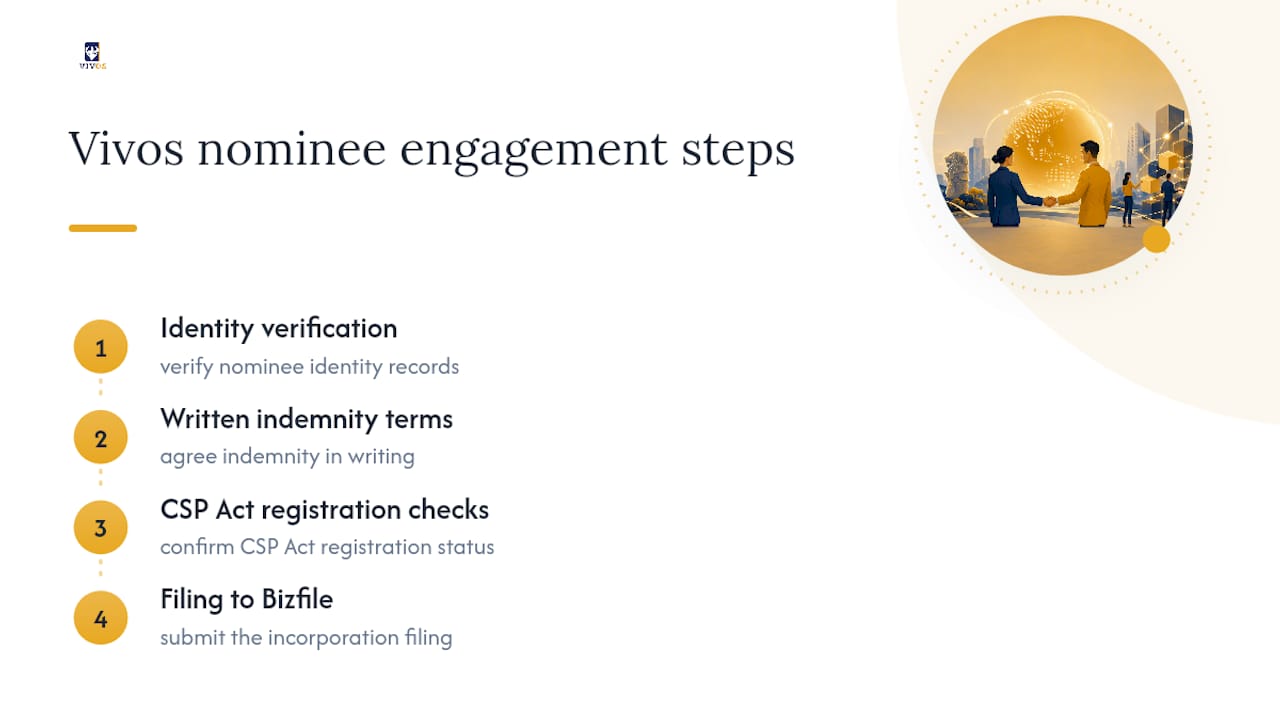
“Foreign founders don’t need a warm body on the board. They need a resident director arrangement that survives an ACRA audit and a liquidator’s questions equally well,” says Ray Tay, co-founder of Vivos. Every nominee engagement at Vivos runs through identity verification, written indemnity terms, and CSP Act registration checks before a single filing goes to Bizfile.
— Ray
Ready to Appoint a Compliant Resident Director?
Sorting out a resident director shouldn’t be the step that stalls your incorporation timeline. Vivos handles the full package for foreign founders entering Singapore: nominee resident director appointment, registered address, corporate secretarial filings, and bank account introductions, coordinated so nothing sits waiting on a missing signature.
Vivos also runs incorporation and compliance work in Malaysia, Hong Kong, and the UAE for founders expanding beyond a single market, with expert insights on cross-border staffing and relocation considerations. If you’re ready to move on a Singapore entity, start with Singapore company incorporation for foreign investors and founders to see how the nominee arrangement, registered address, and secretarial filings fit together as one package rather than three separate vendors to manage. For founders who already have a director lined up and just need the entity registered, the Singapore company registration service covers the Bizfile process end to end.
Where to Verify These Rules Yourself
Regulatory details shift, so confirm anything time-sensitive against primary sources rather than secondhand summaries. Section 145 of the Companies Act is the statutory text behind the resident director requirement. ACRA’s guidance on appointing directors covers eligibility and the company secretary deadline. The Corporate Service Providers Act page explains nominee registration obligations, and MOM’s FAQ on Employment Pass holders clarifies pass-based director eligibility. File all appointments and changes through Bizfile, and check MOM directly before assuming any specific work pass qualifies you as ordinarily resident.
Do you need a local director to open a Singapore company as a foreigner? Yes — but you don’t need to move here, and you never need a local shareholder. I’m Ray Tay, co-founder of VIVOS. Here’s how the rule really works in 2026.
Under Section 145 of the Companies Act, every Singapore company needs at least one director who ordinarily lives in Singapore — a citizen, a permanent resident, or certain work-pass holders. Your shares are untouched: foreigners can still own 100 percent of the company.
No local person? You appoint a nominee director. Since 9 June 2025, nominees can only be appointed through an ACRA-registered corporate service provider, and they must pass a fit-and-proper assessment — informal arrangements with a friend are no longer allowed.
A professional nominee typically costs S$3,500 to S$5,000 a year — and holds no shares and runs nothing. Day-to-day control stays with you.
One warning: choose a licensed provider. The nominee carries real statutory duties, and banks and regulators check exactly who stands behind your company.
VIVOS is an ACRA-registered filing agent — nominee director, incorporation and corporate secretarial in one package. Book a free consultation at vivos.com.sg.
This video is presented by an AI-generated avatar and voice of Ray Tay, co-founder of VIVOS. The content was written and fact-checked by VIVOS PTE. LTD.
Frequently asked questions
Can my friend or relative in Singapore act as my nominee director?
No. Since 9 June 2025, a nominee director can only be appointed through a corporate service provider registered with ACRA, and the nominee must pass a fit-and-proper assessment, so informal arrangements with a friend, a relative or an employee are no longer allowed. If that person is a Singapore citizen or permanent resident and genuinely joins your board as a director in their own right, that is an ordinary appointment rather than a nominee arrangement, and it remains perfectly legal.
Is a nominee director the same thing as a resident director?
Not quite. “Resident director” is the statutory role — the at-least-one director who is ordinarily resident in Singapore that Section 145 of the Companies Act 1967 requires every company to have. A nominee director is simply one way of filling that role: a professional appointed through an ACRA-registered corporate service provider purely to satisfy the requirement, who holds no shares and takes no part in running the business.
Does a nominee director control my company’s shares, decisions or bank account?
No. A professional nominee director holds no shares in your company and runs nothing, so strategy, hiring and spending stay with you as the shareholder and as an executive director. Nominees are normally excluded from bank signing rights by the engagement letter, although the bank will still run its own due diligence on every director shown on the ACRA register.
Will using a nominee director hurt my business bank account application?
Not by itself, but it puts your provider under scrutiny. Banks and regulators check exactly who stands behind a company, so a nominee supplied by a licensed, ACRA-registered corporate service provider is treated very differently from an informal or undisclosed one. Expect the bank to ask who the beneficial owners are, what the business actually does, and why the nominee is in place.
Can my nominee director also act as my company secretary?
They are two separate statutory appointments and are usually filled by two different people, even when one provider supplies both. Every Singapore company must appoint a company secretary within six months of incorporation under the Companies Act 1967, and a sole director cannot also serve as that company’s secretary. In practice most foreign founders buy nominee director, corporate secretarial and registered address as a single bundled package.
How many directors does a Singapore company need in total?
At least one, and that director must be ordinarily resident in Singapore under Section 145 of the Companies Act 1967. You may appoint as many further directors as you wish, resident or not, provided each is a natural person aged 18 or over who is not disqualified. A solo foreign founder therefore usually ends up with two names on the ACRA register: their own, and the resident or nominee director.
Master the cap versus discount crossover. Calculate the $12.5M breakpoint from a $10M cap and 20% discount, model conversions, and avoid Singapore filing...
Which consulting niches need a licence in Singapore, PDPA obligations every consulting firm carries, and the SS 680:2021 standard that replaced TR 43:2015 for Enterprise…