Singapore OnePass 2027: The Strategic Shift Replacing Tech Pass for Global Talent
Dawn Lee
Singapore is introducing a new immigration route for top-tier tech talent. On 3 March 2026, Minister for Manpower Dr Tan See Leng announced a landmark…
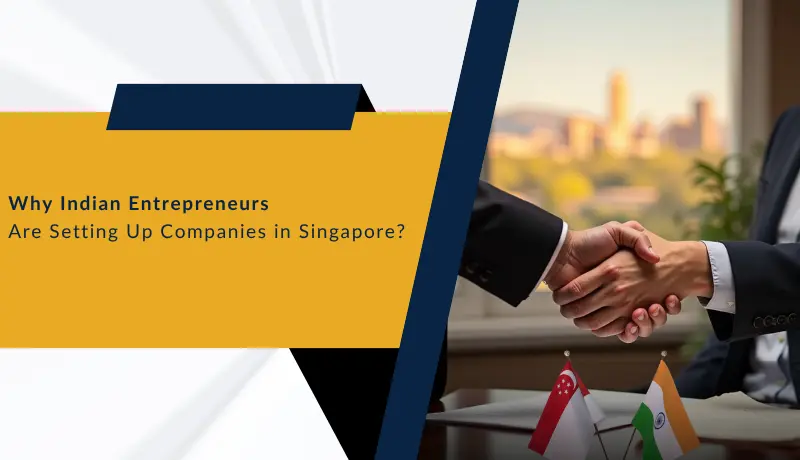
Over the past decade, Singapore has become one of the most trusted, secure, and business-friendly international locations for Indian entrepreneurs seeking to expand globally. From technology startups to fintech and SaaS companies, many founders are incorporating holding companies or global operating companies in Singapore while continuing to operate in India.
According to reports, more than 8,000 Indian companies have registered in Singapore since 2000, making India one of the largest contributors to foreign businesses in the country.
Several well-known Indian startups have adopted this strategy. Flipkart incorporated its holding company in Singapore in 2011 to attract global investors, while companies such as Razorpay, Pine Labs, InMobi, and Freshworks have also leveraged Singapore’s globally trusted, business and investor-friendly ecosystem to raise international capital and expand into global markets.
In this blog, we will explain why Singapore has become a preferred business hub for Indian entrepreneurs and what it takes to establish a company there.
Singapore is increasingly seen as a trusted offshore location for Indian founders with global ambitions, offering stability, strong legal protections, and ease of doing business.
Singapore hosts a large network of venture capital firms, private equity funds, and family offices. Many global investors prefer to invest through Singapore-registered entities because the country offers a transparent regulatory framework and strong investor protection.
Many Indian startups historically adopted the “Singapore holding company + India operating subsidiary” structure. This structure allows companies to raise foreign capital more easily while maintaining operations in India.
The success of companies like Flipkart helped popularise this model among Indian entrepreneurs. By incorporating in Singapore, Flipkart attracted global investors such as SoftBank, Tiger Global, and Tencent.
While Southeast Asia is one opportunity, many Indian founders use Singapore as a springboard to global markets, including Europe, North America, and the Middle East, leveraging Singapore’s robust corporate and banking infrastructure.
Singapore consistently ranks first globally in ease of doing business, investor protection, and trustworthiness of institutions. Entrepreneurs benefit from fast incorporation, minimal bureaucracy, and a stable legal system, making operations smooth and predictable.
Singapore’s global reputation as a business hub is supported by several structural advantages.
| Advantage | Details | Examples / Data |
|---|---|---|
| Tax Efficiency | Corporate tax at 17% (with a wide range of allowances and rebates that lower the effective rate significantly), & 0 capital gains or dividend taxes | Lower than India (25–28%), making it highly attractive to investors and founders |
| Access to Global Capital | Hub for VC, private equity, and wealth management | Startups like Flipkart, Razorpay, Pine Labs, and InMobi raised global funding through Singapore |
| Ease of Doing Business | Fast incorporation (1–2 days), minimal bureaucracy | The ACRA online registration system makes setup simple |
| Strategic Location | Gateway to 650+ million consumers in ASEAN markets | Ideal for expansion to Southeast Asia |
| Legal & IP Protection | Strong IP laws and a reputable arbitration centre (SIAC) | Reduces risk for IP-heavy businesses |
| Talent & Infrastructure | Skilled, English-speaking workforce and world-class infrastructure | Supports efficient scaling of operations |
| Ease of International Expansion | Transparent, connected, globally trusted, and corruption-free jurisdiction | Used as a holding company hub for global and regional operations |
Note: Singapore’s tax system is always framed as a headline 17% corporate tax & zero capital gains & dividend taxes, but the effective rate is lower due to allowances. Almost no company ever actually pays the full 17% due to generous reliefs.
Before incorporating a business, one of the first questions many founders ask is: Can I fully own my company as a foreigner?
The answer is yes, Indian founders can own 100% of a Singapore company, meaning they do not need a local partner to retain control. However, there are a few statutory requirements. Here’s a breakdown:
A Singapore company must have at least one shareholder, which can be an individual or a corporate entity.
A resident director must be appointed; this can be a Singapore citizen, permanent resident, or a professionally appointed nominee director via a licensed Corporate Service Provider.
Every company must maintain a local Singapore business address that serves as its official correspondence address (which can be provided by your Corporate Service Provider).
A qualified corporate secretary must be appointed within six months of incorporation to comply with ACRA requirements (which is typically provided by your Corporate Service Provider).
The minimum paid-up capital is SGD 1, though businesses often opt for higher capital to enhance credibility with investors and partners.
Companies must declare their business activities using the Singapore Standard Industrial Classification (SSIC) codes during incorporation.
Following these requirements ensures compliance with Singapore’s Accounting and Corporate Regulatory Authority (ACRA) and allows Indian entrepreneurs to start operations smoothly, access global investors, and scale internationally.
Indian entrepreneurs can set up a Singapore company efficiently in 2026 by following a structured process. There are no restrictions on Indians or any other foreigners incorporating and operating fully foreign owned companies in Singapore, through which they can efficiently trade, raise funds or invest internationally. Here are easy steps:
Choosing the correct business structure is crucial for ownership, liability, and investor credibility.
| Business Structure | Ownership | Liability | Ideal For |
|---|---|---|---|
| Private Limited Company (Pte Ltd) | 100% foreign ownership allowed | Limited to shareholding | Startups, tech companies, international investors |
| Sole Proprietorship | Individual owner | Unlimited | Small local businesses |
| Partnership / LLP | 2+ partners | Unlimited for partners (except LLP) | Professional services |
| Branch Office / Subsidiary | Parent company ownership | Unlimited (branch) | Foreign companies expanding to Singapore |
Most Indian startups choose to incorporate Private Limited Companies (Pte Ltd) due to their advantages in simplicity, raising capital and scaling globally.
Before registering, you must select a unique and suitable company name.
Tip: Choose a name that reflects your business purpose and is easy to brand internationally.
Specify your company’s primary and secondary business activities using Singapore Standard Industrial Classification (SSIC) codes.
Collect all required documents before submitting to ACRA.
Documents include:
Submit all incorporation documents via ACRA’s BizFile+ portal or through a corporate service provider.
A corporate bank account is required to manage business operations and international transactions.
Certain business activities require Business licenses before starting operations, such as :
After incorporation, your company must:
While Singapore offers an attractive environment for Indian founders, several challenges may arise during expansion. Understanding these in advance helps ensure smooth operations and long-term growth.
| Challenge | Key Considerations | Strategic Approach |
|---|---|---|
| Regulatory & Compliance | Appointment of a resident director (Singapore citizen, PR, or Employment/EntrePass holder) Corporate bank accounts require enhanced KYC, taking 4–8 weeks Employment Pass requirements with higher salary thresholds (S$5,000+) Navigating the local company regulations and filings (which are relatively light touch and transparent, compared to other jurisdictions – contributing to Singapore’s frequent ranking as the easiest place in the world to do business) | Engage local corporate service providers and appoint a resident director to ensure smooth regulatory compliance and efficient banking setup |
| Operational Costs | High business and rental costs compared to India Competitive salaries for skilled local talent Transition from low-cost operations to a high-efficiency, high-value environment | Adopt co-working spaces or virtual offices, implement phased hiring, and optimise operational workflows to manage costs effectively. Or leverage outsourcing solutions for office management from your Corporate Service Provider. |
| Market Entry & Competition | Small domestic market (~5.7 million) Saturated market, requiring investment in brand presence and marketing Consumers prioritise quality and established reputation | Position Singapore as a regional hub for Southeast Asia, targeting regional and global markets from a trusted Singapore. |
| Financial & Tax Considerations | corporate tax rate of 17% (with allowances lowering effective rate), no capital gains/dividend taxes Difficulty raising later-stage funding (Series B+) Need to comply with RBI ODI regulations for some types of overseas investment | Engage professional accountants and legal advisors to optimise taxation, funding strategy, and cross-border compliance |
| Cultural & Operational Differences | Fast-paced, structured business culture Emphasis on productivity and efficiency Networking critical for establishing credibility | Adapt internal workflows, establish local partnerships, and invest in relationship-building within the ecosystem |
Singapore remains a top choice for Indian entrepreneurs seeking regional growth and access to global investors. Its low corporate tax, transparent regulatory framework, strong legal protections, and strategic ASEAN location make it ideal for startups and scaling businesses.
However, establishing a presence in Singapore requires careful planning to navigate regulatory compliance, resident director requirements, operational costs, and competitive markets.
With VIVOS, founders gain end-to-end support for company incorporation, banking, and ongoing compliance, ensuring their business setup is fully aligned with legal and policy regulations.
Take your business to Singapore and beyond with VIVOS, simplifying company setup, compliance, and operations.
Can Indian entrepreneurs fully own a Singapore company?
Yes. Indian founders can own 100% of a Singapore Private Limited Company (Pte Ltd). No local partner is required, giving full control over business operations and decision-making.
How long does it take to incorporate a company in Singapore?
Incorporation is fast and efficient. Using ACRA’s BizFile+ portal, a Singapore company can be registered within 1–2 business days, provided all documents are complete.
Is a local director mandatory for Singapore incorporation?
Yes. Every Singapore company must have at least one resident director who is a Singapore citizen, permanent resident, or an Employment/EntrePass holder, to ensure regulatory compliance.
What is the minimum paid-up capital for a Singapore company?
The minimum paid-up capital is SGD 1. Many startups choose to raise more capital to boost credibility with investors, banks, and partners in Singapore and internationally.
Do all businesses require licenses in Singapore?
No. Only certain sectors, such as fintech, F&B, healthcare, and education, need specific licenses before operations. Most other business activities can start immediately after incorporation.
Can I manage a Singapore company entirely from India?
Yes. Indian entrepreneurs can operate remotely, but a resident director and local registered address are mandatory for legal compliance and banking requirements.
How can VIVOS help Indian founders in Singapore?
VIVOS offers comprehensive support for company setup, advisory, banking, licensing, and ongoing compliance, ensuring a smooth, fully compliant Singapore business presence.
Singapore is introducing a new immigration route for top-tier tech talent. On 3 March 2026, Minister for Manpower Dr Tan See Leng announced a landmark…
In the effort to quickly secure working capital, many businesses consider short-term foreign loans as a “lifeline” thanks to their relatively simple procedures and the…
In the context where Vietnam has officially opened two International Financial Centres (“IFC”) in Ho Chi Minh City and Da Nang City. In pursuit of…
14b Stanley Street, Singapore 068733
Incorporated in Singapore under the Companies Act 1967 UEN 202416468C | ACRA Registered Filing Agent FA20240323 | MOM Employment Agency Licence 24S242