Avoid Rejected XBRL Uploads: Singapore Filing for Foreign Founders

XBRL filing in Singapore: who must file, mapping and taxonomy traps, how to reconcile with your AGM PDF, and outsourcing options for foreign founders.

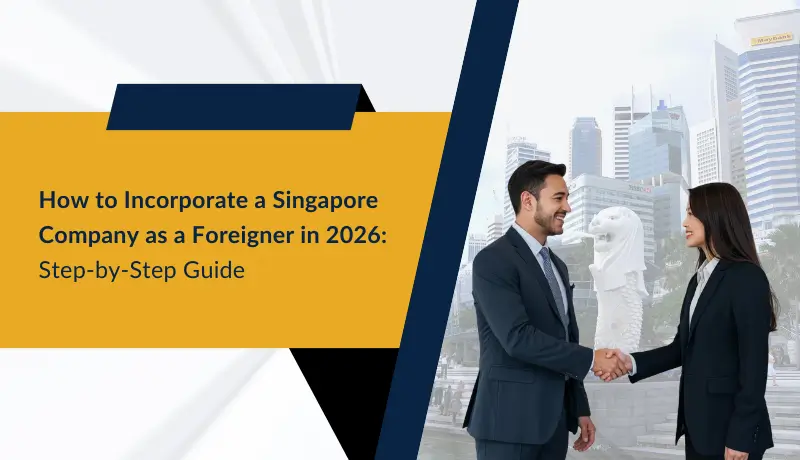
Starting a business in another country is about more than completing paperwork. It is about choosing a place where the rules are clear, the system is reliable, and growth feels possible rather than uncertain.
For decades, Singapore has been a top choice for foreign entrepreneurs, multinational companies, startups, and investors who are looking to establish a presence in Asia. In 2026, its appeal remains strong, supported by a stable regulatory environment, a competitive tax framework, and a legal system that businesses trust.
This guide explains how to Incorporate a Singapore company as a foreigner in 2026, covering eligibility, structures, compliance requirements, taxation, and everyday challenges.
Singapore consistently ranks among the world’s easiest places to do business. For foreign founders, its lies in a combination of regulatory clarity, economic stability, and global connectivity.
Foreigners are fully eligible to incorporate a company in Singapore, subject to a few statutory requirements under the Accounting and Corporate Regulatory Authority (ACRA).
Most foreigners appoint a Corporate Advisory Services in Singapore to meet local director and compliance requirements.
Before incorporating a company in Singapore, foreign entrepreneurs must carefully select the appropriate business structure.
There are six primary business structures in Singapore: Private Limited Company (Pte. Ltd.), Subsidiary Company, Branch Office, Representative Office, Sole Proprietorship, and Limited Liability Partnership (LLP).
| Business Structure | Legal Status | Foreign Ownership | Key Features | Best Suited For |
|---|---|---|---|---|
| Private Limited Company (Pte. Ltd.) | Separate legal entity | 100% allowed | Limited liability, tax-efficient, scalable, and eligible for government incentives | Startups, SMEs, foreign entrepreneurs, long-term operations |
| Subsidiary Company | Separate legal entity | 100% owned by a foreign parent | Considered a local tax resident and eligible for Singapore tax benefits | Multinational corporations expanding into Singapore |
| Branch Office | Extension of the foreign parent | 100% foreign | Not a separate legal entity; the foreign parent bears all liabilities | Companies wanting to operate under the parent’s brand |
| Representative Office | Not a legal entity | 100% foreign | Cannot generate revenue, limited scope, temporary setup | Market research and feasibility studies |
| Sole Proprietorship | Not a separate legal entity | Allowed with a local authorised representative | Simple setup with unlimited personal liability | Low-risk, small-scale operations |
| Limited Liability Partnership (LLP) | Separate legal entity | Allowed | Flexible structure with limited liability for partners | Professional services firms and joint ventures |
Singapore is widely regarded as one of the most business-friendly jurisdictions in the world. Setting up a company still requires careful attention to local legal, tax, and regulatory obligations.
The following steps outline how foreigners can incorporate and operate a business in Singapore
in 2026:
Choosing the proper legal structure is the foundation of your business. Most foreign entrepreneurs establish a Private Limited Company (Pte. Ltd.) due to its limited liability, tax advantages, and strong credibility with financial institutions and investors.
Once all documents are submitted, incorporation just takes one to two business days, making Singapore one of the fastest countries globally for company formation.
Foreign-owned companies should maintain accurate accounting records and engage professional service providers for tax compliance and advisory services.
VIVOS provides end-to-end corporate services, including company registration, statutory filings, tax compliance, and licensing support. The professional and structured approach helps businesses operate efficiently, remain fully compliant, and focus on scaling operations and expanding in the Asia-Pacific market.

 2 January, 2025
 2 January, 2025
Can a foreigner incorporate a company in Singapore?
Yes. Foreigners are fully eligible to incorporate a company in Singapore, provided they meet statutory requirements such as appointing at least one resident director and maintaining a registered office in Singapore.
Can foreigners own Singapore companies?
Yes. Foreigners can own Singapore companies either fully or partially, depending on the business structure and sector. Most sectors allow 100% foreign ownership.
Can a foreigner own 100% of a business in Singapore?
In most industries, yes. Foreign investors can fully own a company, giving them complete control over decisions and profits.
Can a non-resident set up a company in Singapore?
Yes. Non-residents can establish a company, but Singapore law requires at least one director to be a resident and the business to have a registered office in Singapore.
How to set up a company in Singapore for foreigners?
Foreigners can easily set up a company in Singapore by choosing a suitable business structure, appointing a resident director, and registering with ACRA. Additional steps include opening a corporate bank account, obtaining any required licenses, and ensuring tax compliance.
Can a foreigner own a sole proprietorship in Singapore?
Yes, Foreigners can operate a sole proprietorship in Singapore. Still, they must appoint a local representative to act on their behalf, as full foreign ownership is not allowed for this business type.
Is Singapore good for foreign entrepreneurs?
Yes. Singapore is highly attractive for foreign entrepreneurs due to its business-friendly regulations, low taxes, fast company registration, skilled workforce, and strategic location for regional growth.
Can a foreigner serve as a director of a Singapore company?
Yes. Foreigners can serve as directors of a Singapore company, but the company must have at least one resident director to comply with local regulations.

XBRL filing in Singapore: who must file, mapping and taxonomy traps, how to reconcile with your AGM PDF, and outsourcing options for foreign founders.

PDPA checklist for Singapore founders and DPOs: first 90 days priorities, the 11 obligations, plus Vivos incorporation and DPO support.
There’s no single “best” Singapore incorporation service — it depends on whether you want a self-serve digital platform, a full-service compliance partner, or a provider…


Incorporated in Singapore under the Companies Act 1967 UEN 202416468C | ACRA Registered Filing Agent FA20240323 | MOM Employment Agency Licence 24S2425
Malaysia – VIVOS (M) Sdn. Bhd. | Registration Number:
People’s Republic of China, Hong Kong – VIVOS CORPORATE SERVICES (HK) LTD. | Business Registration Number: 80545137
United Arab Emirates, Dubai – VIVOS CORPORATE SERVICES L.L.C. | Commercial Licence Number: 1638200