Singapore Company Registration for Indians Guide
Dawn Lee
How Can Indians Legally Own and Register a Company in Singapore? How Can Indians Legally Own and Register a Company in Singapore? Download The Free…
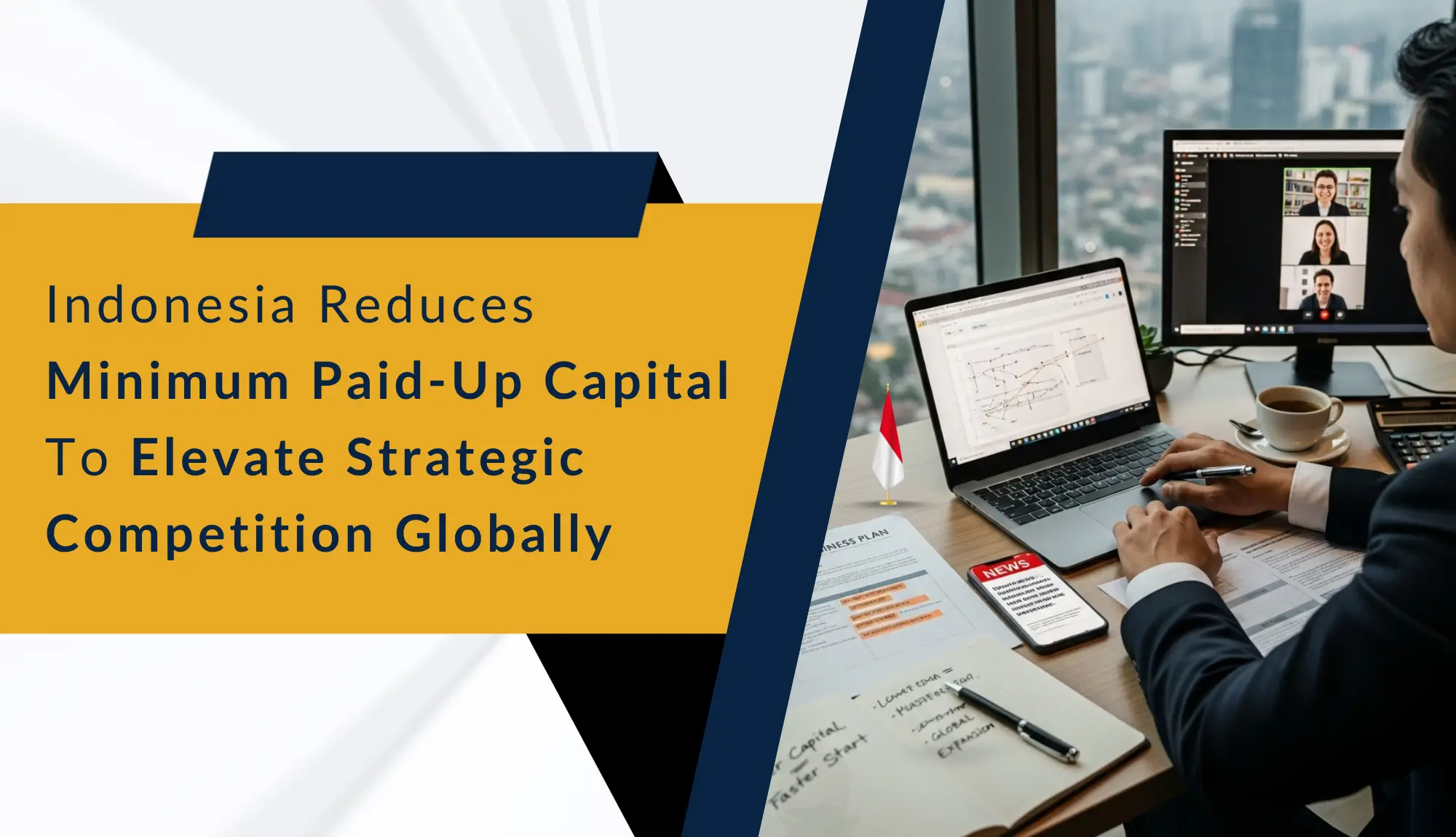
As Southeast Asia’s largest economy continues to evolve, Indonesia reduces minimum paid-up capital requirements for foreign-owned companies (PT PMA), signalling a decisive step toward a more inclusive and competitive investment environment.
Indonesia has reduced the minimum paid-up capital requirement for foreign investors from IDR 10 billion (USD 750,000) to IDR 2.5 billion (USD 160,000). This regulatory change aims to attract a wider range of foreign investors, enabling them to participate more easily in Indonesia’s economic growth.
For Singapore-based entrepreneurs and corporations the reform represents not just easier entry but also a chance to strategically position Indonesia as a key pillar in their regional expansion plan.
Foreign investors entering Indonesia are required to establish a PT PMA (Perseroan Terbatas Penanaman Modal Asing), the only legal entity that permits foreign ownership.
Previously, the high capital requirement often limited entry to large multinationals, excluding startups and mid-sized firms with innovative business models. By reducing the threshold, Indonesia aims to stimulate cross-border entrepreneurship, particularly in emerging sectors such as:
The new regulation aligns with the government’s broader agenda to simplify the Online Single Submission – Risk-Based Approach (OSS-RBA) process, accelerate licensing approvals, and strengthen Indonesia’s competitiveness as an investment destination.
Learn more about why Indonesia is reducing its minimum paid-up capital and discover the right market entry strategy.
Singapore and Indonesia share one of the strongest economic corridors in Asia. Singapore consistently ranks as Indonesia’s largest source of foreign direct investment (FDI), accounting for over 25% of total inflows annually.
With Indonesia reducing the minimum paid-up capital, investors in Singapore now gain three major advantages:
In short, what used to be a regulatory hurdle is now an open gateway to Southeast Asia’s
most promising market.
While the new capital rule simplifies market entry, compliance remains essential to ensure long-term success. Investors planning to set up a foreign company should be aware of the following:
These steps, while procedural, are crucial for establishing credibility with regulators and local partners.
Indonesia’s decision to lower the minimum paid-up capital requirement has a significant impact beyond mere administrative streamlining; it fundamentally alters how investors strategize and allocate their funds.
Indonesia’s digital economy is projected to reach USD 130 billion by 2025. Lower entry requirements allow Singapore-based tech firms, SaaS providers, and fintech startups to enter the market earlier, form partnerships, and scale rapidly under compliant structures.
Medical device manufacturers and healthcare service providers now find Indonesia’s licensing and investment process more approachable. This supports broader ASEAN collaboration in medical technology, logistics, and research.
Foreign investors can now participate in Indonesia’s renewable energy transition with smaller capital commitments. The government’s focus on green infrastructure and sustainable urban development presents new opportunities for joint ventures and technology transfer.
With reduced capital requirements, brands from Singapore and other regions can establish local subsidiaries, test market demand, and expand distribution networks across Indonesia’s second-tier cities.
This regulatory reform reflects Indonesia’s broader strategy to complement Singapore as an investment destination, rather than competing with it.
By combining Singapore’s strengths as a financial and corporate hub with Indonesia’s scale and resources, investors can build resilient regional ecosystems:
This two-market strategy not only lowers operational risk but also ensures flexibility as global supply chains continue to shift toward Southeast Asia.
More than just numbers and regulations, the lowered capital requirement signals Indonesia’s proactive stance in fostering international collaboration.
By modernizing investment laws and improving transparency, the government is aligning Indonesia’s regulatory environment with global standards.
For investors, the timing is ideal:
The latest reform, where Indonesia reduces the minimum paid-up capital, is an invitation to participate in the region’s next growth chapter.
For Singaporean businesses looking beyond domestic borders, Indonesia presents a strategic combination of affordability, opportunity, and growth potential.
Through a well-structured company in Indonesia, investors can establish a compliant and scalable foundation to reach 270 million consumers in the world’s fourth-largest economy.
At VIVOS, together with Business Hub Asia, we help Singaporean enterprises unlock these opportunities by bridging compliance, strategy, and execution to accelerate your expansion journey into Indonesia’s growing market.
Partner with Business Hub Asia to turn Indonesia’s latest investment reform into real opportunities.
What does “Indonesia reduces minimum paid-up capital” mean for foreign investors?
It means that the minimum investment required to establish a foreign-owned company (PT PMA) has been lowered from IDR 10 billion to IDR 2.5 billion, making market entry more accessible for SMEs and startups.
How does the new regulation affect Singapore-based businesses?
Singaporean companies can now expand into Indonesia with lower financial commitments, leveraging the proximity and strong bilateral ties between both economies for easier cross-border collaboration.
Are there specific sectors that benefit most from this change?
Yes. Sectors such as digital technology, healthcare, renewable energy, and consumer goods stand to gain significantly due to lower entry costs and high domestic demand.
Does lowering paid-up capital affect compliance or legal obligations?
No. While the entry barrier is lower, companies must still comply with Indonesia’s investment regulations by including OSS-RBA registration, tax reporting, and periodic investment activity reports (LKPM).
What new business opportunities arise from Indonesia’s lower paid-up capital rule?
The reform opens doors for small and medium foreign investors to participate in Indonesia’s growth industries, particularly in tech startups, green energy, e-commerce, and logistics. It also enables regional firms to establish local subsidiaries faster, test new markets, and scale operations without heavy upfront costs.
How Can Indians Legally Own and Register a Company in Singapore? How Can Indians Legally Own and Register a Company in Singapore? Download The Free…

Singapore is introducing a new immigration route for top-tier tech talent. On 3 March 2026, Minister for Manpower Dr Tan See Leng announced a landmark…

Over the past decade, Singapore has become one of the most trusted, secure, and business-friendly international locations for Indian entrepreneurs seeking to expand globally. From…

14b Stanley Street, Singapore 068733
Incorporated in Singapore under the Companies Act 1967 UEN 202416468C | ACRA Registered Filing Agent FA20240323 | MOM Employment Agency Licence 24S242